Archival pigment print mounted on aluminium Dibond.
One Size Only / 40.6 x 61 cm / 16 x 24 in
Hand-signed by the artist, with title, date, and edition number inscribed in ink on an archival label affixed to the reverse side of the mounted photograph
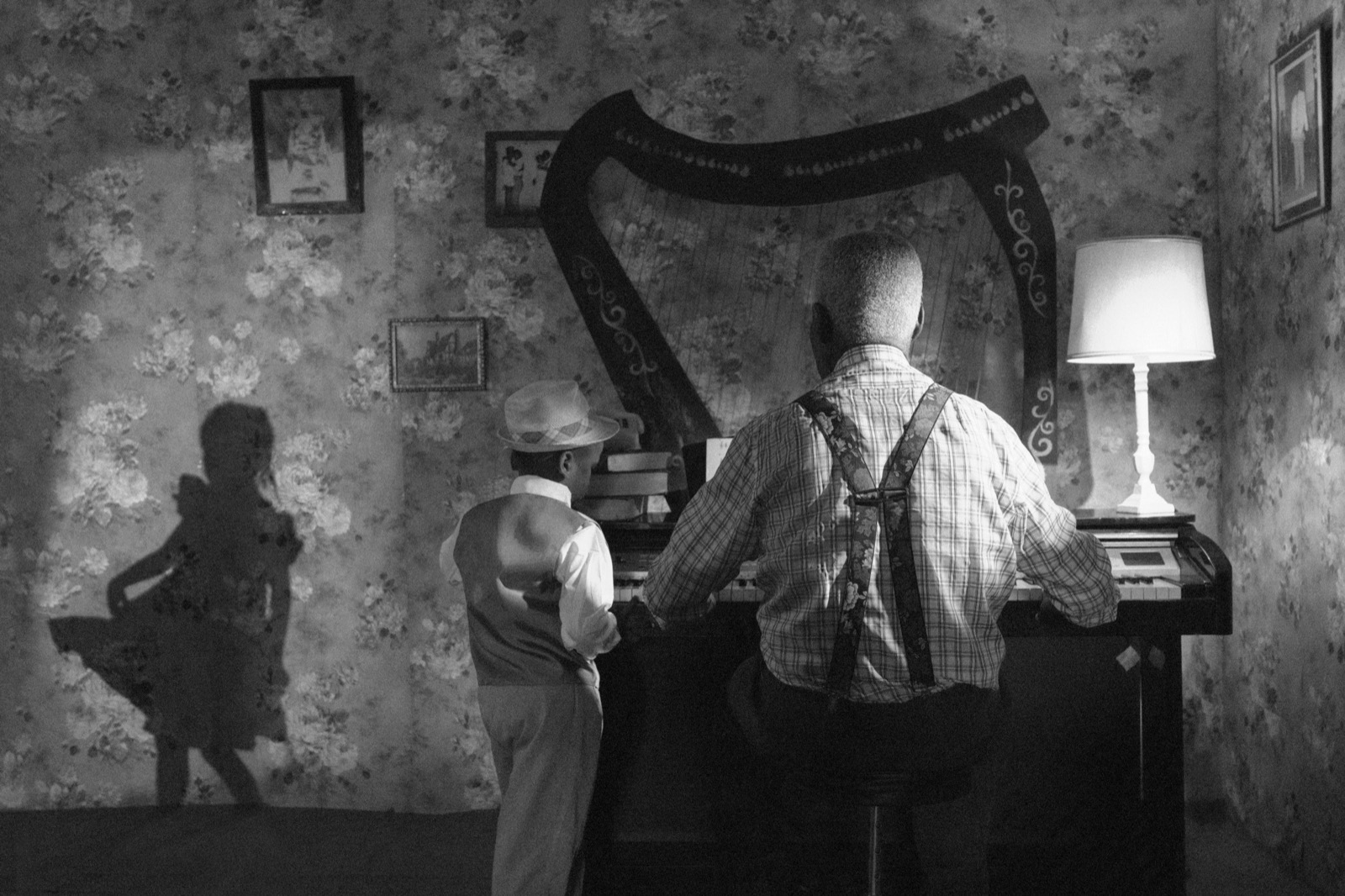
A photograph cannot hold sound, and Carlos Idun-Tawiah knows it. That impossibility is the whole ache of this picture: an old man bent to a wheezing harmonium, patterned braces taut across his back, coaxing out of the room a music no image will ever carry. What survives on paper is only the posture of listening—the boy in his pale straw hat leaning in as if to catch the notes before they leave, the elder's hands settled on keys worn smooth by decades of the same hymns.
Look to the wall and the photograph begins to argue with itself. The shadow of a girl mid-turn, skirt flung wide, is printed as firmly as the living figures, so that a gesture lasting half a second is granted the same permanence as the harp, the lamp, the framed faces watching from the flowered paper. Idun-Tawiah builds this Accra interior like a remembered one, thick with the props of family, and lets the monochrome push it gently back toward the past it is already becoming.
The title asks for the one thing a picture is made to refuse and to promise at once: to keep. No one can own a sound; it dies as it is made. But you can own the instant of its making, and photography's old consolation is exactly this exchange of the seen for the heard, the kept for the lost. What passes here between an elder and a child is not a melody but the act of handing it on—the quiet insistence that some inheritance be carried forward, long after the music stops.
A photograph cannot hold sound, and Carlos Idun-Tawiah knows it. That impossibility is the whole ache of this picture: an old man bent to a wheezing harmonium, patterned braces taut across his back, coaxing out of the room a music no image will ever carry. What survives on paper is only the posture of listening—the boy in his pale straw hat leaning in as if to catch the notes before they leave, the elder's hands settled on keys worn smooth by decades of the same hymns.
Look to the wall and the photograph begins to argue with itself. The shadow of a girl mid-turn, skirt flung wide, is printed as firmly as the living figures, so that a gesture lasting half a second is granted the same permanence as the harp, the lamp, the framed faces watching from the flowered paper. Idun-Tawiah builds this Accra interior like a remembered one, thick with the props of family, and lets the monochrome push it gently back toward the past it is already becoming.
The title asks for the one thing a picture is made to refuse and to promise at once: to keep. No one can own a sound; it dies as it is made. But you can own the instant of its making, and photography's old consolation is exactly this exchange of the seen for the heard, the kept for the lost. What passes here between an elder and a child is not a melody but the act of handing it on—the quiet insistence that some inheritance be carried forward, long after the music stops.