At the turn of the millennium, while photography argued over its digital future, Hido was out on two-lane roads in winter, making pictures like this one: a snowed-over curve, tire tracks arcing through the slush, a line of scrub dissolving into low cloud. He has often worked through the glass of his car, and something of that veil remains here, softening the trees until they hover. It is a picture of driving as much as of land, the era’s true American vantage.
Notice what the snow is doing: it is behaving like photographic paper. Every vehicle that passed has left its signature, ruts curving in parallel like the grooves of a record, and the camera doubles that inscription, a trace of traces. Photography’s oldest promise was just this, that a surface could remember touch. Here the promise spreads across the whole terrain: weeds stitch through the verge like scratches on a negative, and the two tall trees at left print themselves against a sky the color of tarnished silver.
The object extends the thought. As an archival pigment print, the image lives as fine mineral color laid onto paper, a settled, stable thing made from so unstable a subject: fog, slush, falling light. Hido, born in Kent, Ohio, and based in the San Francisco Bay Area, has carried this cold poetry into the collections of SFMOMA, the Getty, and the Whitney, where such prints circulate as quiet documents of their moment. The snow itself was gone by morning, the ruts erased by the next plow. The trace of the trace endures, fixed at last.
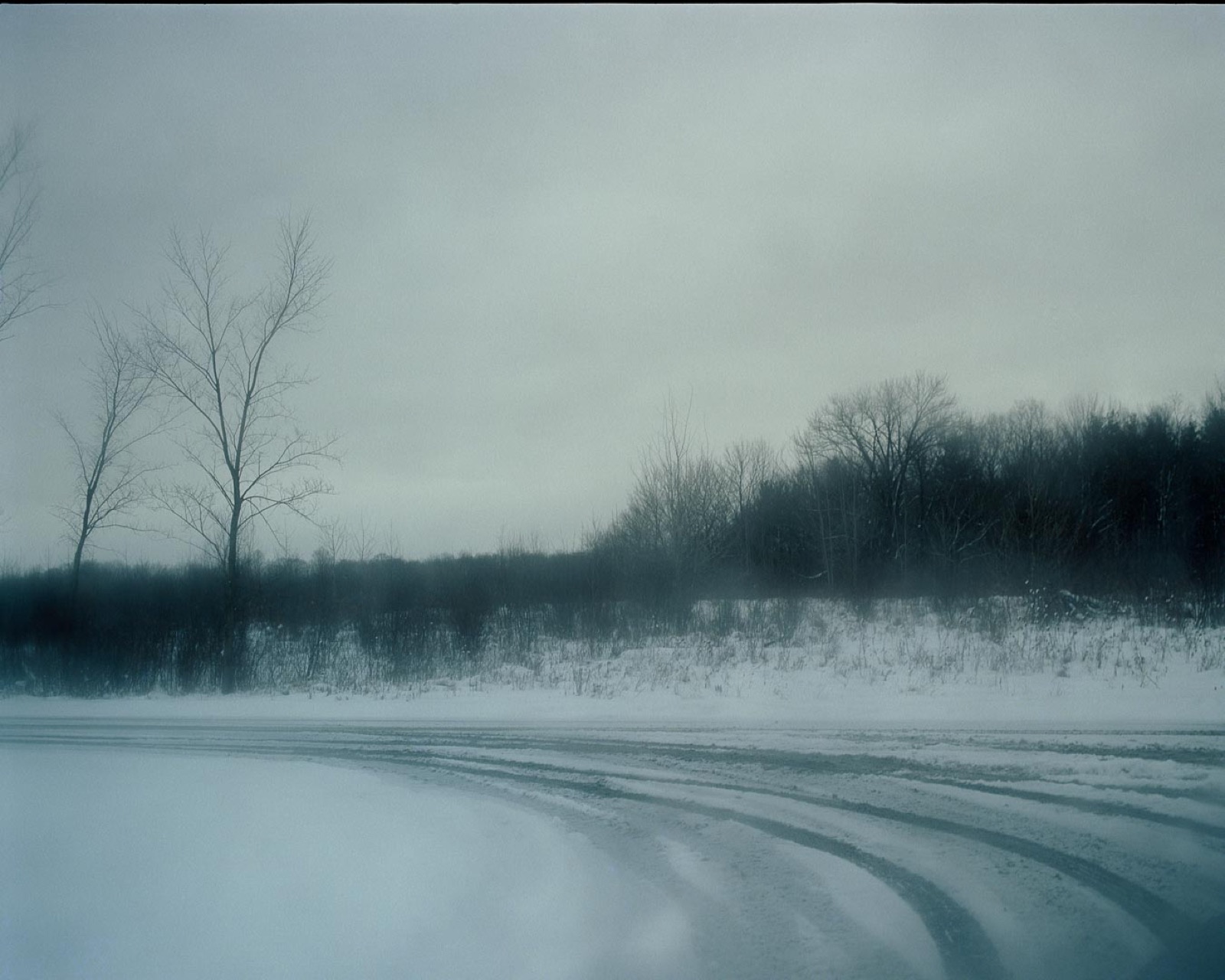

At the turn of the millennium, while photography argued over its digital future, Hido was out on two-lane roads in winter, making pictures like this one: a snowed-over curve, tire tracks arcing through the slush, a line of scrub dissolving into low cloud. He has often worked through the glass of his car, and something of that veil remains here, softening the trees until they hover. It is a picture of driving as much as of land, the era’s true American vantage.
Notice what the snow is doing: it is behaving like photographic paper. Every vehicle that passed has left its signature, ruts curving in parallel like the grooves of a record, and the camera doubles that inscription, a trace of traces. Photography’s oldest promise was just this, that a surface could remember touch. Here the promise spreads across the whole terrain: weeds stitch through the verge like scratches on a negative, and the two tall trees at left print themselves against a sky the color of tarnished silver.
The object extends the thought. As an archival pigment print, the image lives as fine mineral color laid onto paper, a settled, stable thing made from so unstable a subject: fog, slush, falling light. Hido, born in Kent, Ohio, and based in the San Francisco Bay Area, has carried this cold poetry into the collections of SFMOMA, the Getty, and the Whitney, where such prints circulate as quiet documents of their moment. The snow itself was gone by morning, the ruts erased by the next plow. The trace of the trace endures, fixed at last.