Someone came through only a little while ago: a line of footprints crosses the drift, blue in the building’s shadow, and wanders off toward the open ground. Or perhaps it was hours; snow keeps poor time, holding every crossing on the same white ledger until the next fall wipes it clean. The picture sits inside that uncertain interval, after the walker, before the erasure, while the car beside the white gable still wears its unswept inch of snow.
The tonal structure is a study in complements: indigo shadow across the foreground, amber where an unseen lamp warms the clapboard and the field of snow between the houses. One window glows a mottled gold, a lantern behind paper, and the bare tree before it doubles itself as shadow on the pale wall. Photographers have loved such weather since Stieglitz carried his camera into the icy New York nights of the 1890s; what is different here is the emptiness, no city and no crowd, only housing and winter negotiating terms.
Hido, raised in Kent, Ohio, and long settled in the San Francisco Bay Area, has built his reputation on exactly these charged suburban nights, and his prints have entered SFMOMA, the Getty, and the Whitney. As an archival pigment print this image rewards close viewing: the indigo holds its detail without collapsing into black, and the glittering foreground reads grain by grain, crystal by crystal. Nothing dramatic has happened here, which is the point. The footprints continue past the edge of the frame; the photograph is where they remain.
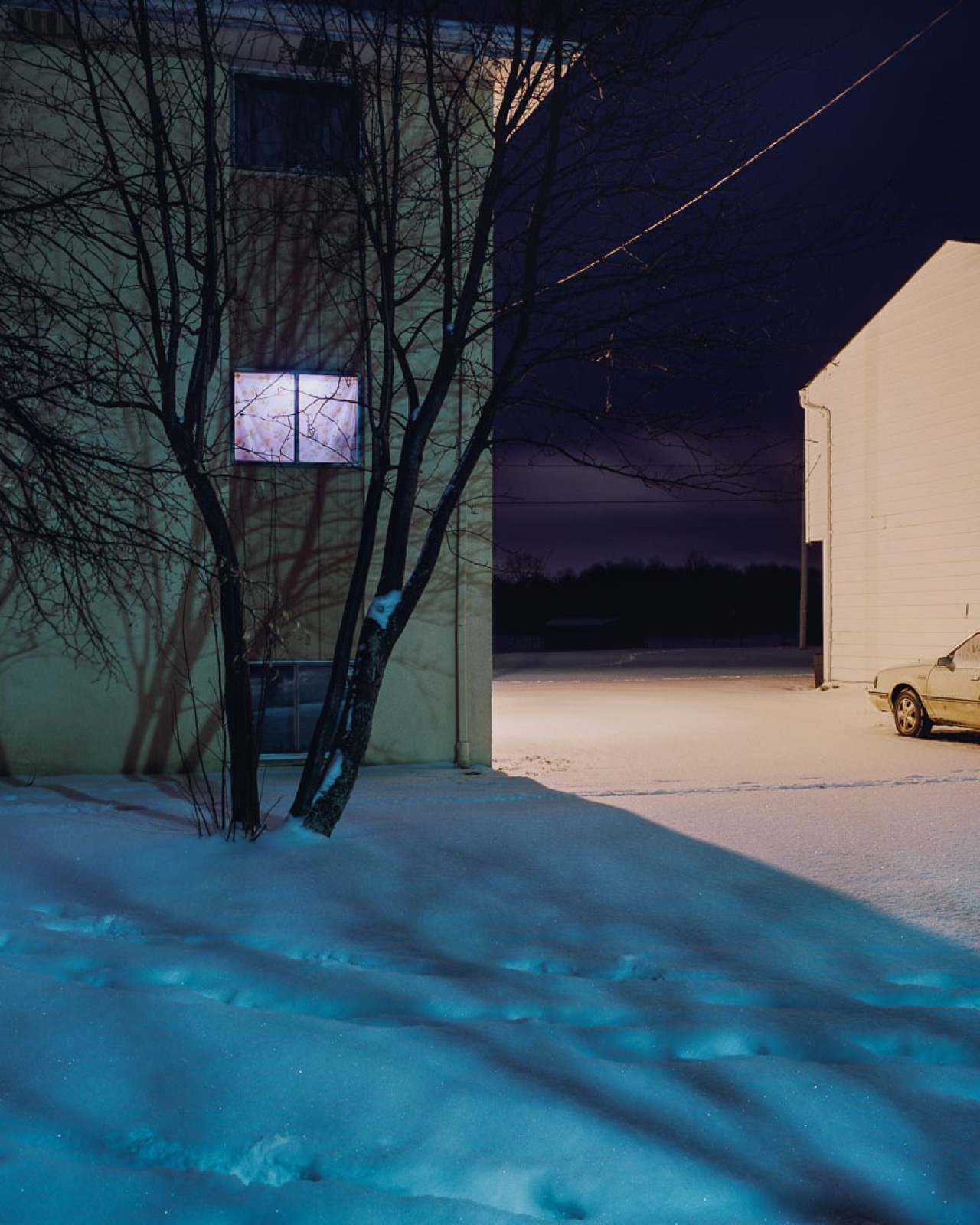

Someone came through only a little while ago: a line of footprints crosses the drift, blue in the building’s shadow, and wanders off toward the open ground. Or perhaps it was hours; snow keeps poor time, holding every crossing on the same white ledger until the next fall wipes it clean. The picture sits inside that uncertain interval, after the walker, before the erasure, while the car beside the white gable still wears its unswept inch of snow.
The tonal structure is a study in complements: indigo shadow across the foreground, amber where an unseen lamp warms the clapboard and the field of snow between the houses. One window glows a mottled gold, a lantern behind paper, and the bare tree before it doubles itself as shadow on the pale wall. Photographers have loved such weather since Stieglitz carried his camera into the icy New York nights of the 1890s; what is different here is the emptiness, no city and no crowd, only housing and winter negotiating terms.
Hido, raised in Kent, Ohio, and long settled in the San Francisco Bay Area, has built his reputation on exactly these charged suburban nights, and his prints have entered SFMOMA, the Getty, and the Whitney. As an archival pigment print this image rewards close viewing: the indigo holds its detail without collapsing into black, and the glittering foreground reads grain by grain, crystal by crystal. Nothing dramatic has happened here, which is the point. The footprints continue past the edge of the frame; the photograph is where they remain.