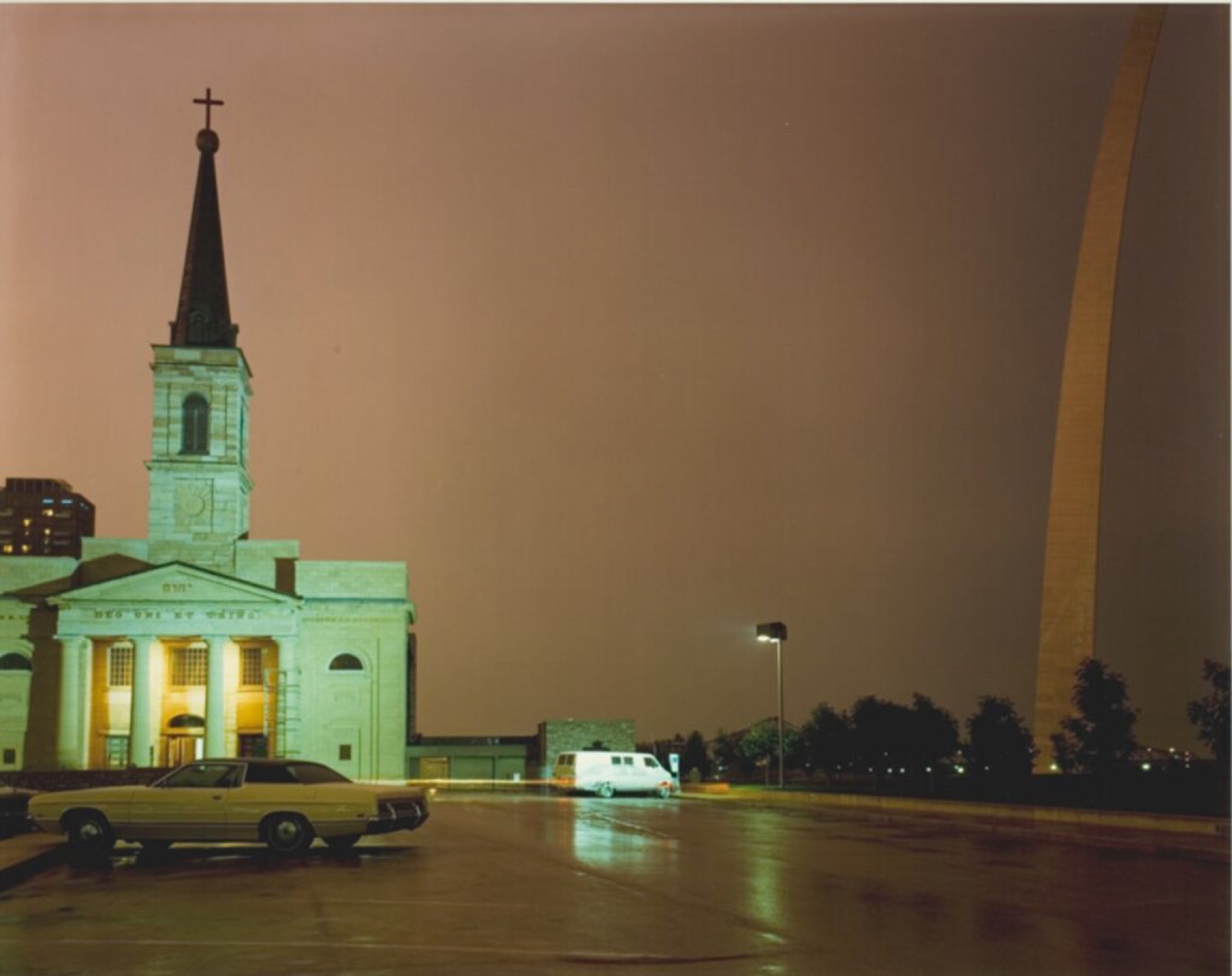
Cut into the stone frieze above the lit portico, three words hold their ground against the night: DEO UNO ET TRINO, to the One and Triune God. It is the kind of text a camera can record but not translate, and Meyerowitz lets it glow rather than gloss it. The Old Cathedral sits floodlit in cream and gold, its steeple and cross climbing into a sky the color of weak tea or sodium haze. Photography keeps the legible and the illegible in one frame: faith and infrastructure, side by side.
To the right, the Gateway Arch enters as a single curved leg of stainless steel, too tall to be contained, its mirrored surface catching the same brown dusk. Between the sacred masonry and the secular parabola lies a wet parking lot, and on it a pale station wagon and a white van wait like witnesses. The asphalt has become a second sky, doubling the lamp glow and the smear of city lights beyond the trees. This is the American night as a set of competing monuments, none quite in scale.
Meyerowitz made this on the 8×10 view camera he took up for Cape Light, and the long exposure is why the darkness reads as color rather than absence. One of the photographers who, with Shore and Eggleston, argued that color could be serious, he treats a St. Louis car park as worth the same attention as a cathedral. Held now in MoMA, the Met and the Boston MFA, his work turns description into a form of belief. This archival pigment print holds the tea-brown dusk and every reflected light.
Cut into the stone frieze above the lit portico, three words hold their ground against the night: DEO UNO ET TRINO, to the One and Triune God. It is the kind of text a camera can record but not translate, and Meyerowitz lets it glow rather than gloss it. The Old Cathedral sits floodlit in cream and gold, its steeple and cross climbing into a sky the color of weak tea or sodium haze. Photography keeps the legible and the illegible in one frame: faith and infrastructure, side by side.
To the right, the Gateway Arch enters as a single curved leg of stainless steel, too tall to be contained, its mirrored surface catching the same brown dusk. Between the sacred masonry and the secular parabola lies a wet parking lot, and on it a pale station wagon and a white van wait like witnesses. The asphalt has become a second sky, doubling the lamp glow and the smear of city lights beyond the trees. This is the American night as a set of competing monuments, none quite in scale.
Meyerowitz made this on the 8×10 view camera he took up for Cape Light, and the long exposure is why the darkness reads as color rather than absence. One of the photographers who, with Shore and Eggleston, argued that color could be serious, he treats a St. Louis car park as worth the same attention as a cathedral. Held now in MoMA, the Met and the Boston MFA, his work turns description into a form of belief. This archival pigment print holds the tea-brown dusk and every reflected light.