Fashion photography reached the new century having decided that glamour and the elemental could occupy one frame, and this seated figure is a composed heir to that settlement. She rests against a backdrop behaving like wet paint, sheets of electric blue bleeding into magenta with a smear of red along the right edge. Around her chest runs a bandeau of clustered glass orbs, green and clear and faintly lilac, each catching light like water that has forgotten to fall.
What holds the picture together is tonal, not narrative. Yeste lets the deep blue-black of her skin carry the composition, so the brightest events are small and precise: the beads at her breast, a blue rim along one shoulder, the wet shine down her forearm and shin. The patent skirt reads almost as a second light source, a slab of gloss that gathers the whole scene and hands it back. Her gaze is level, unhurried, meeting the lens without appeal. Nothing is coy about the pose; it is frontal, planted, deliberate.
Yeste belongs to the front rank of Spanish fashion photography, his images filling Numéro, Harper’s Bazaar and Vogue, and here the elemental strain in that work turns aquatic, the body dressed in what looks like caught water. The archival pigment print is the right vehicle for such a scene, holding the saturated blues and that lone red without letting the shadows close to mud. Detail survives where a lesser process would surrender it. The result is a picture that keeps its cool at the exact temperature the light demands.
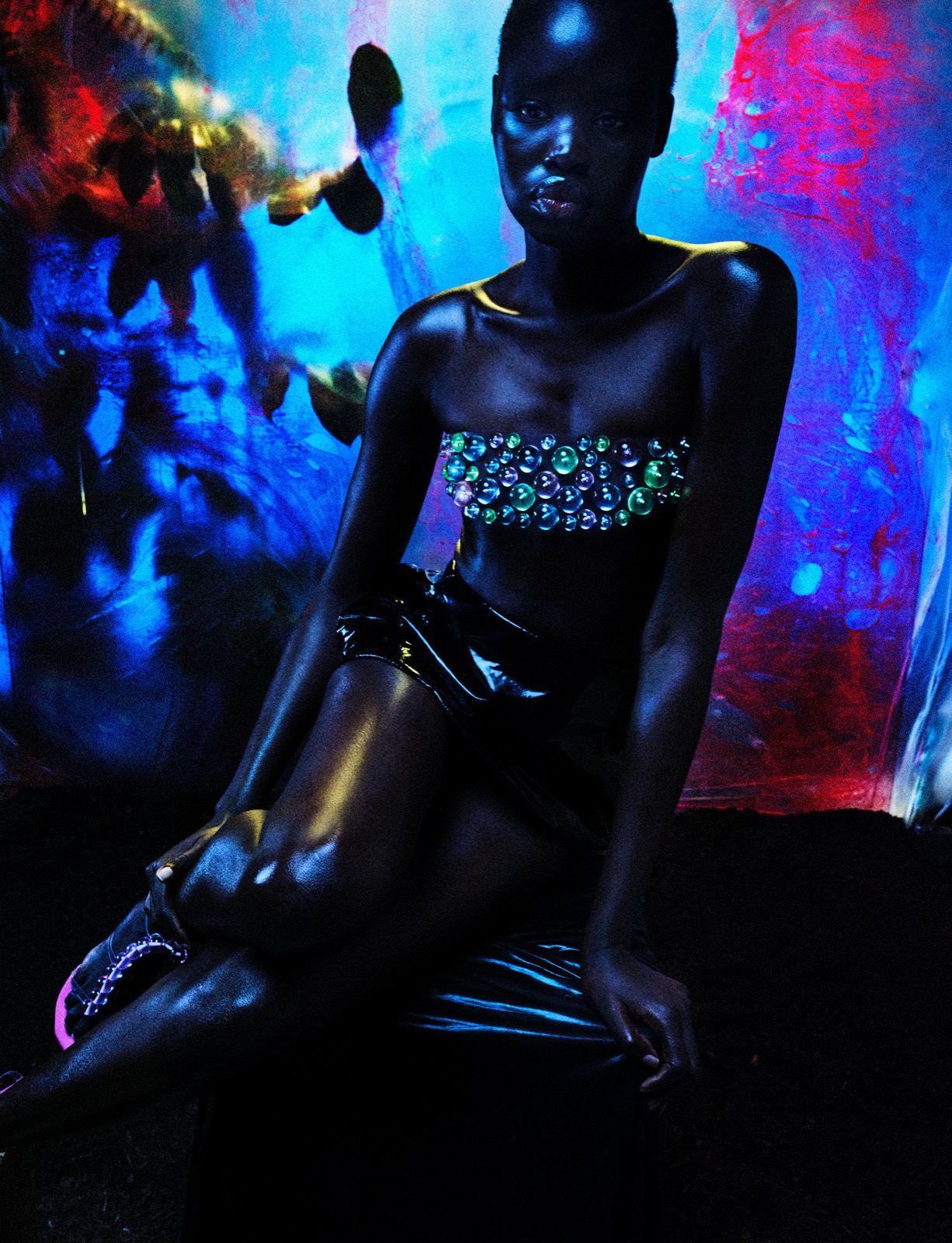

Fashion photography reached the new century having decided that glamour and the elemental could occupy one frame, and this seated figure is a composed heir to that settlement. She rests against a backdrop behaving like wet paint, sheets of electric blue bleeding into magenta with a smear of red along the right edge. Around her chest runs a bandeau of clustered glass orbs, green and clear and faintly lilac, each catching light like water that has forgotten to fall.
What holds the picture together is tonal, not narrative. Yeste lets the deep blue-black of her skin carry the composition, so the brightest events are small and precise: the beads at her breast, a blue rim along one shoulder, the wet shine down her forearm and shin. The patent skirt reads almost as a second light source, a slab of gloss that gathers the whole scene and hands it back. Her gaze is level, unhurried, meeting the lens without appeal. Nothing is coy about the pose; it is frontal, planted, deliberate.
Yeste belongs to the front rank of Spanish fashion photography, his images filling Numéro, Harper’s Bazaar and Vogue, and here the elemental strain in that work turns aquatic, the body dressed in what looks like caught water. The archival pigment print is the right vehicle for such a scene, holding the saturated blues and that lone red without letting the shadows close to mud. Detail survives where a lesser process would surrender it. The result is a picture that keeps its cool at the exact temperature the light demands.