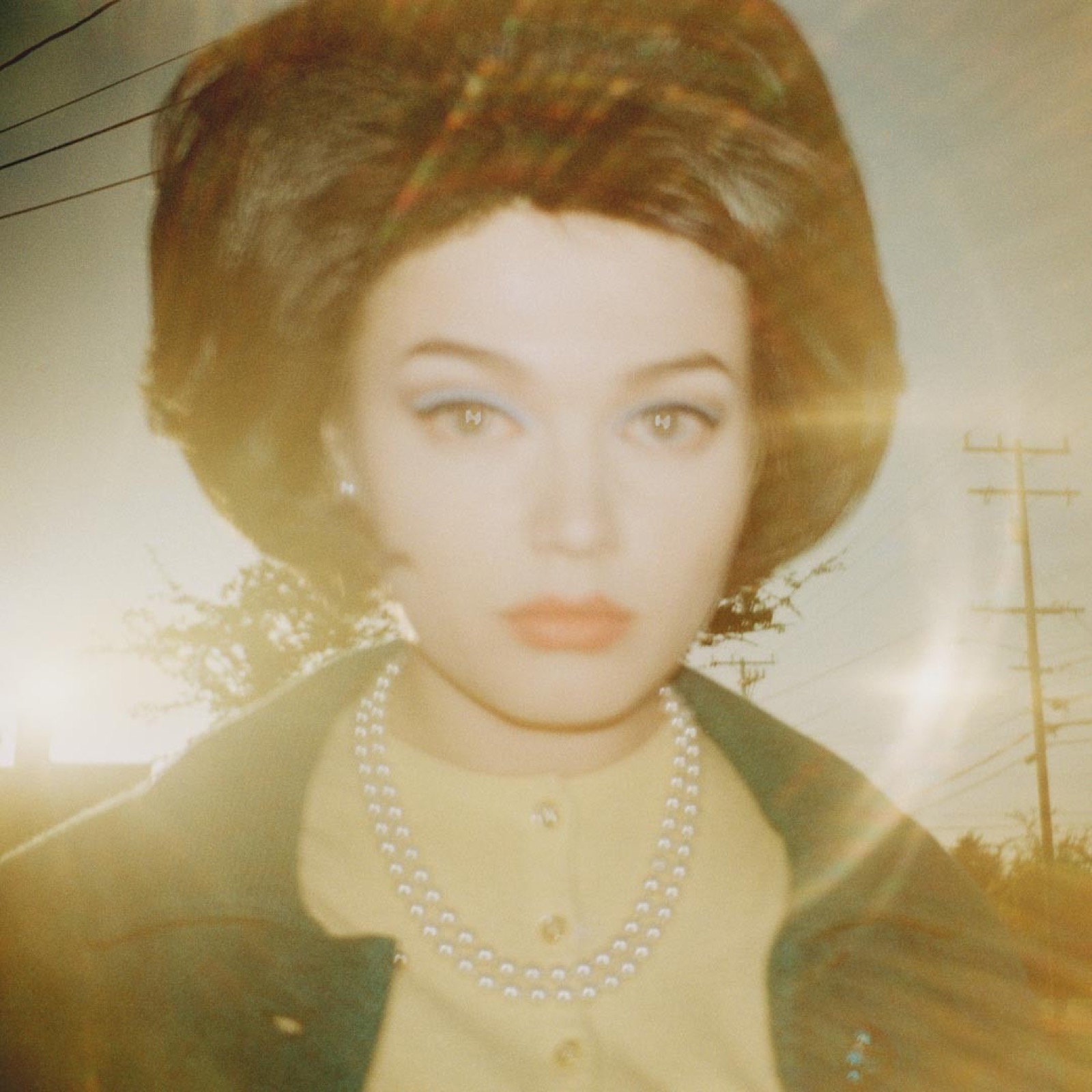
Pearls, a lacquered bouffant, blue eyeshadow, a double strand of beads over a canary-yellow blouse: everything about this woman says a specific vanished decade, roughly 1962, give or take a can of hairspray. Except she isn't quite there. Todd Hido has double-exposed the portrait with a landscape, so that telephone wires cross her forehead and a spectral tree and utility pole surface on the right, the whole thing drenched in a golden light-leak that could be nostalgia rendered as a chemical accident.
I find these hybrid pictures the strangest and most beguiling things in Excerpts from Silver Meadows. The woman—model, mannequin, or a found image of one, it's genuinely hard to say—hovers between person and apparition, her painted eyes fixed on me with the serene blankness of a catalogue. The landscape behind and within her is pure Hido: the anonymous American road, glimpsed as if through the woman's own remembering.
What I keep circling back to is the honesty of the artifice. Hido isn't pretending this is a straight portrait; he's letting two exposures argue on a single sheet, and out of that argument comes something no single image could manage—the sensation of a memory decaying in real time, place and person bleeding into each other. Printed on Dibond, it glows like an over-loved snapshot rescued from a shoebox. It shouldn't work. It works completely.
Pearls, a lacquered bouffant, blue eyeshadow, a double strand of beads over a canary-yellow blouse: everything about this woman says a specific vanished decade, roughly 1962, give or take a can of hairspray. Except she isn't quite there. Todd Hido has double-exposed the portrait with a landscape, so that telephone wires cross her forehead and a spectral tree and utility pole surface on the right, the whole thing drenched in a golden light-leak that could be nostalgia rendered as a chemical accident.
I find these hybrid pictures the strangest and most beguiling things in Excerpts from Silver Meadows. The woman—model, mannequin, or a found image of one, it's genuinely hard to say—hovers between person and apparition, her painted eyes fixed on me with the serene blankness of a catalogue. The landscape behind and within her is pure Hido: the anonymous American road, glimpsed as if through the woman's own remembering.
What I keep circling back to is the honesty of the artifice. Hido isn't pretending this is a straight portrait; he's letting two exposures argue on a single sheet, and out of that argument comes something no single image could manage—the sensation of a memory decaying in real time, place and person bleeding into each other. Printed on Dibond, it glows like an over-loved snapshot rescued from a shoebox. It shouldn't work. It works completely.