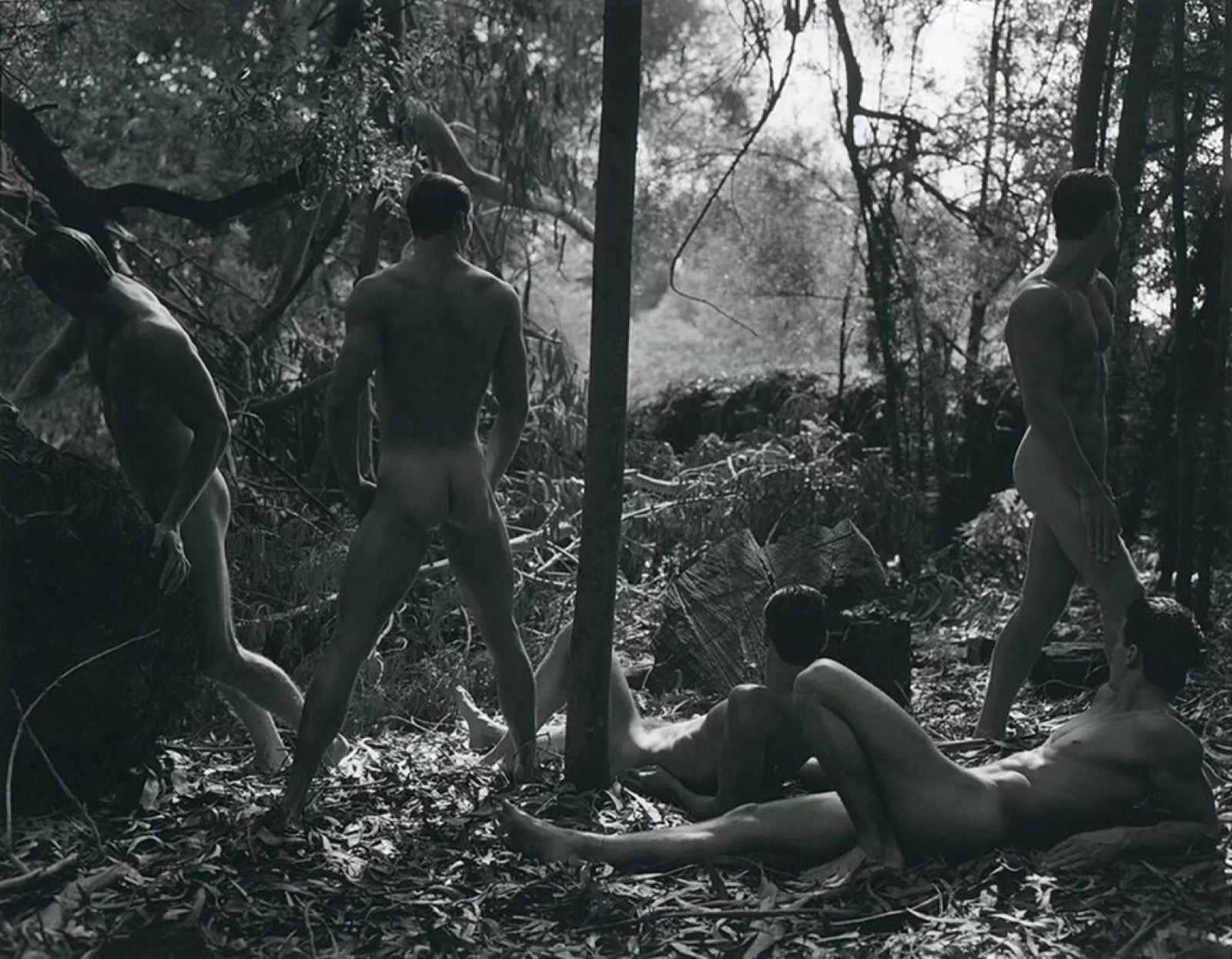
In a Californian grove, leaves ankle-deep and the light falling in broken patches through the canopy, five men have taken off their clothes and arranged themselves among the trees. Two recline on the leaf litter in the foreground; three stand, one seen from behind at the left, one squared to a slender vertical trunk at the centre, one walking off in profile at the right. The place does half the work. Set the same bodies in a studio and you have a fashion shoot; set them here and you have Arcadia.
That is Weber’s game, and he plays it knowingly. The scene quotes a deep tradition of men bathing in the wild, Eakins by his swimming hole, the painted Arcadias before him, and photography, with its stubborn hold on the actual, both honours and punctures the fantasy. These are models, styled and cast, yet the dappled forest light falls on them exactly as it would on anyone, indifferent and true. The picture hovers between myth and document, which is precisely where Weber likes to work.
Weber built his reputation staging American desire for fashion, but the ambition here is older: to make a photograph that behaves like a nineteenth-century idyll while remaining of its own moment. The gelatin silver print is essential to the illusion, its silvered greys dissolving skin and bark and fallen leaf into one continuous tissue of tone, so the figures seem native to the wood. Look long enough and the models become inhabitants, the grove becomes myth. Then a stray branch reminds you it is only a Tuesday in Santa Barbara.
In a Californian grove, leaves ankle-deep and the light falling in broken patches through the canopy, five men have taken off their clothes and arranged themselves among the trees. Two recline on the leaf litter in the foreground; three stand, one seen from behind at the left, one squared to a slender vertical trunk at the centre, one walking off in profile at the right. The place does half the work. Set the same bodies in a studio and you have a fashion shoot; set them here and you have Arcadia.
That is Weber’s game, and he plays it knowingly. The scene quotes a deep tradition of men bathing in the wild, Eakins by his swimming hole, the painted Arcadias before him, and photography, with its stubborn hold on the actual, both honours and punctures the fantasy. These are models, styled and cast, yet the dappled forest light falls on them exactly as it would on anyone, indifferent and true. The picture hovers between myth and document, which is precisely where Weber likes to work.
Weber built his reputation staging American desire for fashion, but the ambition here is older: to make a photograph that behaves like a nineteenth-century idyll while remaining of its own moment. The gelatin silver print is essential to the illusion, its silvered greys dissolving skin and bark and fallen leaf into one continuous tissue of tone, so the figures seem native to the wood. Look long enough and the models become inhabitants, the grove becomes myth. Then a stray branch reminds you it is only a Tuesday in Santa Barbara.