In the lean years after the war, when a camera was still a small luxury and a gravel pit could pass for a studio, two young men have come out to play at photography. One crouches and lifts a folding camera to his eye; the other stands behind a great circular wire screen, caught in its web of spokes. I recognise the situation at once: the amateur’s Sunday, the photo-club improvisation, the era teaching itself to see through cheap and ingenious means.
What holds me is the wire disc itself, a spider’s web of concentric rings and radiating spokes, through which a second figure looms, half fan, half phantom. The photographer becomes a picture inside a picture, screened and doubled, so that I can never quite say who is looking at whom. Then a smaller thing detains me: the plain wooden ladder propped against a bank of pale earth at the right, going nowhere, absurd and tender. It is the ordinary object that makes the staged scene suddenly real to me.
This is Masats among his own kind at the beginning, in the Terrassa where his eye was formed, before the Sanfermines, before Neutral Corner, before the Premio Nacional de Fotografía. The AFAL generation he would help lead pulled Spanish photography toward exactly this: play, chance, self-awareness, the camera turned on the act of using a camera. Printed later in gelatin silver, the sheet keeps the chalky whites of the mounds and the fine grey mesh of the screen, every wire distinct, as if remembering how carefully it was once seen.
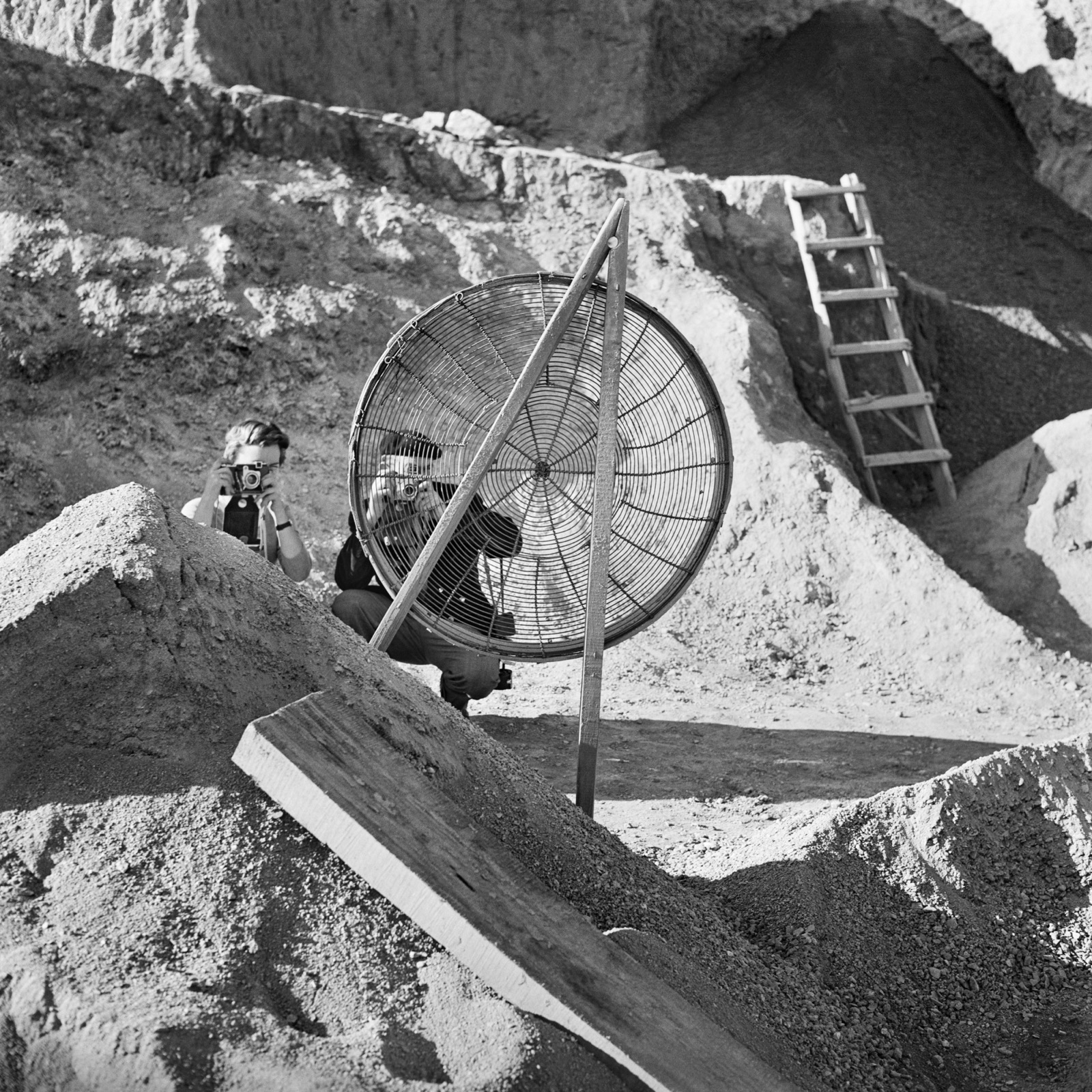

In the lean years after the war, when a camera was still a small luxury and a gravel pit could pass for a studio, two young men have come out to play at photography. One crouches and lifts a folding camera to his eye; the other stands behind a great circular wire screen, caught in its web of spokes. I recognise the situation at once: the amateur’s Sunday, the photo-club improvisation, the era teaching itself to see through cheap and ingenious means.
What holds me is the wire disc itself, a spider’s web of concentric rings and radiating spokes, through which a second figure looms, half fan, half phantom. The photographer becomes a picture inside a picture, screened and doubled, so that I can never quite say who is looking at whom. Then a smaller thing detains me: the plain wooden ladder propped against a bank of pale earth at the right, going nowhere, absurd and tender. It is the ordinary object that makes the staged scene suddenly real to me.
This is Masats among his own kind at the beginning, in the Terrassa where his eye was formed, before the Sanfermines, before Neutral Corner, before the Premio Nacional de Fotografía. The AFAL generation he would help lead pulled Spanish photography toward exactly this: play, chance, self-awareness, the camera turned on the act of using a camera. Printed later in gelatin silver, the sheet keeps the chalky whites of the mounds and the fine grey mesh of the screen, every wire distinct, as if remembering how carefully it was once seen.