Every photograph of a boy in a plain white T-shirt is partly a photograph of a pose he is trying on. This one puts the proposition to the test at once: tousled dark hair, a scatter of freckles, a cigarette held to an open mouth with the tongue already out to meet it, the whole face arranged into a study of teenage nonchalance. And yet the arrangement keeps slipping. The raised arm is a little awkward, the eyes not quite committed to the performance.
What photography does so well, and what interests me here, is register that gap between the attitude a sitter reaches for and the person who cannot quite hold it. Weber lets both show. Against the mottled plaster wall the pose declares itself grown, worldly, a little dangerous, while the freckled skin and the damp, slept-in shirt report something younger and more vulnerable underneath. The picture does not resolve the two. It leaves the boy suspended between the role and the fact of himself.
Casting the beautiful, unpolished young man has been Weber’s method for decades, and his gift is to make such a face carry the weight of a matinee idol without losing its ordinariness. That doubleness is the whole subject. The gelatin silver print is the medium that can hold it, its silvered greys giving equal truth to the bright cotton shirt, the plaster’s grain and the shadowed hollow of the mouth. Printed by hand, it fixes a fleeting swagger and the doubt inside it together, on one sheet.
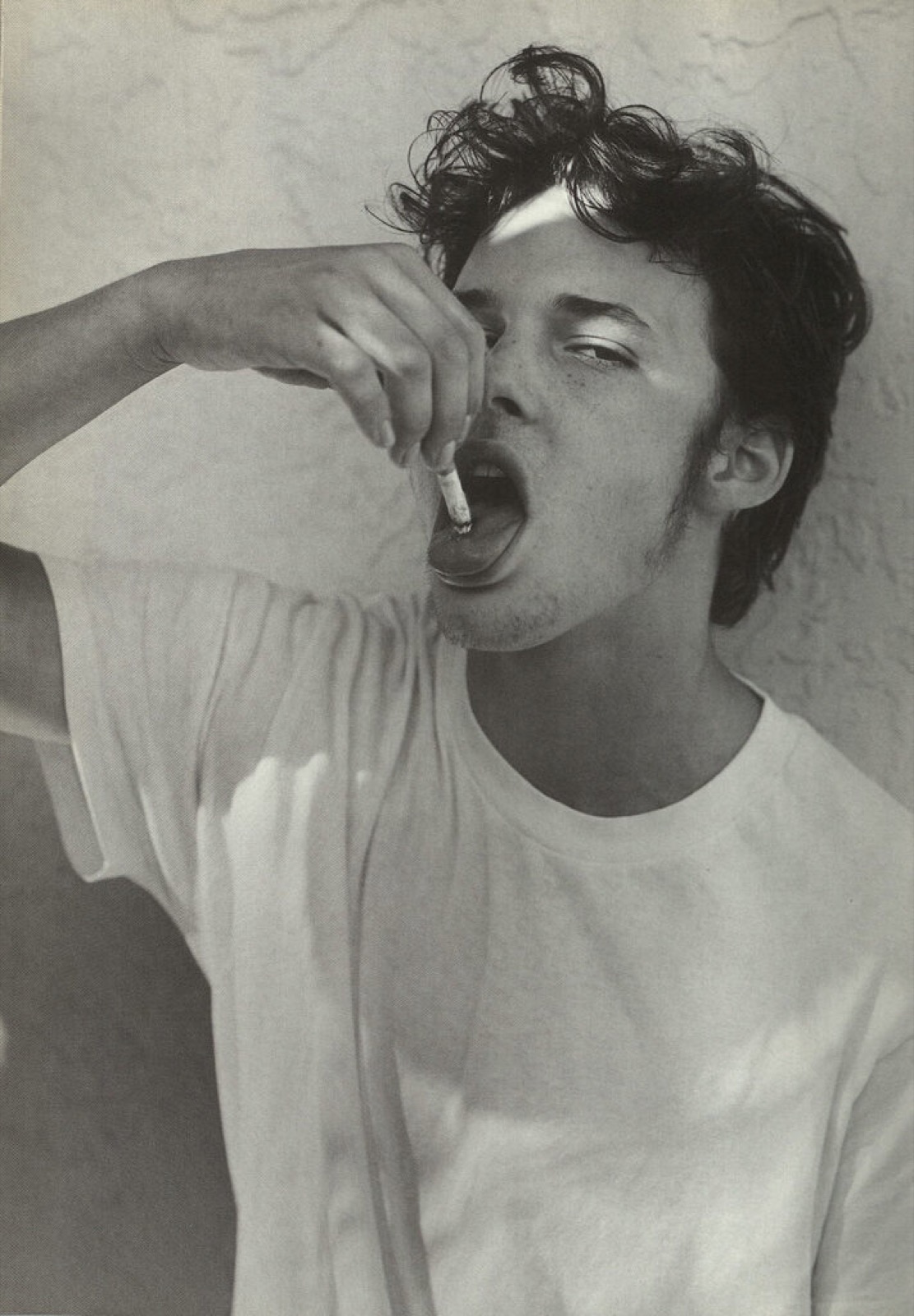

Every photograph of a boy in a plain white T-shirt is partly a photograph of a pose he is trying on. This one puts the proposition to the test at once: tousled dark hair, a scatter of freckles, a cigarette held to an open mouth with the tongue already out to meet it, the whole face arranged into a study of teenage nonchalance. And yet the arrangement keeps slipping. The raised arm is a little awkward, the eyes not quite committed to the performance.
What photography does so well, and what interests me here, is register that gap between the attitude a sitter reaches for and the person who cannot quite hold it. Weber lets both show. Against the mottled plaster wall the pose declares itself grown, worldly, a little dangerous, while the freckled skin and the damp, slept-in shirt report something younger and more vulnerable underneath. The picture does not resolve the two. It leaves the boy suspended between the role and the fact of himself.
Casting the beautiful, unpolished young man has been Weber’s method for decades, and his gift is to make such a face carry the weight of a matinee idol without losing its ordinariness. That doubleness is the whole subject. The gelatin silver print is the medium that can hold it, its silvered greys giving equal truth to the bright cotton shirt, the plaster’s grain and the shadowed hollow of the mouth. Printed by hand, it fixes a fleeting swagger and the doubt inside it together, on one sheet.