Somewhere behind this photograph stands Hopper’s house by the railroad, ancestor of every lonely white house in American picture-making since. Hido has spent a career minding that inheritance, but this house has slipped its lineage and wandered into a Rothko: bands of apricot and smoked olive stacked to the horizon, no edges anywhere, and the white gable dissolving into fog like a guest leaving a party without quite saying goodbye.
The facts, such as the fog will confirm them: one telephone pole planted mid-frame like a mast, its wires sagging off to nowhere; a low barn crouching behind a rise; and a foreground of snow-capped boulders that could just as plausibly be a flock of sheep sitting out the cold. It is that kind of visibility. The sun itself is only a rumor, an ember glow along the earth’s rim, and dusk and dawn become interchangeable, which is roughly the condition the picture is about.
Hido works from the road, often shooting through the window of his car, and titles the results with numbers rather than names, as though refusing to prejudice us. Fair enough: a name would pin this place down, and its whole gift is being unpinnable. The pictures have ended up, as inevitabilities do, at SFMOMA, the Getty and the Whitney. This one is an archival pigment print, which turns out to be the right technology for fog, holding those long tonal dissolves without a seam. The house, meanwhile, goes on leaving. It has been leaving for years and never once arrived at gone.
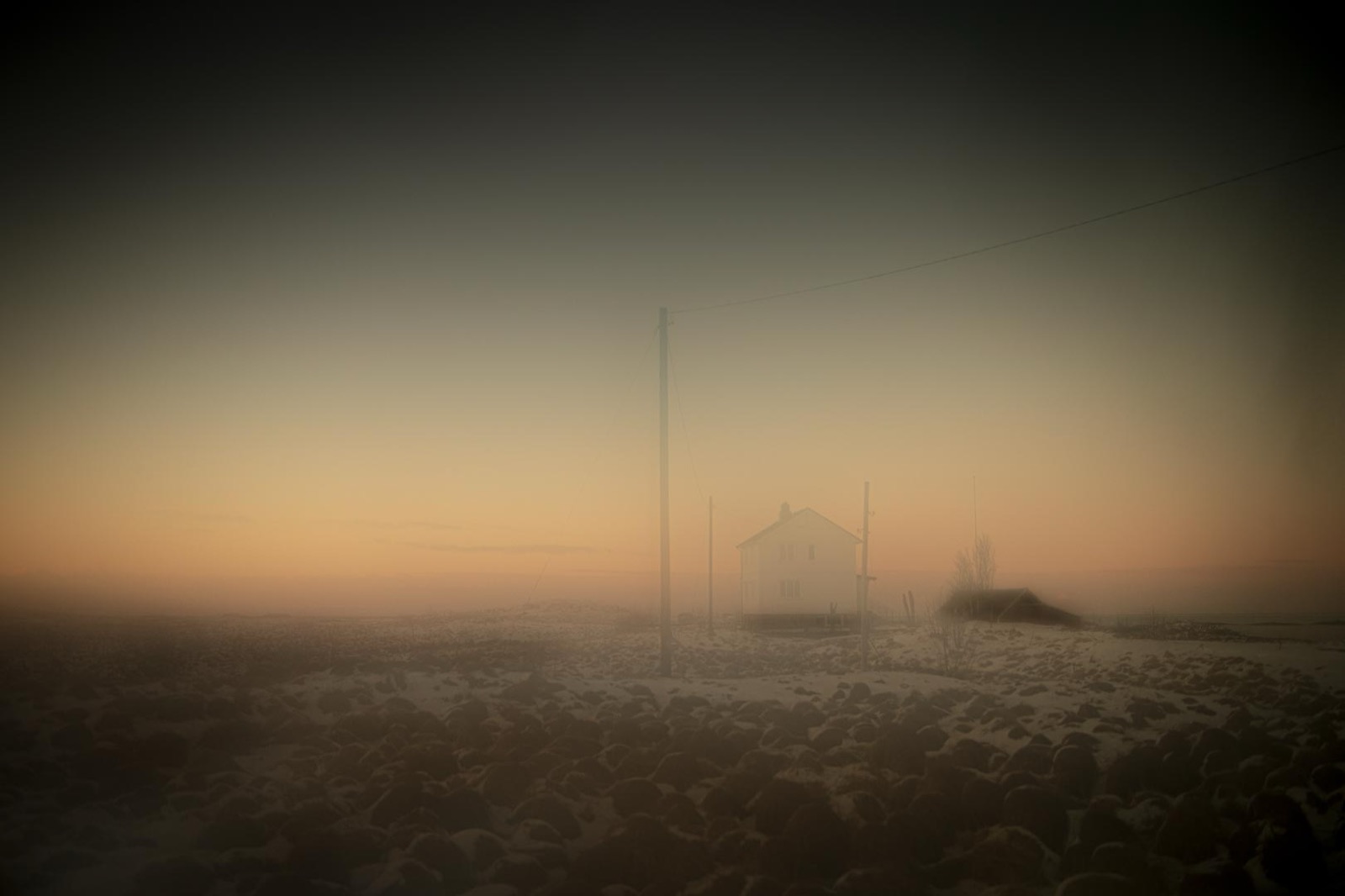

Somewhere behind this photograph stands Hopper’s house by the railroad, ancestor of every lonely white house in American picture-making since. Hido has spent a career minding that inheritance, but this house has slipped its lineage and wandered into a Rothko: bands of apricot and smoked olive stacked to the horizon, no edges anywhere, and the white gable dissolving into fog like a guest leaving a party without quite saying goodbye.
The facts, such as the fog will confirm them: one telephone pole planted mid-frame like a mast, its wires sagging off to nowhere; a low barn crouching behind a rise; and a foreground of snow-capped boulders that could just as plausibly be a flock of sheep sitting out the cold. It is that kind of visibility. The sun itself is only a rumor, an ember glow along the earth’s rim, and dusk and dawn become interchangeable, which is roughly the condition the picture is about.
Hido works from the road, often shooting through the window of his car, and titles the results with numbers rather than names, as though refusing to prejudice us. Fair enough: a name would pin this place down, and its whole gift is being unpinnable. The pictures have ended up, as inevitabilities do, at SFMOMA, the Getty and the Whitney. This one is an archival pigment print, which turns out to be the right technology for fog, holding those long tonal dissolves without a seam. The house, meanwhile, goes on leaving. It has been leaving for years and never once arrived at gone.