Hand-signed by the artist, with title, date, and edition number inscribed in ink on an archival label affixed to the reverse side of the mounted photograph.
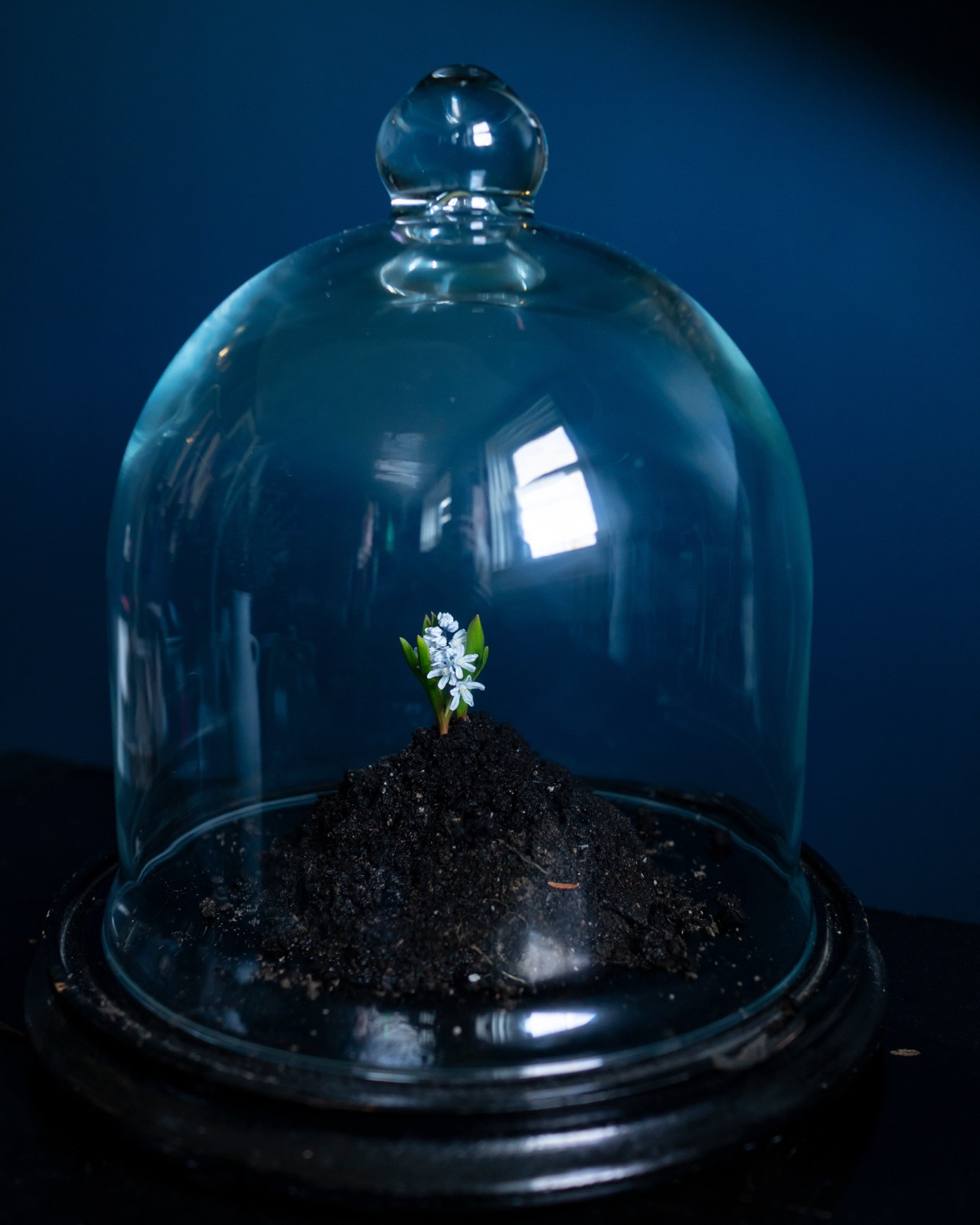
Early Stardrift positions itself squarely within the constructed still life that has become one of contemporary photography's most articulate genres — the tabletop tableau, lit and staged, that knows it is a picture before it is a record. Cig Harvey gives us a Victorian bell jar set on a turned black base, and beneath that glass dome a single stem of striped squill rising from a mound of loose, grit-flecked soil: four or five star-flowers, white veined with pale blue, no bigger than a thumbnail inside all that engineered emptiness.
The strategy is deliberately legible. Harvey, British-born and long based on the midcoast of Maine, doesn't hide the staging — the cloche reads at once as shelter and as vitrine, the museological gesture of putting one small living thing under glass and asking us to attend to it. A smear of cool window light dissolves into the curve of the dome; the back wall sinks to a blue so saturated it functions as a studio ground rather than a room. This is the wonder-cabinet recast as photographic set, the natural specimen knowingly theatricalised.
What keeps it on the contemporary side of mere prettiness is precisely that candour about its own apparatus. The soil is real and scattered; the bloom is absurdly, pointedly minor against the scale of its container. Held in the collections of the Museum of Fine Arts, Houston and the Farnsworth Art Museum, Harvey's colour work earns its audience through this register — domestic matter raised, by staging and light, into image. An archival pigment print, 2020.

Early Stardrift positions itself squarely within the constructed still life that has become one of contemporary photography's most articulate genres — the tabletop tableau, lit and staged, that knows it is a picture before it is a record. Cig Harvey gives us a Victorian bell jar set on a turned black base, and beneath that glass dome a single stem of striped squill rising from a mound of loose, grit-flecked soil: four or five star-flowers, white veined with pale blue, no bigger than a thumbnail inside all that engineered emptiness.
The strategy is deliberately legible. Harvey, British-born and long based on the midcoast of Maine, doesn't hide the staging — the cloche reads at once as shelter and as vitrine, the museological gesture of putting one small living thing under glass and asking us to attend to it. A smear of cool window light dissolves into the curve of the dome; the back wall sinks to a blue so saturated it functions as a studio ground rather than a room. This is the wonder-cabinet recast as photographic set, the natural specimen knowingly theatricalised.
What keeps it on the contemporary side of mere prettiness is precisely that candour about its own apparatus. The soil is real and scattered; the bloom is absurdly, pointedly minor against the scale of its container. Held in the collections of the Museum of Fine Arts, Houston and the Farnsworth Art Museum, Harvey's colour work earns its audience through this register — domestic matter raised, by staging and light, into image. An archival pigment print, 2020.