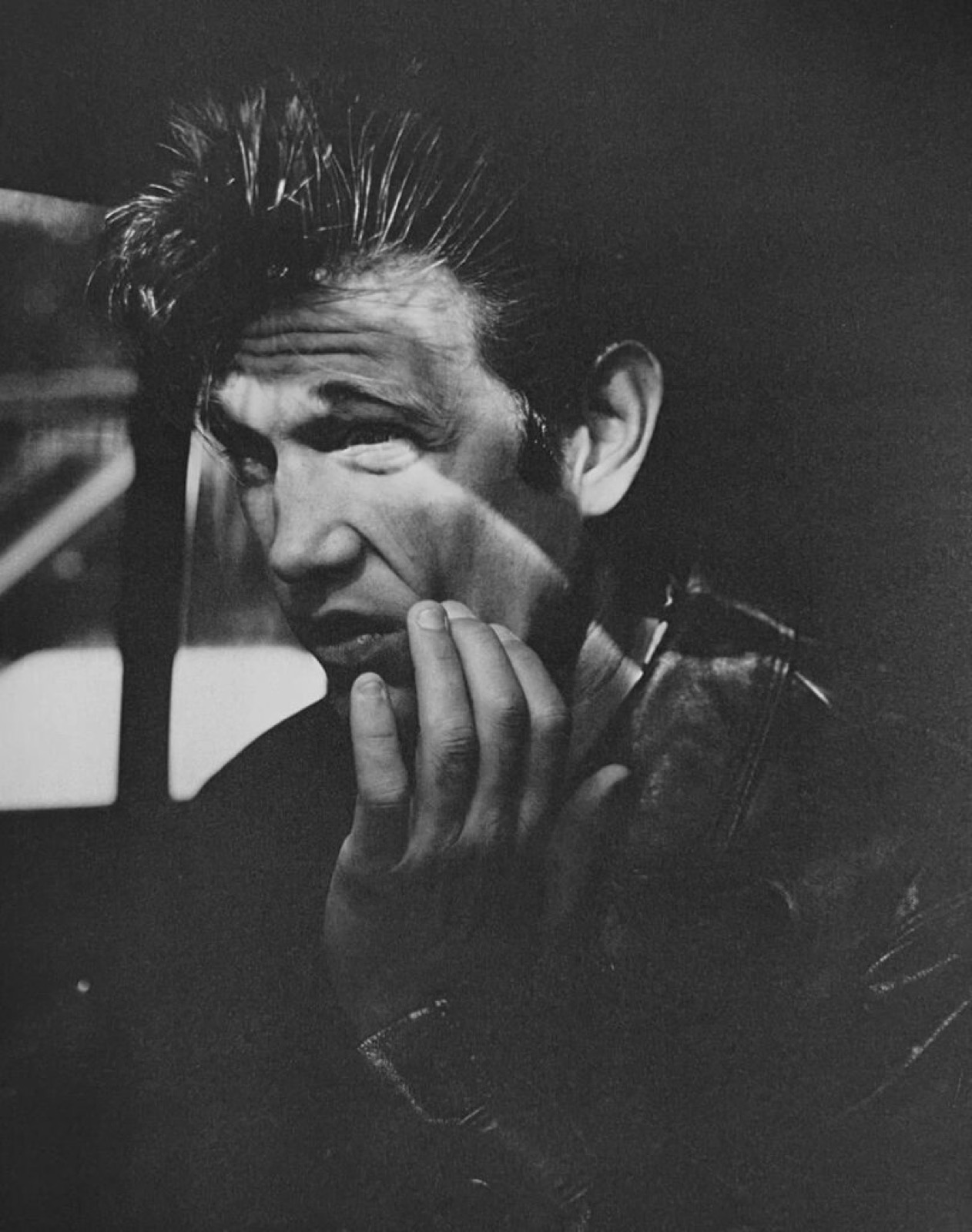
A single blade of light has found his face and left the rest to black. It enters from the bright window burning at the lower left and lays a hard diagonal across the brow, the ridge of the nose and one cheek, catching too the raised hand pressed to his lips, before the darkness closes over everything else: the leather jacket, the far shoulder, the whole right side of the head. This is a picture about light before it is a picture about a man.
What holds me is the division the light performs. One brow, one eye, half a mouth are given to me with almost surgical clarity; the other half has been subtracted into the dark, as if the man were only provisionally present. I find that I trust the lit eye and suspect the vanished one. Here is the small cruelty of such illumination: it does not describe a person so much as decide, on our behalf, how much of him we are permitted to keep.
Weber is remembered for sunlight, for beaches and open Adirondack air, which makes this nocturne the more startling: a New York portrait pitched in the deep chiaroscuro of film noir, all leather and shadow and nerve. The gelatin silver print is indispensable to the effect, its blacks absolute, its lone highlight allowed to burn without apology; no other process holds such extremes on one sheet. I look a last time and cannot say whether the light has arrived to reveal this man or to interrogate him. The picture keeps that question in the dark.

A single blade of light has found his face and left the rest to black. It enters from the bright window burning at the lower left and lays a hard diagonal across the brow, the ridge of the nose and one cheek, catching too the raised hand pressed to his lips, before the darkness closes over everything else: the leather jacket, the far shoulder, the whole right side of the head. This is a picture about light before it is a picture about a man.
What holds me is the division the light performs. One brow, one eye, half a mouth are given to me with almost surgical clarity; the other half has been subtracted into the dark, as if the man were only provisionally present. I find that I trust the lit eye and suspect the vanished one. Here is the small cruelty of such illumination: it does not describe a person so much as decide, on our behalf, how much of him we are permitted to keep.
Weber is remembered for sunlight, for beaches and open Adirondack air, which makes this nocturne the more startling: a New York portrait pitched in the deep chiaroscuro of film noir, all leather and shadow and nerve. The gelatin silver print is indispensable to the effect, its blacks absolute, its lone highlight allowed to burn without apology; no other process holds such extremes on one sheet. I look a last time and cannot say whether the light has arrived to reveal this man or to interrogate him. The picture keeps that question in the dark.