On the raised white platform at Silver Cup Studios, six young men have been arranged into a living frieze, and the floor drops away at the front into a shallow film of water that returns their legs as reflection. Everything is touch: two of them press a heavy medicine ball overhead, a pair of hands flattens against the spine of a kneeling figure, another rider tips back on a rope swing. The white Calvin Klein waistbands repeat across the frame like a caption stamped six times over.
Weber has built a gymnasium out of quotation: a fluted column base at the left edge, bodies set like an Attic relief, the whole tableau lit so that muscle reads as marble. Yet the picture is entirely about surface and skin, the vernacular of the locker room dressed up as antiquity. It is a photograph that knew from the start it would be enormous, pasted on billboards, folded into magazines, handled by millions who would never enter this room. The image was made to circulate, and circulate it did.
What reaches us now is something else: an archival pigment print, a single considered object rather than a mass-produced page. The process holds the long grays of the studio wall, the soft cast shadows, the sweat-bright modelling of shoulder and thigh with a density the newsstand never allowed. Weber, who more than anyone set the American body at the center of 1980s fashion, here turns a campaign into choreography. Fixed and still on a wall, it stops selling anything and starts simply being looked at.
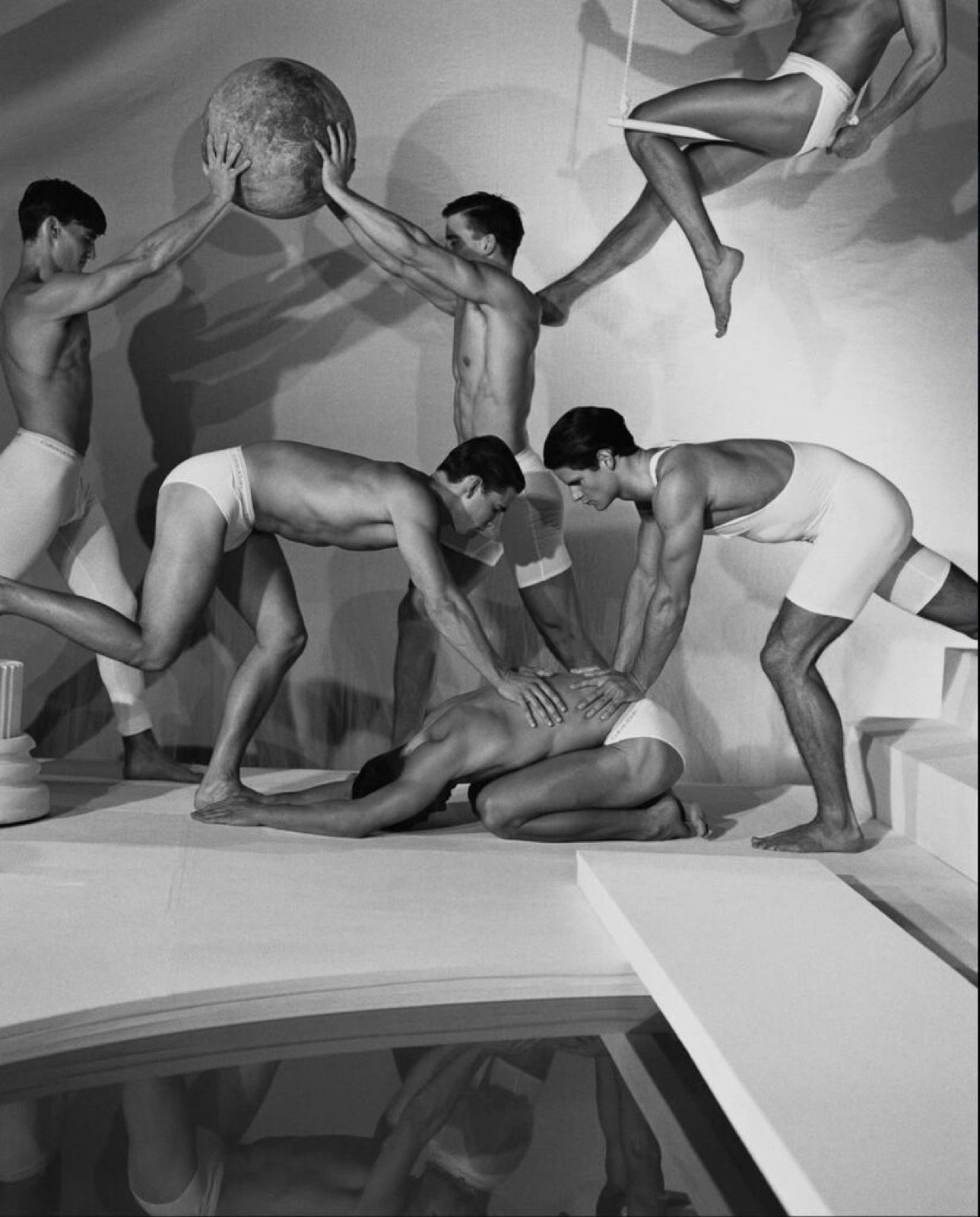

On the raised white platform at Silver Cup Studios, six young men have been arranged into a living frieze, and the floor drops away at the front into a shallow film of water that returns their legs as reflection. Everything is touch: two of them press a heavy medicine ball overhead, a pair of hands flattens against the spine of a kneeling figure, another rider tips back on a rope swing. The white Calvin Klein waistbands repeat across the frame like a caption stamped six times over.
Weber has built a gymnasium out of quotation: a fluted column base at the left edge, bodies set like an Attic relief, the whole tableau lit so that muscle reads as marble. Yet the picture is entirely about surface and skin, the vernacular of the locker room dressed up as antiquity. It is a photograph that knew from the start it would be enormous, pasted on billboards, folded into magazines, handled by millions who would never enter this room. The image was made to circulate, and circulate it did.
What reaches us now is something else: an archival pigment print, a single considered object rather than a mass-produced page. The process holds the long grays of the studio wall, the soft cast shadows, the sweat-bright modelling of shoulder and thigh with a density the newsstand never allowed. Weber, who more than anyone set the American body at the center of 1980s fashion, here turns a campaign into choreography. Fixed and still on a wall, it stops selling anything and starts simply being looked at.