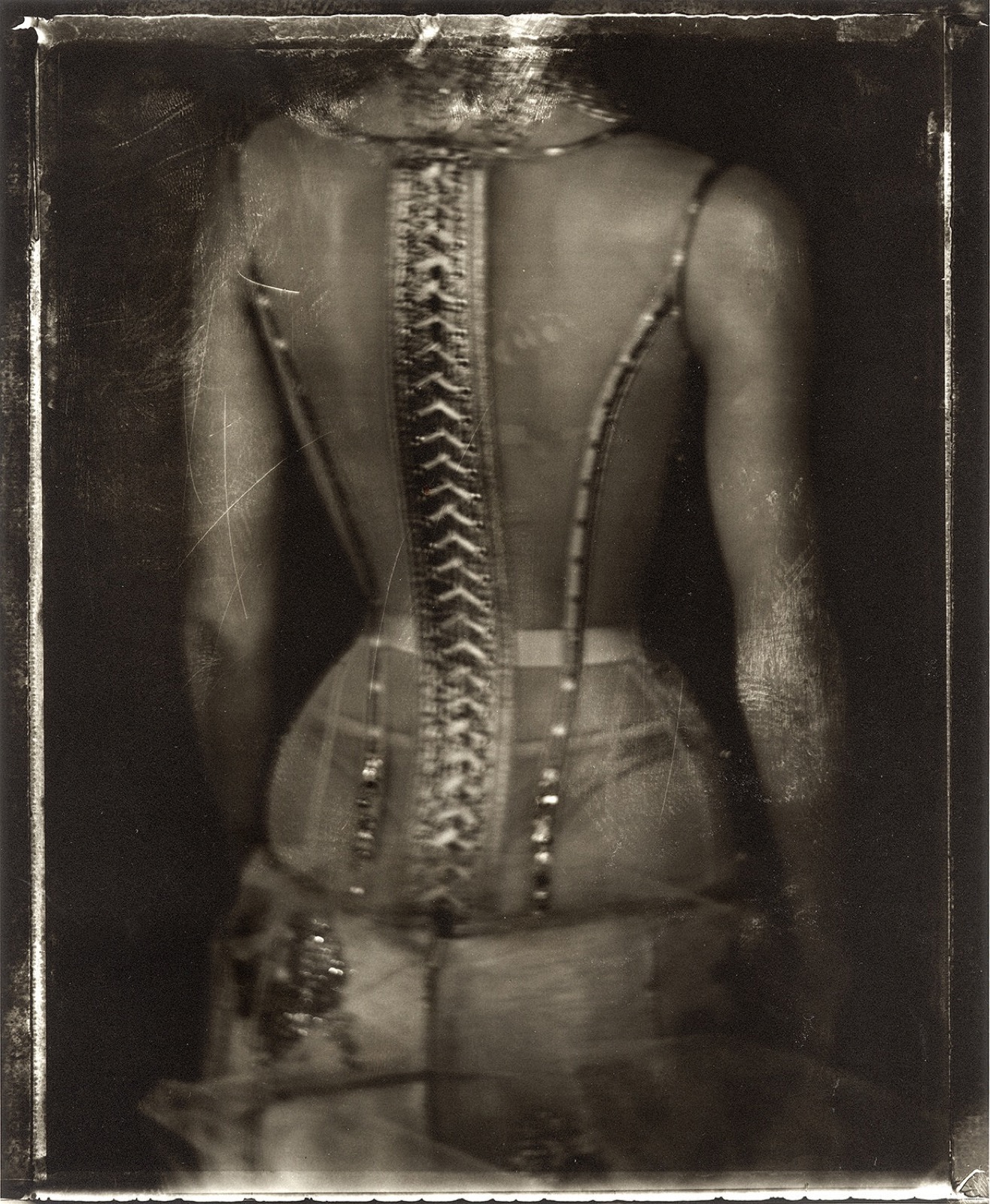
The field is almost all darkness, a warm sepia gloom that the light enters from one side only, grazing the shoulder before it dies into the surrounding brown. There is no room here, no furniture, no horizon — only a depth that has been coaxed into existing by exposure and chemistry, a space closer to the worn ground of a nineteenth-century plate than to any studio of 1997. The borders confess the same artifice: the emulsion is scratched, abraded, the corners gone soft and bruised, so that the photograph announces itself as a made and aged object rather than a window.
Into this constructed dark a woman's back turns toward us, laced spine-down in a corset whose hooked, ladder-like fastening runs the full length of the frame like a seam of script. The strategy is exact and deliberate. By refusing the face entirely, the picture withholds the portrait we expect of fashion and gives us instead a tableau of surface and structure — the muscled shoulder, the cinched waist, the embroidered hip catching a few grains of brightness. This is the constructed image working at its most knowing: garment as architecture, the body staged as anatomy rather than personality.
Made in 1997 and printed in gelatin silver, the picture belongs to a sustained practice that treats the photograph as a painterly, antiquarian thing rather than reportage — the same sensibility that carried this artist from the pages of fashion into the museum, and into collections at the Maison Européenne de la Photographie and the V&A. "Anatomie 1" reads less as a record of a dress than as a meditation on how a body is read at all when the face is taken away, and how much eloquence survives in a spine, a lacing, a held breath in the dark.
The field is almost all darkness, a warm sepia gloom that the light enters from one side only, grazing the shoulder before it dies into the surrounding brown. There is no room here, no furniture, no horizon — only a depth that has been coaxed into existing by exposure and chemistry, a space closer to the worn ground of a nineteenth-century plate than to any studio of 1997. The borders confess the same artifice: the emulsion is scratched, abraded, the corners gone soft and bruised, so that the photograph announces itself as a made and aged object rather than a window.
Into this constructed dark a woman's back turns toward us, laced spine-down in a corset whose hooked, ladder-like fastening runs the full length of the frame like a seam of script. The strategy is exact and deliberate. By refusing the face entirely, the picture withholds the portrait we expect of fashion and gives us instead a tableau of surface and structure — the muscled shoulder, the cinched waist, the embroidered hip catching a few grains of brightness. This is the constructed image working at its most knowing: garment as architecture, the body staged as anatomy rather than personality.
Made in 1997 and printed in gelatin silver, the picture belongs to a sustained practice that treats the photograph as a painterly, antiquarian thing rather than reportage — the same sensibility that carried this artist from the pages of fashion into the museum, and into collections at the Maison Européenne de la Photographie and the V&A. "Anatomie 1" reads less as a record of a dress than as a meditation on how a body is read at all when the face is taken away, and how much eloquence survives in a spine, a lacing, a held breath in the dark.