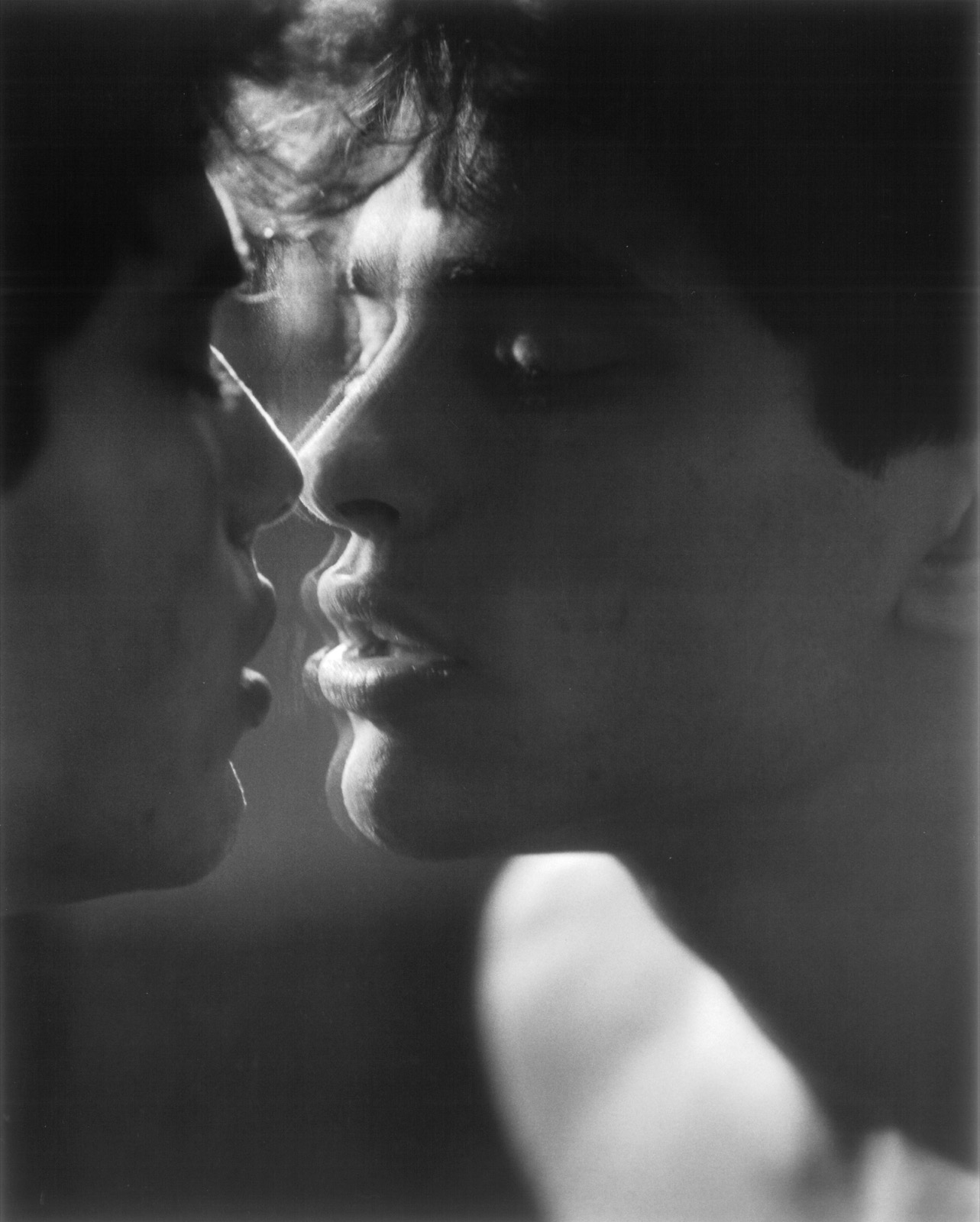
The picture reaches straight back to the Hollywood portrait studios of the thirties, to the hard raking key light that George Hurrell used to carve a face out of blackness, leaving only a bright edge along the nose and brow, and darkness everywhere else. Weber knows that lineage and quotes it deliberately here, dropping most of the frame into shadow and letting a single sculptural highlight define Jonathan Schnek’s profile, his full lips, the loose fall of dark hair. It is glamour photography as art history.
But the staging is more intimate than any studio glamour shot allowed. A second face presses in from the left, barely lit, close enough to breathe against his; a bare shoulder glows in the lower corner, warm and out of focus. The scene reads as the instant before a kiss, held and made ambiguous, so that portraiture tips toward something private and cinematic. The actor is given a role even in a still photograph, cast as the object of a desire the picture never fully names.
This is Weber’s directorial method, the reason his fashion and portrait work belongs in museums as readily as in magazines. He treats the sitter as a character and the print as a screen, borrowing the emotional weather of film. The gelatin silver print earns that ambition: deep, velvety blacks, a narrow ribbon of highlight, grain fine enough to model the skin without hardening it. It is a contemporary image built entirely from the memory of an older Hollywood, and it knows it.
The picture reaches straight back to the Hollywood portrait studios of the thirties, to the hard raking key light that George Hurrell used to carve a face out of blackness, leaving only a bright edge along the nose and brow, and darkness everywhere else. Weber knows that lineage and quotes it deliberately here, dropping most of the frame into shadow and letting a single sculptural highlight define Jonathan Schnek’s profile, his full lips, the loose fall of dark hair. It is glamour photography as art history.
But the staging is more intimate than any studio glamour shot allowed. A second face presses in from the left, barely lit, close enough to breathe against his; a bare shoulder glows in the lower corner, warm and out of focus. The scene reads as the instant before a kiss, held and made ambiguous, so that portraiture tips toward something private and cinematic. The actor is given a role even in a still photograph, cast as the object of a desire the picture never fully names.
This is Weber’s directorial method, the reason his fashion and portrait work belongs in museums as readily as in magazines. He treats the sitter as a character and the print as a screen, borrowing the emotional weather of film. The gelatin silver print earns that ambition: deep, velvety blacks, a narrow ribbon of highlight, grain fine enough to model the skin without hardening it. It is a contemporary image built entirely from the memory of an older Hollywood, and it knows it.