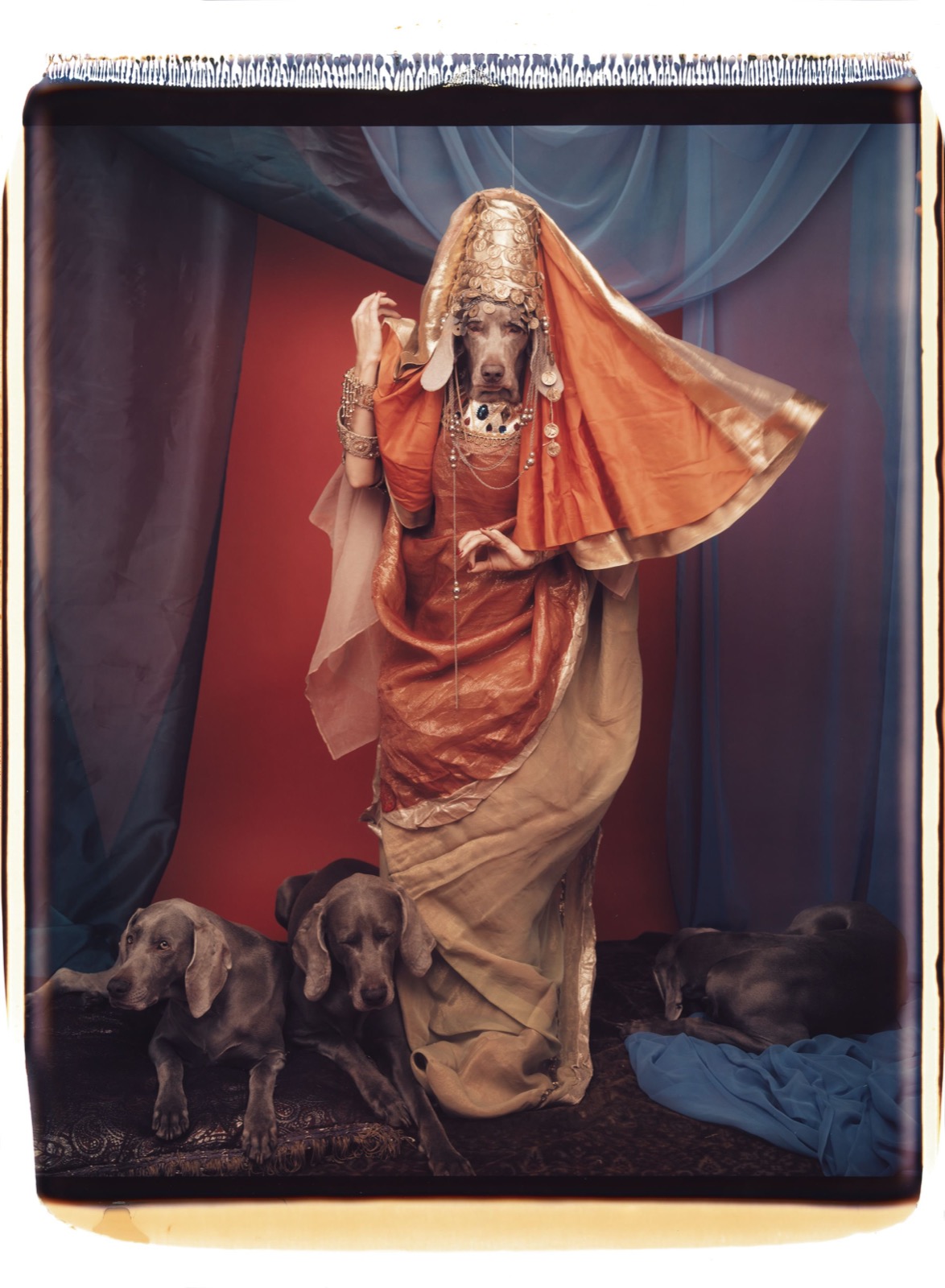
Travesty, performed with enough conviction, becomes a form of devotion. Here is the proposition tested at full scale: a Weimaraner robed as Salome in saffron silk and gold lamé, a headdress fringed with coins framing the long gray face, while a human hand with red-lacquered nails lifts the veil in the dance’s oldest gesture. Another hand pinches a strand of pearls with courtly delicacy. The dog’s expression is mournful, patient, immense; it declines the joke. The picture never winks, and that refusal is the art.
Everything else conspires to seduce. The backdrop burns a courtesan’s red; blue chiffon sags into a canopy that quotes every Orientalist stage set the nineteenth century ever built; the whole tableau is opera reduced to its essential vice, which is excess. One distrusts such pleasure even while taking it. Then the eye drops to the hem, where three more Weimaraners recline like a bored corps de ballet, one slumped on a spill of blue fabric, eyes half closed. Their patience is not acted. The costume is a lie the animal keeps telling the truth through, and this friction, not the finery, is what holds the image taut.
Wegman made this in 1996 in the 24×20 large-format Polaroid studio, casting his Weimaraners in the stage roles of opera; Salome belongs to that series. The result is a unique color Polaroid, developed in the minute after exposure, its chemistry frilling the upper margin like a proscenium. No negative exists and no second print can. The performance survives in exactly one object, and this is it.
Travesty, performed with enough conviction, becomes a form of devotion. Here is the proposition tested at full scale: a Weimaraner robed as Salome in saffron silk and gold lamé, a headdress fringed with coins framing the long gray face, while a human hand with red-lacquered nails lifts the veil in the dance’s oldest gesture. Another hand pinches a strand of pearls with courtly delicacy. The dog’s expression is mournful, patient, immense; it declines the joke. The picture never winks, and that refusal is the art.
Everything else conspires to seduce. The backdrop burns a courtesan’s red; blue chiffon sags into a canopy that quotes every Orientalist stage set the nineteenth century ever built; the whole tableau is opera reduced to its essential vice, which is excess. One distrusts such pleasure even while taking it. Then the eye drops to the hem, where three more Weimaraners recline like a bored corps de ballet, one slumped on a spill of blue fabric, eyes half closed. Their patience is not acted. The costume is a lie the animal keeps telling the truth through, and this friction, not the finery, is what holds the image taut.
Wegman made this in 1996 in the 24×20 large-format Polaroid studio, casting his Weimaraners in the stage roles of opera; Salome belongs to that series. The result is a unique color Polaroid, developed in the minute after exposure, its chemistry frilling the upper margin like a proscenium. No negative exists and no second print can. The performance survives in exactly one object, and this is it.