Two camel coats, the same warm tan, move away from us into a wall of steam. That repetition is the picture's whole engine. Meyerowitz did not arrange it, but he saw, in the half-second he had, that the man's coat and the woman's coat rhymed exactly with the light coming low down the cross street, and that the same tan turns up again on the woman bending to her shopping bag at the right. The camera describes all of this evenly, without comment, and the rhyme does the work.
Look at how the steam is handled. It rises from a vent and divides the frame into two facts: on the left, soft incandescent light caught in vapor; on the right, the hard marble corner of the Gucci store on Fifth Avenue, lettering legible above the door. The couple walk the seam between them. Steam ordinarily ruins a photograph by hiding things; here it does the opposite, lifting the two figures out of the crowd and giving them a stage exactly their color. The woman's red shoe, the one bright accent, marks the step that will carry her into the cloud.
This is the problem early color photography had to solve—how to make color carry meaning rather than merely decorate—and it is solved here by matching, not by spectacle. Meyerowitz, working the 35mm street alongside the large-camera Cape Cod pictures, belongs to the small group who made color serious. Prints of this image sit in major museum collections. What it finally shows is plain and exact: that a New York sidewalk, looked at hard enough, composes itself.
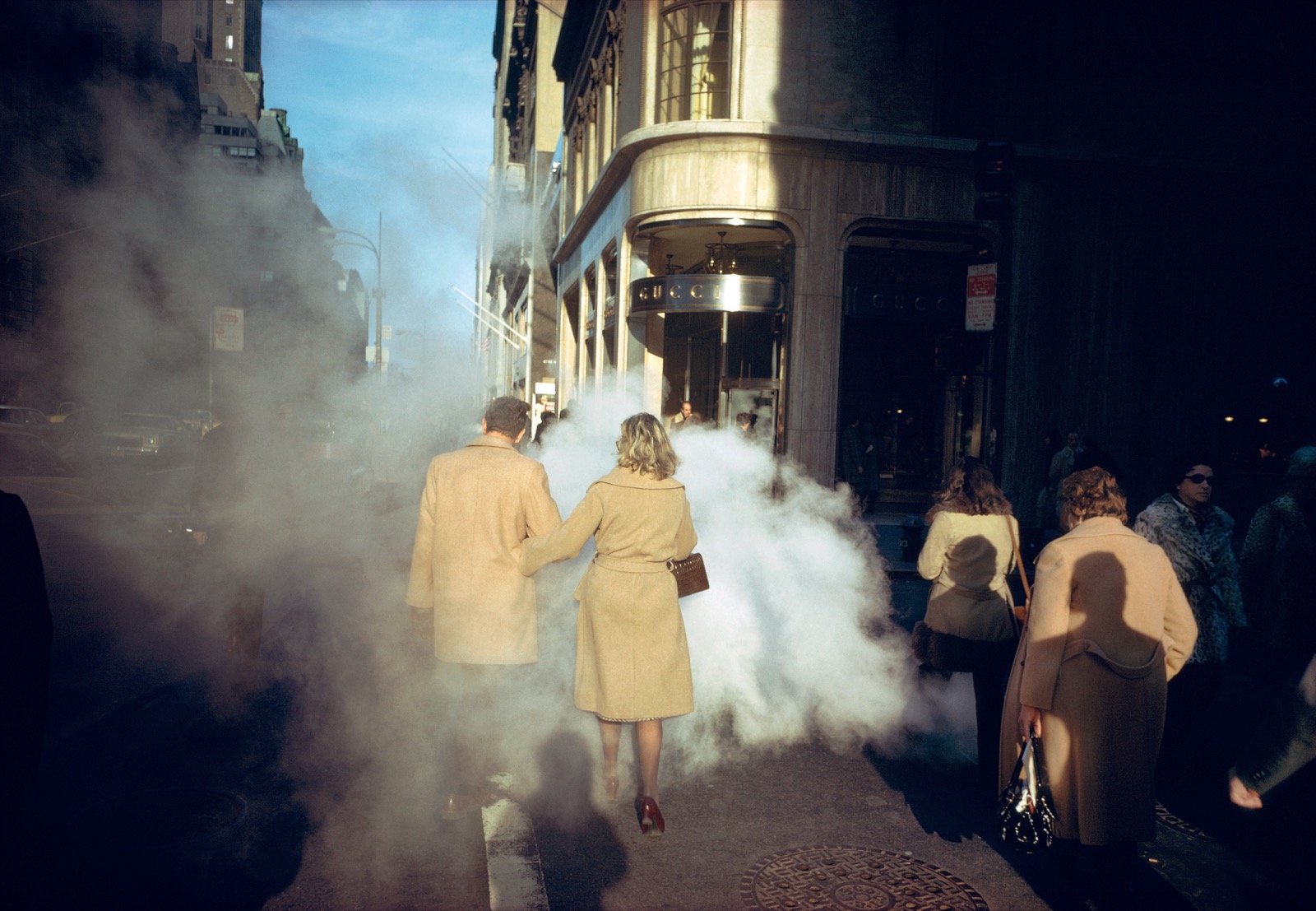

Two camel coats, the same warm tan, move away from us into a wall of steam. That repetition is the picture's whole engine. Meyerowitz did not arrange it, but he saw, in the half-second he had, that the man's coat and the woman's coat rhymed exactly with the light coming low down the cross street, and that the same tan turns up again on the woman bending to her shopping bag at the right. The camera describes all of this evenly, without comment, and the rhyme does the work.
Look at how the steam is handled. It rises from a vent and divides the frame into two facts: on the left, soft incandescent light caught in vapor; on the right, the hard marble corner of the Gucci store on Fifth Avenue, lettering legible above the door. The couple walk the seam between them. Steam ordinarily ruins a photograph by hiding things; here it does the opposite, lifting the two figures out of the crowd and giving them a stage exactly their color. The woman's red shoe, the one bright accent, marks the step that will carry her into the cloud.
This is the problem early color photography had to solve—how to make color carry meaning rather than merely decorate—and it is solved here by matching, not by spectacle. Meyerowitz, working the 35mm street alongside the large-camera Cape Cod pictures, belongs to the small group who made color serious. Prints of this image sit in major museum collections. What it finally shows is plain and exact: that a New York sidewalk, looked at hard enough, composes itself.