It’s the chair that gets me. Not propped to sit on, not pulled up to anything — folded shut and tipped against the door, a padded folding chair laid down like something put away mid-thought. The cover is the colour of a healing bruise, the legs scissored half-open across the carpet. You could spend a while wondering what it’s doing. Bracing the door? Waiting to be carried out? Or just dropped in the nearest spot in a room nobody intends to return to. I keep landing on the last, the most unsettling of the three.
The whole frame is bathed in that Hido purple, the long-exposure colour he found by driving around at dusk, shooting houses from the street until, here, he got inside one. White-painted cinderblock, red shag that looks warm and slightly damp underfoot, and in the door a small pane glowing amber — the one warm thing in the picture, lit from somewhere we’ll never see. That square does all the narrative work. It says someone, somewhere, recently. It’s the pilot light of the whole image.
Hido grew up in Ohio, and his interiors carry that Midwestern weight, the feeling of rooms emptied out between one life and the next. He doesn’t stage them so much as walk in and notice. What he noticed here is that a room can be completely still and still feel like the second after something happened — that a folded chair can stop being furniture and become a trace of whoever folded it. Printed on Dibond, the carpet becomes a field and you’re standing in the dim with it, waiting.
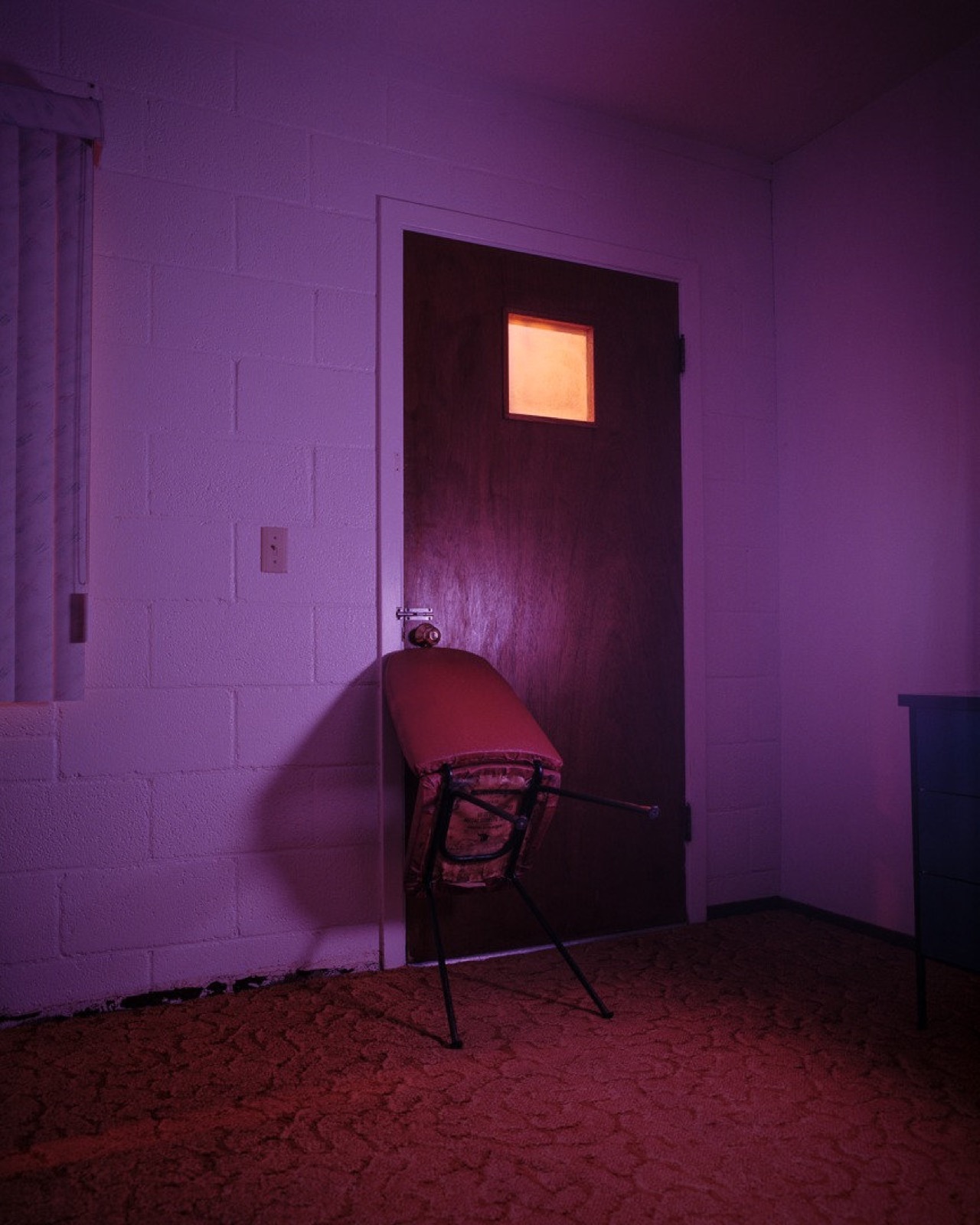

It’s the chair that gets me. Not propped to sit on, not pulled up to anything — folded shut and tipped against the door, a padded folding chair laid down like something put away mid-thought. The cover is the colour of a healing bruise, the legs scissored half-open across the carpet. You could spend a while wondering what it’s doing. Bracing the door? Waiting to be carried out? Or just dropped in the nearest spot in a room nobody intends to return to. I keep landing on the last, the most unsettling of the three.
The whole frame is bathed in that Hido purple, the long-exposure colour he found by driving around at dusk, shooting houses from the street until, here, he got inside one. White-painted cinderblock, red shag that looks warm and slightly damp underfoot, and in the door a small pane glowing amber — the one warm thing in the picture, lit from somewhere we’ll never see. That square does all the narrative work. It says someone, somewhere, recently. It’s the pilot light of the whole image.
Hido grew up in Ohio, and his interiors carry that Midwestern weight, the feeling of rooms emptied out between one life and the next. He doesn’t stage them so much as walk in and notice. What he noticed here is that a room can be completely still and still feel like the second after something happened — that a folded chair can stop being furniture and become a trace of whoever folded it. Printed on Dibond, the carpet becomes a field and you’re standing in the dim with it, waiting.