
Ramón Masats
Spanish, 1931–2024Puerto de Barcelona, 1953
Gelatin Silver Print.
Printed later.
Image: 24.5 x 37.5 cm / 9 5/8 x 14 3/4 in / Paper: 30 x 40 cm / 11 3/4 x 15 3/4 in
Image: 37.5 x 56.5 cm / 14 3/4 x 22 1/4 in / Paper: 50 x 60 cm / 19 3/4 x 23 5/8 in
Ramón Masats Estate dry stamp, signed and authenticated by Sonia Masats with title and edition number in pencil on label affixed to print verso
Edition of 15 — Image: 24.5 x 37.5 cm / 9 5/8 x 14 3/4 in / Paper: 30 x 40 cm / 11 3/4 x 15 3/4 in
Edition of 5 — Image: 37.5 x 56.5 cm / 14 3/4 x 22 1/4 in / Paper: 50 x 60 cm / 19 3/4 x 23 5/8 in
© The Artist
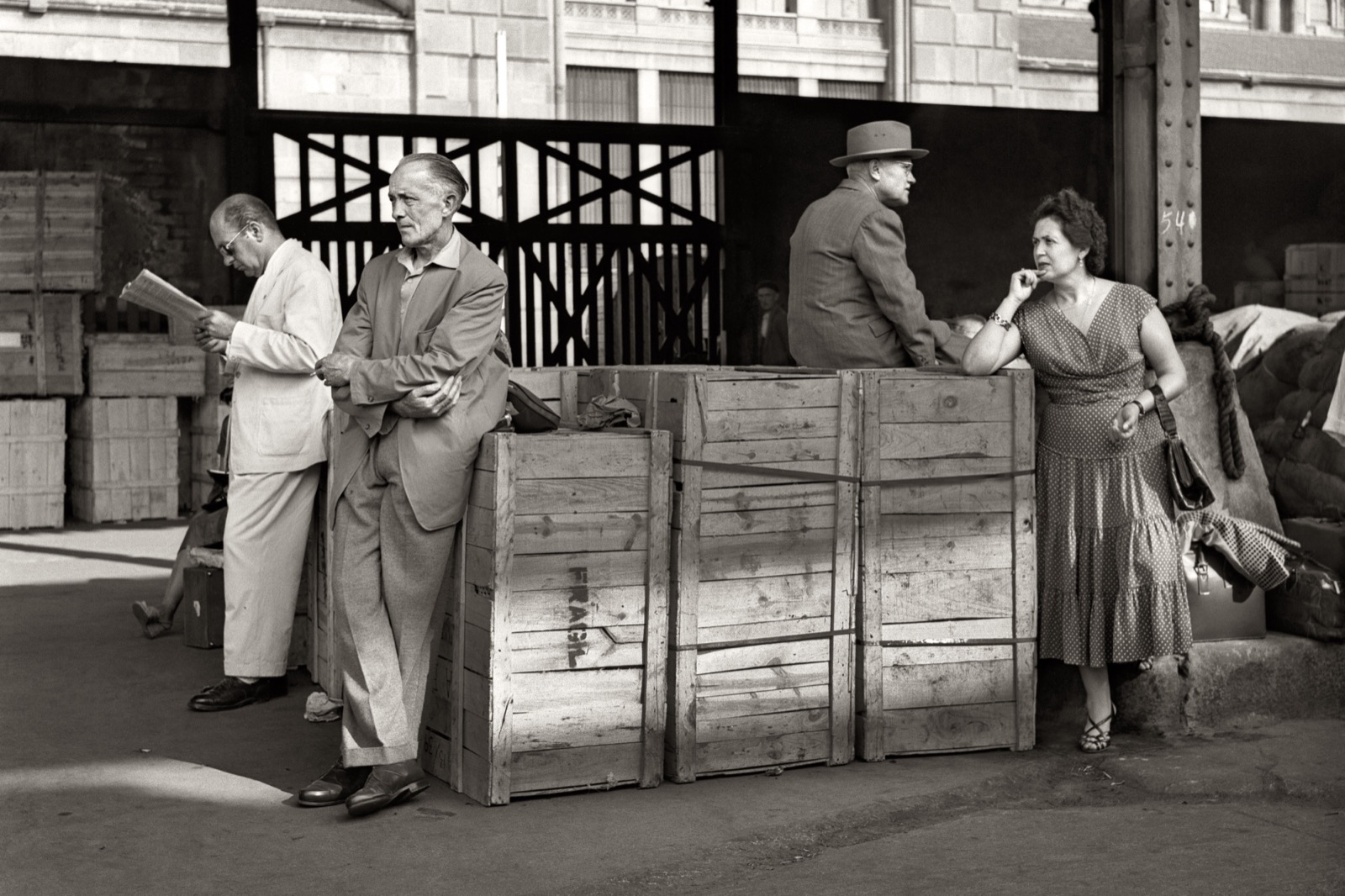
Two men in pale suits lean against a stack of crates stamped FRAGIL on a Barcelona dock, one lost in his newspaper, the other in his own thoughts, while a woman in a polka-dot dress turns sharply toward something beyond the frame. Ramon Masats made this picture at the port in 1953, and it shows why he stands among the founding masters of modern Spanish photography, an eye that found whole human comedies in the ordinary traffic of the street.
Masats came of age in the grey, guarded years of postwar Spain and helped lead the AFAL group, the circle of photographers who dragged Spanish image-making into the modern world, trading sentimental pictorialism for the candor and wit of the street. Here the rough wooden crates become a kind of improvised stage set, the four figures arranged by pure chance into a small drama of waiting and distraction, every glance pointing somewhere different so that the eye is sent travelling around the frame. The light is soft and even, the framing exact, the humanity unmistakable, and the word FRAGIL stencilled across the boxes reads almost like a caption for the people leaning on them. Further back a second pair, a man in a straw hat and a woman caught mid-gesture, doubles the comedy, two small conversations that will never quite meet.
One of the most decorated Spanish photographers of the twentieth century, honored with the Premio Nacional de Fotografia and major museum retrospectives, Masats left a body of work that defines the era. This dockside scene is vintage Masats, proof that the richest theatre is the one that assembles itself, unbidden, on an ordinary working afternoon.