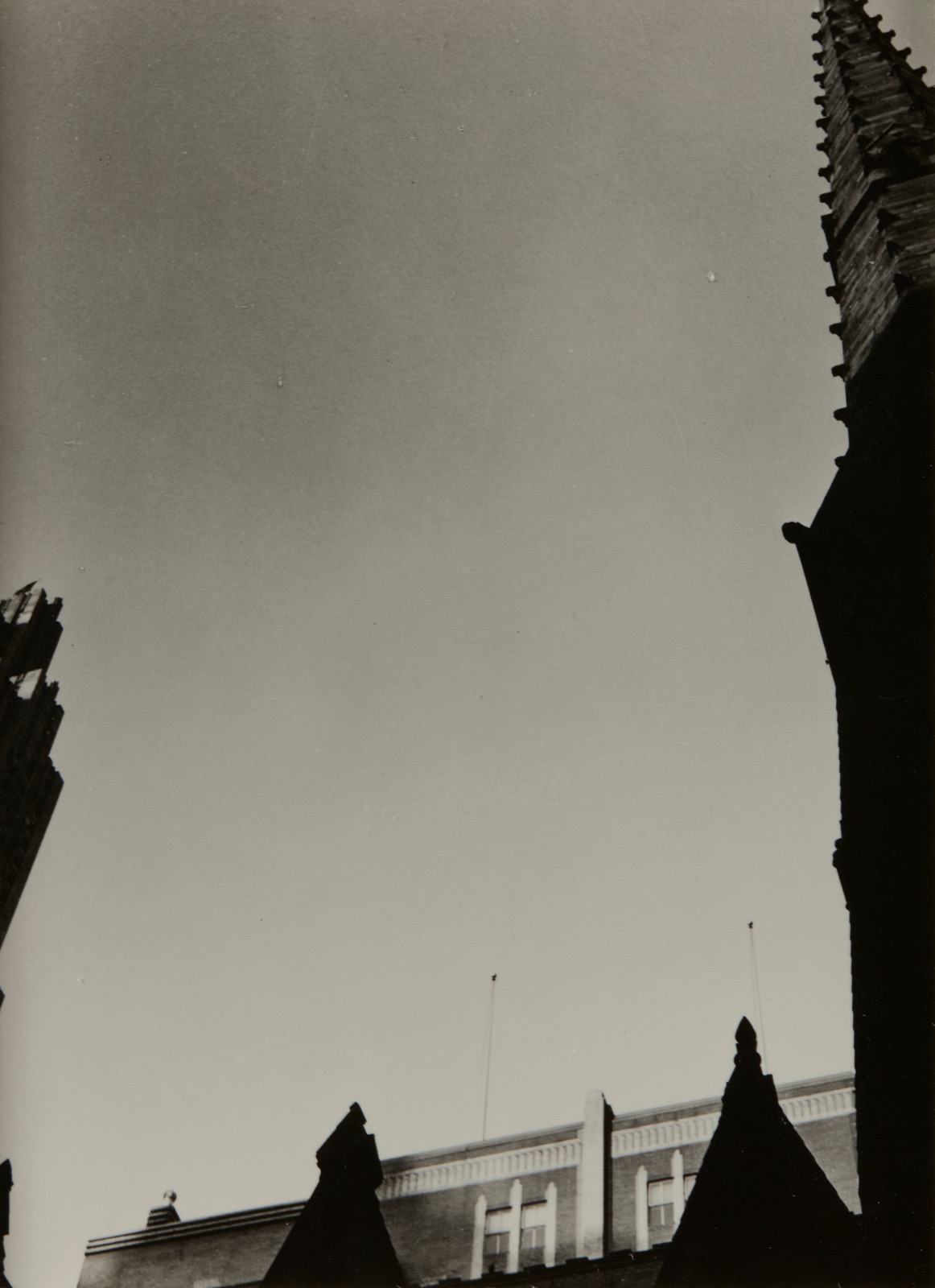
Almost nothing happens here, and that is the whole event. Three-quarters of the frame is given over to an empty pale sky, faintly mottled, a grey neither dawn nor dusk but simply duration. The camera has tilted its head back, as a child does, until the buildings lose their function and become pure edge. At the right a dark church mass climbs out of view, its buttress crowned with small blunt projections — gargoyles, finials, I cannot say which — bitten flat into silhouette. At the lower margin, gable peaks and a balustraded cornice line up like cut paper. This is the studium: the known iconography of the upward urban glance, Stieglitz's circle, the modernist habit of seeing the city as geometry.
But something stops me, and it is small, almost negligible. Against that wide neutral sky stand two thin flagpoles, bare, holding no flags. They rise from the building below and simply end, pointing at nothing. That emptiness is the punctum — it wounds where the architecture only instructs. The poles insist on an absence; whatever they were meant to fly is gone, and the photograph keeps the vacancy without comment. A tiny pale finial at far left answers them across the void, a punctuation mark in a sentence with no words.
The print carries this restraint in its body: deep velvet blacks, a sky all tone and no incident, silver holding light the way memory holds it — partial, hushed. Made by a photographer whose work the Met and Philadelphia keep, it gives, in asking so little, the strange persistence of a vintage object: a 1932 morning, still bare, still pointing upward at nothing.
Almost nothing happens here, and that is the whole event. Three-quarters of the frame is given over to an empty pale sky, faintly mottled, a grey neither dawn nor dusk but simply duration. The camera has tilted its head back, as a child does, until the buildings lose their function and become pure edge. At the right a dark church mass climbs out of view, its buttress crowned with small blunt projections — gargoyles, finials, I cannot say which — bitten flat into silhouette. At the lower margin, gable peaks and a balustraded cornice line up like cut paper. This is the studium: the known iconography of the upward urban glance, Stieglitz's circle, the modernist habit of seeing the city as geometry.
But something stops me, and it is small, almost negligible. Against that wide neutral sky stand two thin flagpoles, bare, holding no flags. They rise from the building below and simply end, pointing at nothing. That emptiness is the punctum — it wounds where the architecture only instructs. The poles insist on an absence; whatever they were meant to fly is gone, and the photograph keeps the vacancy without comment. A tiny pale finial at far left answers them across the void, a punctuation mark in a sentence with no words.
The print carries this restraint in its body: deep velvet blacks, a sky all tone and no incident, silver holding light the way memory holds it — partial, hushed. Made by a photographer whose work the Met and Philadelphia keep, it gives, in asking so little, the strange persistence of a vintage object: a 1932 morning, still bare, still pointing upward at nothing.