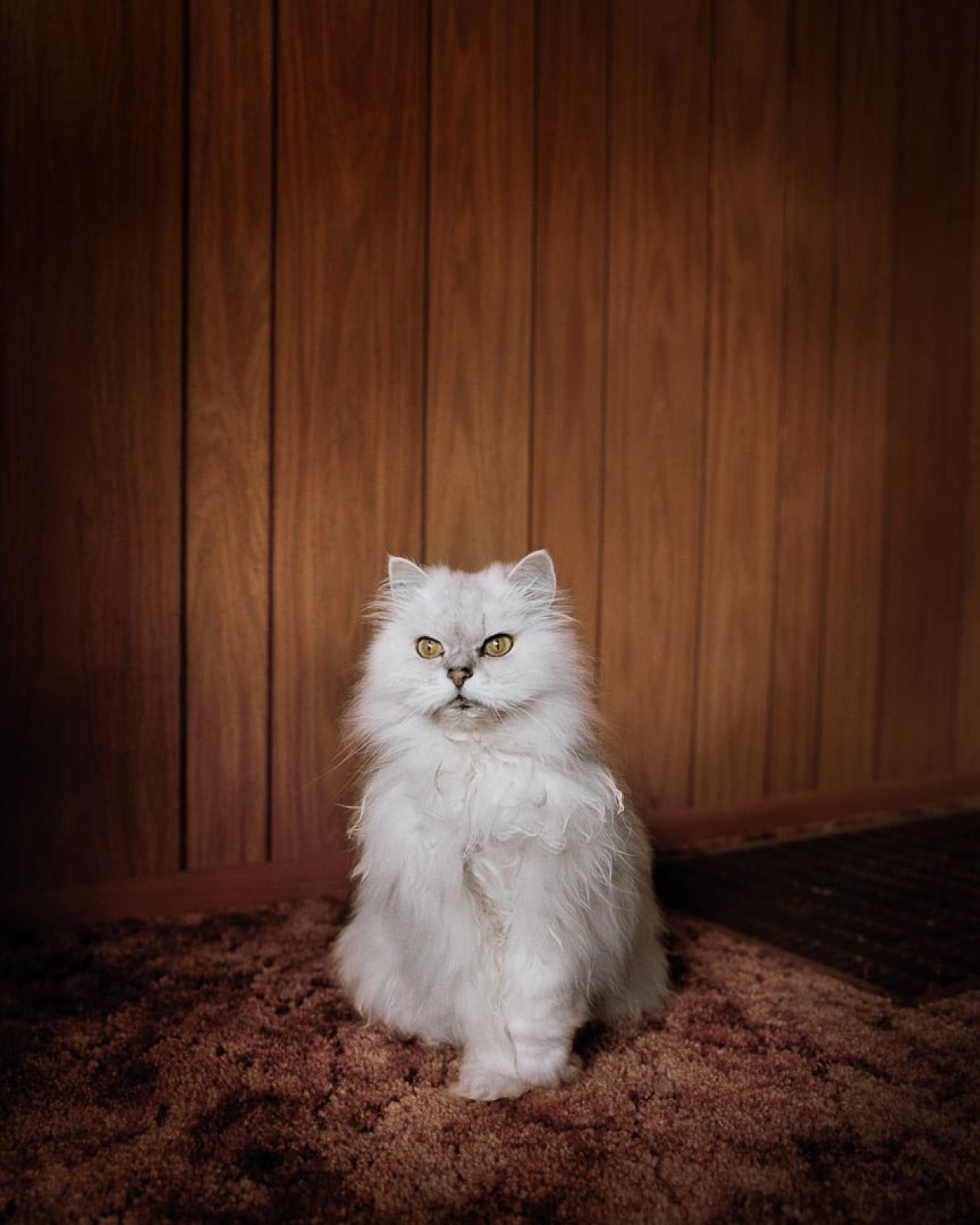
There is a particular kind of silence in this photograph, the silence that settles into a house long after the people in it have gone quiet. A white cat sits on worn shag carpet the colour of old earth, framed by wood panelling that glows amber under a single warm light. It looks straight at us, still and faintly wary, as though we have wandered into a room we were never meant to enter.
The image belongs to Excerpts from Silver Meadows, the series in which Todd Hido returns to the suburban Ohio of his childhood and reassembles it as a kind of fiction. Silver Meadows was the subdivision where he grew up, and here he treats memory not as record but as atmosphere, weaving exteriors, interiors, portraits and found fragments into one melancholic narrative. Nothing is strictly documentary. Everything feels remembered.
Hido has always been a photographer of interiors in the broadest sense, of the feeling of being inside something, a house, a mood, a past. The cat becomes an unlikely protagonist, a small witness to the domestic unease that runs beneath so much of his work. The panelling, the carpet, the low tungsten light all carry the weight of a particular decade and a particular kind of American home, the sort of place that is unremarkable until it is photographed, and then quietly strange.
What lingers is the tension between tenderness and disquiet. The animal is soft, almost luminous against the dark wood, yet the scene holds its breath. It is a picture about presence and absence at once, about how the rooms we grew up in keep looking back at us long after we have left them.

There is a particular kind of silence in this photograph, the silence that settles into a house long after the people in it have gone quiet. A white cat sits on worn shag carpet the colour of old earth, framed by wood panelling that glows amber under a single warm light. It looks straight at us, still and faintly wary, as though we have wandered into a room we were never meant to enter.
The image belongs to Excerpts from Silver Meadows, the series in which Todd Hido returns to the suburban Ohio of his childhood and reassembles it as a kind of fiction. Silver Meadows was the subdivision where he grew up, and here he treats memory not as record but as atmosphere, weaving exteriors, interiors, portraits and found fragments into one melancholic narrative. Nothing is strictly documentary. Everything feels remembered.
Hido has always been a photographer of interiors in the broadest sense, of the feeling of being inside something, a house, a mood, a past. The cat becomes an unlikely protagonist, a small witness to the domestic unease that runs beneath so much of his work. The panelling, the carpet, the low tungsten light all carry the weight of a particular decade and a particular kind of American home, the sort of place that is unremarkable until it is photographed, and then quietly strange.
What lingers is the tension between tenderness and disquiet. The animal is soft, almost luminous against the dark wood, yet the scene holds its breath. It is a picture about presence and absence at once, about how the rooms we grew up in keep looking back at us long after we have left them.