What good is a two-rail fence on an empty hill? It will not stop a dog, much less cattle; the country it divides looks identical on either side, winter grass gone the color of cider from one edge of the frame to the other. But photographically the fence is indispensable. It gives the hill a measure, the eye a route, and the light something to break against, and Hido, who found it, understood all three at a glance.
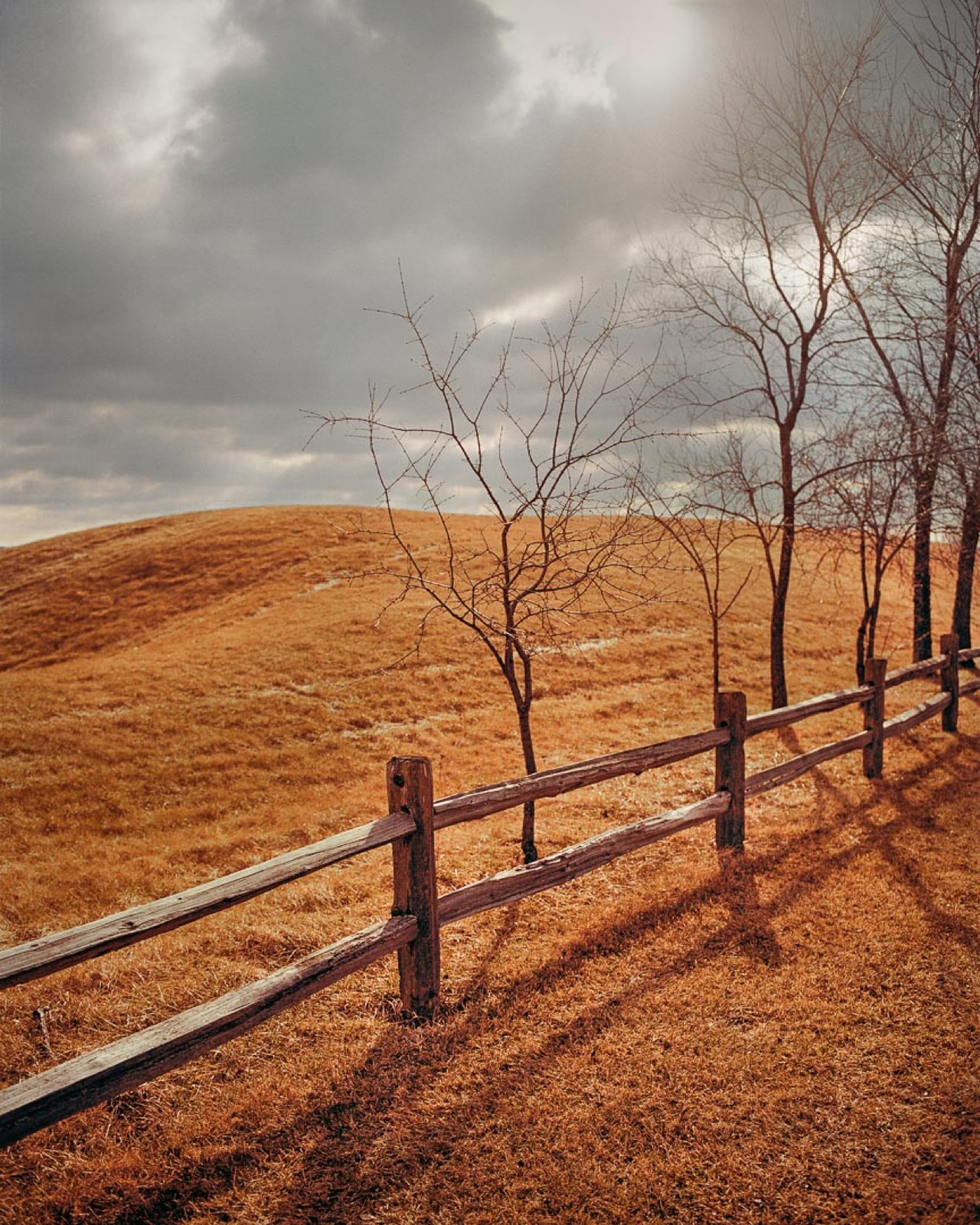
The organization is simple and exactly right. The rails run their diagonal from the near corner up toward the crest, posts weathered to the grey of old barns; late sun comes through where the cloud wears thin, backlighting a row of bare trees, and their shadows stride downhill across the grass like a second fence laid flat. A sapling holds the middle distance, thin as a nerve. Above, the sky keeps its pewter; below, the hill takes the light and turns copper. The picture divides its assets evenly: geometry to the bottom, weather to the top.
Those who know Hido for his lit windows and sodium fog may be surprised to find him out here in daylight, but the eye is the same one: born in Kent, Ohio, settled in the San Francisco Bay Area, alert to whatever the American ordinary will admit. SFMOMA, the Getty, and the Whitney hold his prints. This archival pigment print carries the scene’s warmth without exaggeration, cider and copper against pewter. A fence, some grass, a few bare trees, one hole in the clouds: modest holdings, handsomely invested.

What good is a two-rail fence on an empty hill? It will not stop a dog, much less cattle; the country it divides looks identical on either side, winter grass gone the color of cider from one edge of the frame to the other. But photographically the fence is indispensable. It gives the hill a measure, the eye a route, and the light something to break against, and Hido, who found it, understood all three at a glance.
The organization is simple and exactly right. The rails run their diagonal from the near corner up toward the crest, posts weathered to the grey of old barns; late sun comes through where the cloud wears thin, backlighting a row of bare trees, and their shadows stride downhill across the grass like a second fence laid flat. A sapling holds the middle distance, thin as a nerve. Above, the sky keeps its pewter; below, the hill takes the light and turns copper. The picture divides its assets evenly: geometry to the bottom, weather to the top.
Those who know Hido for his lit windows and sodium fog may be surprised to find him out here in daylight, but the eye is the same one: born in Kent, Ohio, settled in the San Francisco Bay Area, alert to whatever the American ordinary will admit. SFMOMA, the Getty, and the Whitney hold his prints. This archival pigment print carries the scene’s warmth without exaggeration, cider and copper against pewter. A fence, some grass, a few bare trees, one hole in the clouds: modest holdings, handsomely invested.