To photograph a landscape at dusk is to accept that beauty and dread arrive in the same violet light. Here the sky is bruised lavender fading to a thin band of rose along the far shore, and against it two bare pines stand like sentinels, their branches picked out in silhouette, a ragged palm frond crowding the left edge. A calm sheet of water lies beyond a fringe of dark grass. Nothing happens in the frame; everything in it is about to.
Melancholy is the natural mood of the camera, which turns every present into an elegy the instant the shutter falls. This Outskirts picture makes the claim almost literal. The trees are half-dead, the color faintly unreal, the hour the one at which the world briefly resembles a memory of itself rather than a fact. To look at such a scene is already to mourn something that has not yet been named, and perhaps never will be.
The archival pigment print on Dibond deepens the dusk without hardening it, so the purple keeps its atmospheric softness rather than curdling into effect. Hido works the American edge-land — the scrubby, forgotten margins where the suburb gives out to nowhere — and finds in them a genuine moral seriousness. The photograph refuses to console. It states, very quietly, that loveliness and loss are the same fact regarded from two sides, and that the camera cannot tell them apart.
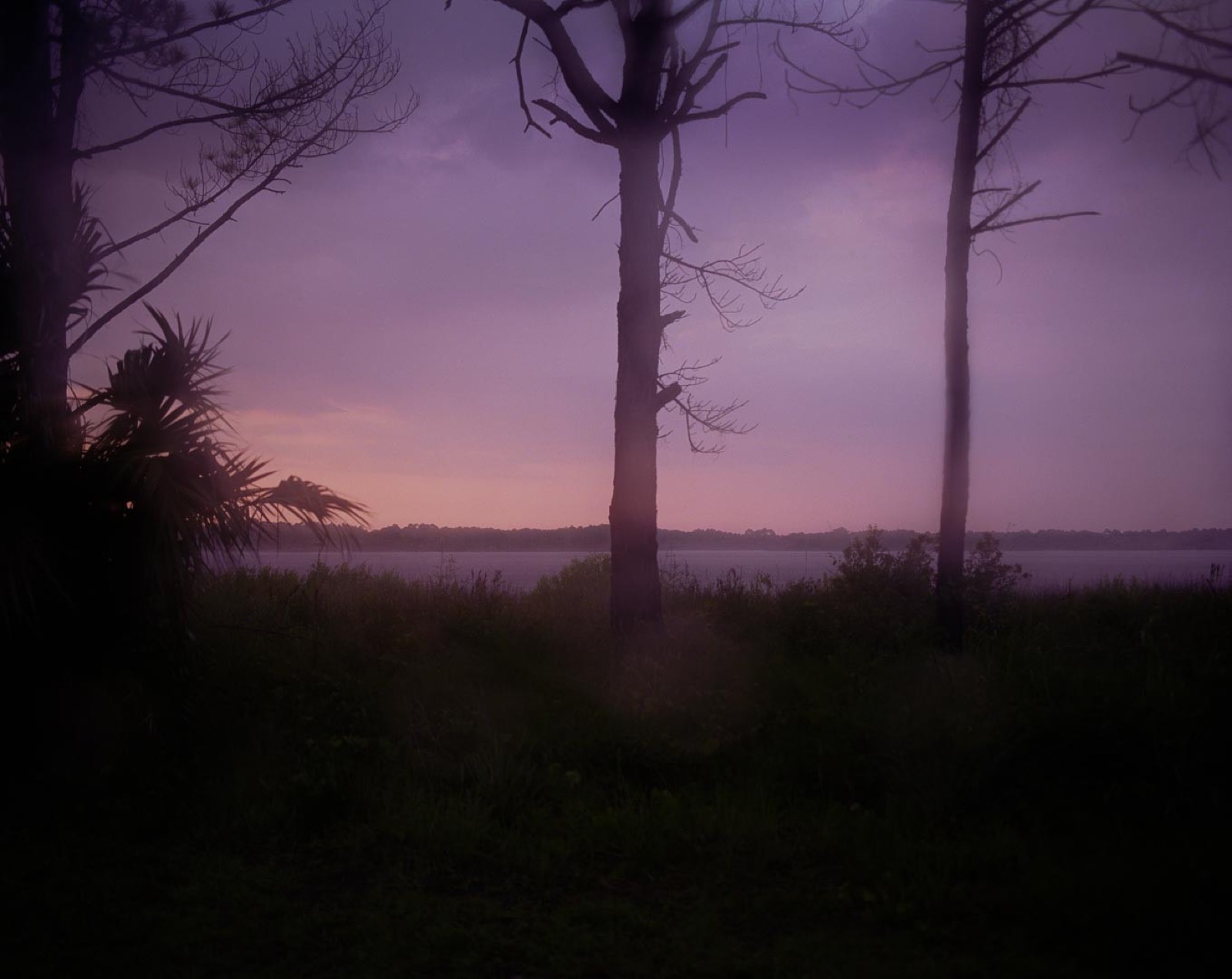

To photograph a landscape at dusk is to accept that beauty and dread arrive in the same violet light. Here the sky is bruised lavender fading to a thin band of rose along the far shore, and against it two bare pines stand like sentinels, their branches picked out in silhouette, a ragged palm frond crowding the left edge. A calm sheet of water lies beyond a fringe of dark grass. Nothing happens in the frame; everything in it is about to.
Melancholy is the natural mood of the camera, which turns every present into an elegy the instant the shutter falls. This Outskirts picture makes the claim almost literal. The trees are half-dead, the color faintly unreal, the hour the one at which the world briefly resembles a memory of itself rather than a fact. To look at such a scene is already to mourn something that has not yet been named, and perhaps never will be.
The archival pigment print on Dibond deepens the dusk without hardening it, so the purple keeps its atmospheric softness rather than curdling into effect. Hido works the American edge-land — the scrubby, forgotten margins where the suburb gives out to nowhere — and finds in them a genuine moral seriousness. The photograph refuses to console. It states, very quietly, that loveliness and loss are the same fact regarded from two sides, and that the camera cannot tell them apart.