The white-T-shirted man has just said something, or is about to; his mouth is parted, one hand lifted from his coffee mug as if to shape a word still in the air. Next to him, arms folded on the counter, the younger man in the pale polo lets the remark pass, his gaze sliding off to the side. Between them the whole apparatus of a diner morning waits: sugar shakers, a ketchup bottle, a napkin caddy, two empty bowls, and nothing happens, which is exactly what the photograph is about.
This is photography working against its own reputation for the decisive moment. Nothing here is decisive; it is the loose, undramatic middle of an ordinary exchange, the kind of interval that only a camera can rescue from oblivion because nobody, including the two men, would think to remember it. Winter titles them Popeye and Pluto, cartoon nicknames that tell us these are regulars, known by the counter that feeds them daily. The names do the intimacy the faces withhold.
Formally the picture is almost austere: a high white wall, a coat rack of empty hooks, an open doorway leading to more white, the dark laminate counter running a slow diagonal to the lower edge. Winter, an American with a documentarian’s patience, gives it all to us in even gelatin silver, refusing to flatter or to caricature. What we are left holding is duration itself — two men, a countertop, the ordinary time that photographs almost never bother to keep. He kept it, and it turns out to be enough.
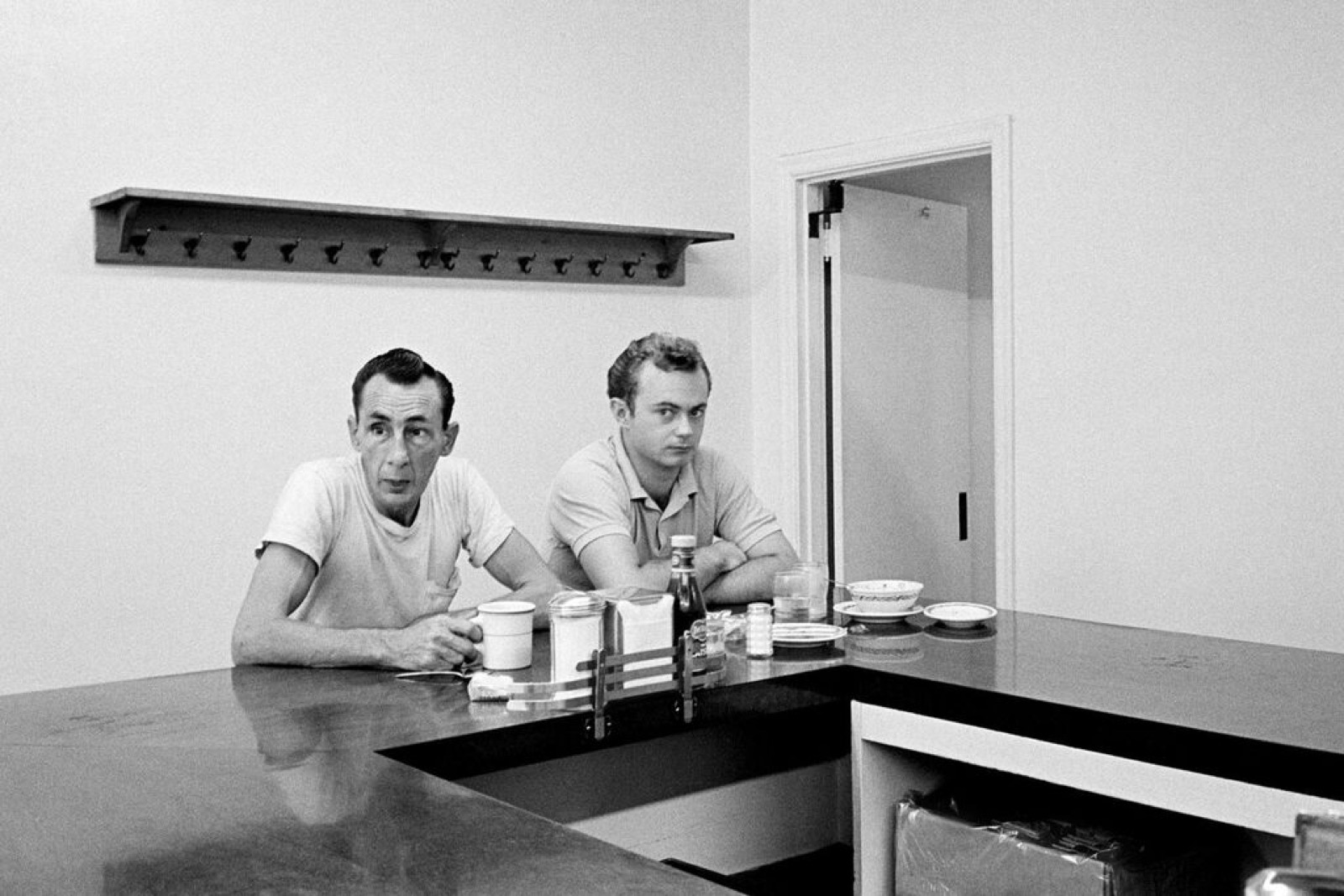

The white-T-shirted man has just said something, or is about to; his mouth is parted, one hand lifted from his coffee mug as if to shape a word still in the air. Next to him, arms folded on the counter, the younger man in the pale polo lets the remark pass, his gaze sliding off to the side. Between them the whole apparatus of a diner morning waits: sugar shakers, a ketchup bottle, a napkin caddy, two empty bowls, and nothing happens, which is exactly what the photograph is about.
This is photography working against its own reputation for the decisive moment. Nothing here is decisive; it is the loose, undramatic middle of an ordinary exchange, the kind of interval that only a camera can rescue from oblivion because nobody, including the two men, would think to remember it. Winter titles them Popeye and Pluto, cartoon nicknames that tell us these are regulars, known by the counter that feeds them daily. The names do the intimacy the faces withhold.
Formally the picture is almost austere: a high white wall, a coat rack of empty hooks, an open doorway leading to more white, the dark laminate counter running a slow diagonal to the lower edge. Winter, an American with a documentarian’s patience, gives it all to us in even gelatin silver, refusing to flatter or to caricature. What we are left holding is duration itself — two men, a countertop, the ordinary time that photographs almost never bother to keep. He kept it, and it turns out to be enough.