Someone has already left. That is the event the photograph records — not a departure caught in the act, but its aftermath, the room some hours or years after the last person carried out what they wanted and let the rest fall where it stood. Two mattresses lean against the far wall, their floral ticking gone grey with dust; an empty dresser, drawerless, opens its dark mouth at the left; a broom rests at an angle in the doorway, abandoned mid-sweep. The history here is small and domestic and therefore enormous: a household undone, a Mississippi house emptied and left to its own shadows.
From the inner doorway a single blade of light lies across the floor, the only brightness in a room otherwise composed of deep, granular black. The eye obeys it, follows it inward toward whatever is beyond — a hallway, a stair, another vacancy. And then there is the thing on the right wall that I cannot stop looking at: a dark stain spread across the wallpaper, shaped almost like a figure, like the after-image of someone who once stood there and pressed against the plaster. It is only damp, only mould. But it reads as a presence, and the room arranges itself around it.
Lange photographs not the people of Highway 61 but the rooms they have surrendered, and here the surrender is total. The mattresses are the proof: a bed is where a life is most private, most asleep, and these stand against the wall like things waiting to be hauled off. What the picture keeps is the texture of leaving — dust, grain, a broom set down and never lifted again. It does not mourn. It simply stays in the room after everyone has gone, and lets me stay there too, longer than I meant to.
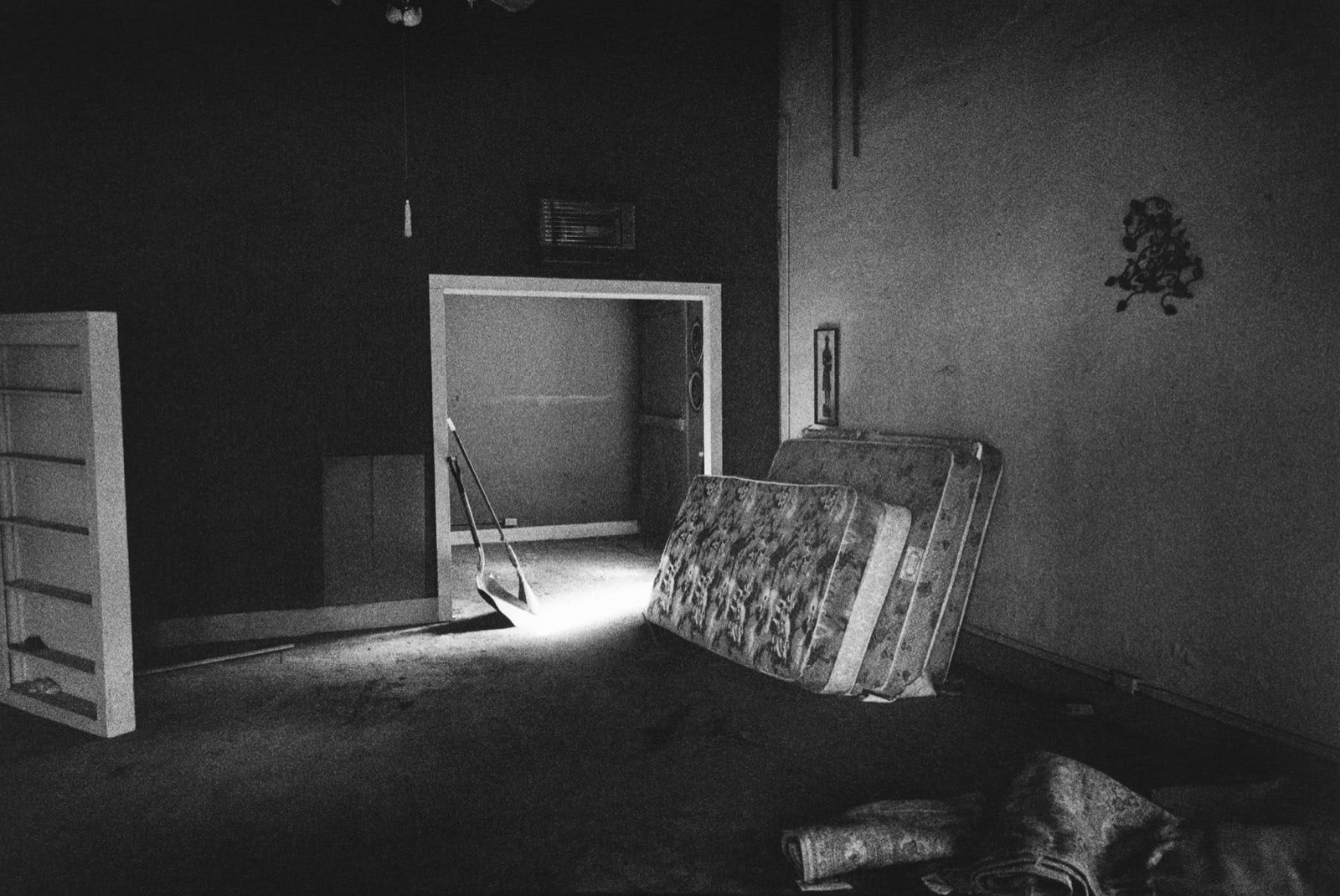

Someone has already left. That is the event the photograph records — not a departure caught in the act, but its aftermath, the room some hours or years after the last person carried out what they wanted and let the rest fall where it stood. Two mattresses lean against the far wall, their floral ticking gone grey with dust; an empty dresser, drawerless, opens its dark mouth at the left; a broom rests at an angle in the doorway, abandoned mid-sweep. The history here is small and domestic and therefore enormous: a household undone, a Mississippi house emptied and left to its own shadows.
From the inner doorway a single blade of light lies across the floor, the only brightness in a room otherwise composed of deep, granular black. The eye obeys it, follows it inward toward whatever is beyond — a hallway, a stair, another vacancy. And then there is the thing on the right wall that I cannot stop looking at: a dark stain spread across the wallpaper, shaped almost like a figure, like the after-image of someone who once stood there and pressed against the plaster. It is only damp, only mould. But it reads as a presence, and the room arranges itself around it.
Lange photographs not the people of Highway 61 but the rooms they have surrendered, and here the surrender is total. The mattresses are the proof: a bed is where a life is most private, most asleep, and these stand against the wall like things waiting to be hauled off. What the picture keeps is the texture of leaving — dust, grain, a broom set down and never lifted again. It does not mourn. It simply stays in the room after everyone has gone, and lets me stay there too, longer than I meant to.