Two windows are lit, and only two. On the gable end of a white clapboard house, a pair of ground-floor sashes burn a thick, sodium amber, while every other opening — the upstairs window under the peak, the dark flank receding to the right — stays shut against the night. The discrepancy is the whole picture. Someone is awake in one room of an otherwise sleeping house, and we are outside in the cold, across a plowed street, looking.
What makes the frame hold is less the glow than the tree. A leafless branch throws its shadow flat across the siding, an inked diagram laid over the clapboard, so the house wears the negative of the very tree that stands beside it. This is the long exposure doing its quiet work: the artificial light from inside and whatever ambient blue hangs in the sky are gathered over time into a single still surface, neither quite day nor quite documentary. The deep cobalt overhead is not how the eye sees a winter sky; it is how the film records one, patiently. Hido lets the medium describe the scene rather than transcribe it.
The picture comes from House Hunting, the series Todd Hido (b. Kent, Ohio, 1968) built through the late 1990s by driving suburban streets after dark, and it shows why that body of work settled into the canon of American color photography. Nothing happens, narratively, which is the point — stillness here is a condition, not an absence. The foreground is given over to the churned bank of plowed snow, a grey nothing that keeps us at a fixed distance from the warmth we can see but not enter. The house offers a story and withholds it in the same gesture. We are left with the literal facts: snow, siding, two lamps, one branch — and the strong sense that the facts are not the subject.
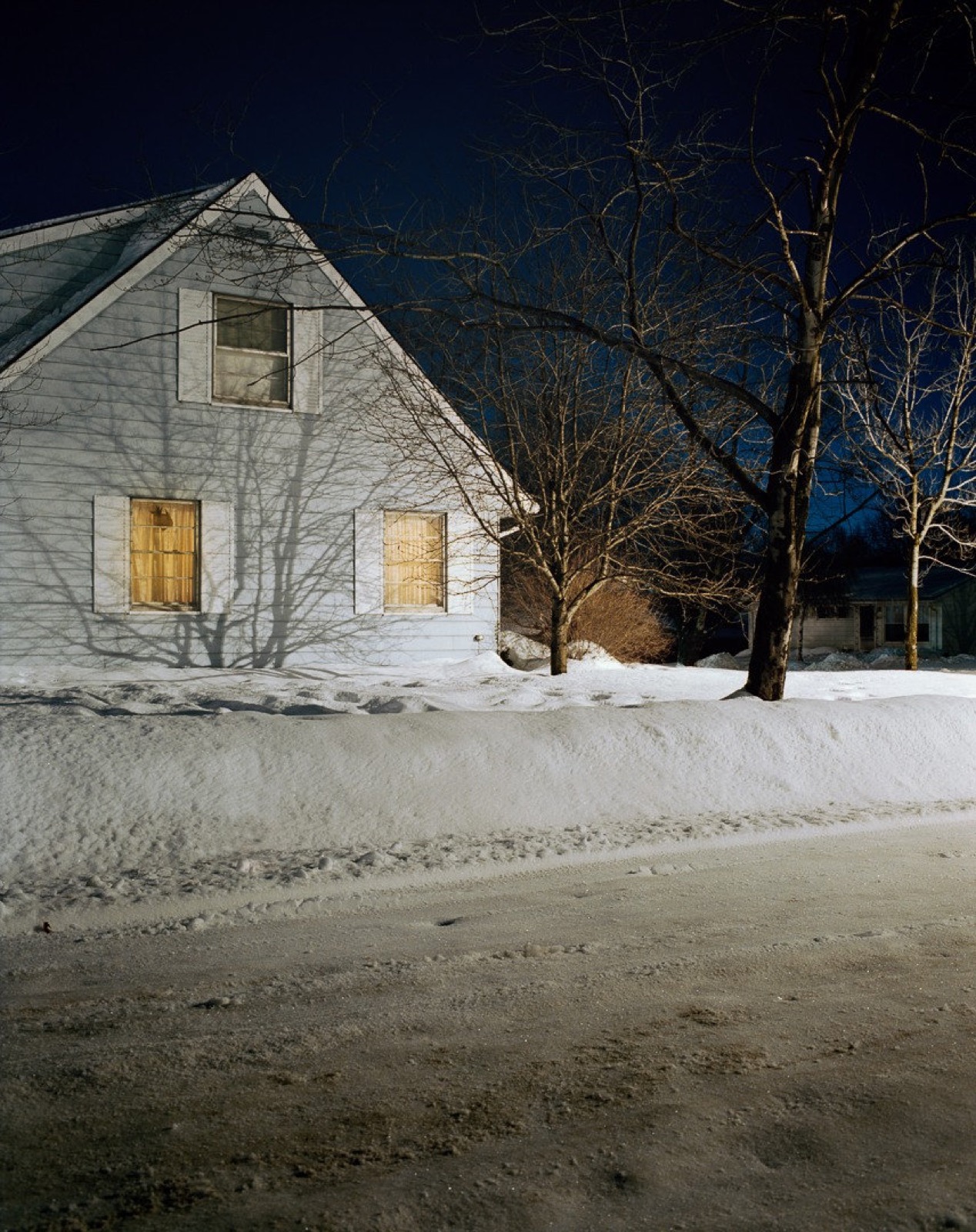

Two windows are lit, and only two. On the gable end of a white clapboard house, a pair of ground-floor sashes burn a thick, sodium amber, while every other opening — the upstairs window under the peak, the dark flank receding to the right — stays shut against the night. The discrepancy is the whole picture. Someone is awake in one room of an otherwise sleeping house, and we are outside in the cold, across a plowed street, looking.
What makes the frame hold is less the glow than the tree. A leafless branch throws its shadow flat across the siding, an inked diagram laid over the clapboard, so the house wears the negative of the very tree that stands beside it. This is the long exposure doing its quiet work: the artificial light from inside and whatever ambient blue hangs in the sky are gathered over time into a single still surface, neither quite day nor quite documentary. The deep cobalt overhead is not how the eye sees a winter sky; it is how the film records one, patiently. Hido lets the medium describe the scene rather than transcribe it.
The picture comes from House Hunting, the series Todd Hido (b. Kent, Ohio, 1968) built through the late 1990s by driving suburban streets after dark, and it shows why that body of work settled into the canon of American color photography. Nothing happens, narratively, which is the point — stillness here is a condition, not an absence. The foreground is given over to the churned bank of plowed snow, a grey nothing that keeps us at a fixed distance from the warmth we can see but not enter. The house offers a story and withholds it in the same gesture. We are left with the literal facts: snow, siding, two lamps, one branch — and the strong sense that the facts are not the subject.