There's a line that runs from the great desert fashion stories — Avedon's Versailles couture dropped into nowhere, Newton stranding his women in hostile glamour — straight into this frame, and Yeste knows exactly where he's standing in it. Two figures in black on the ochre crust of Tenerife's volcanic floor, the blue sky scoured clean behind them, and not a prop or a logo in sight to soften the encounter.
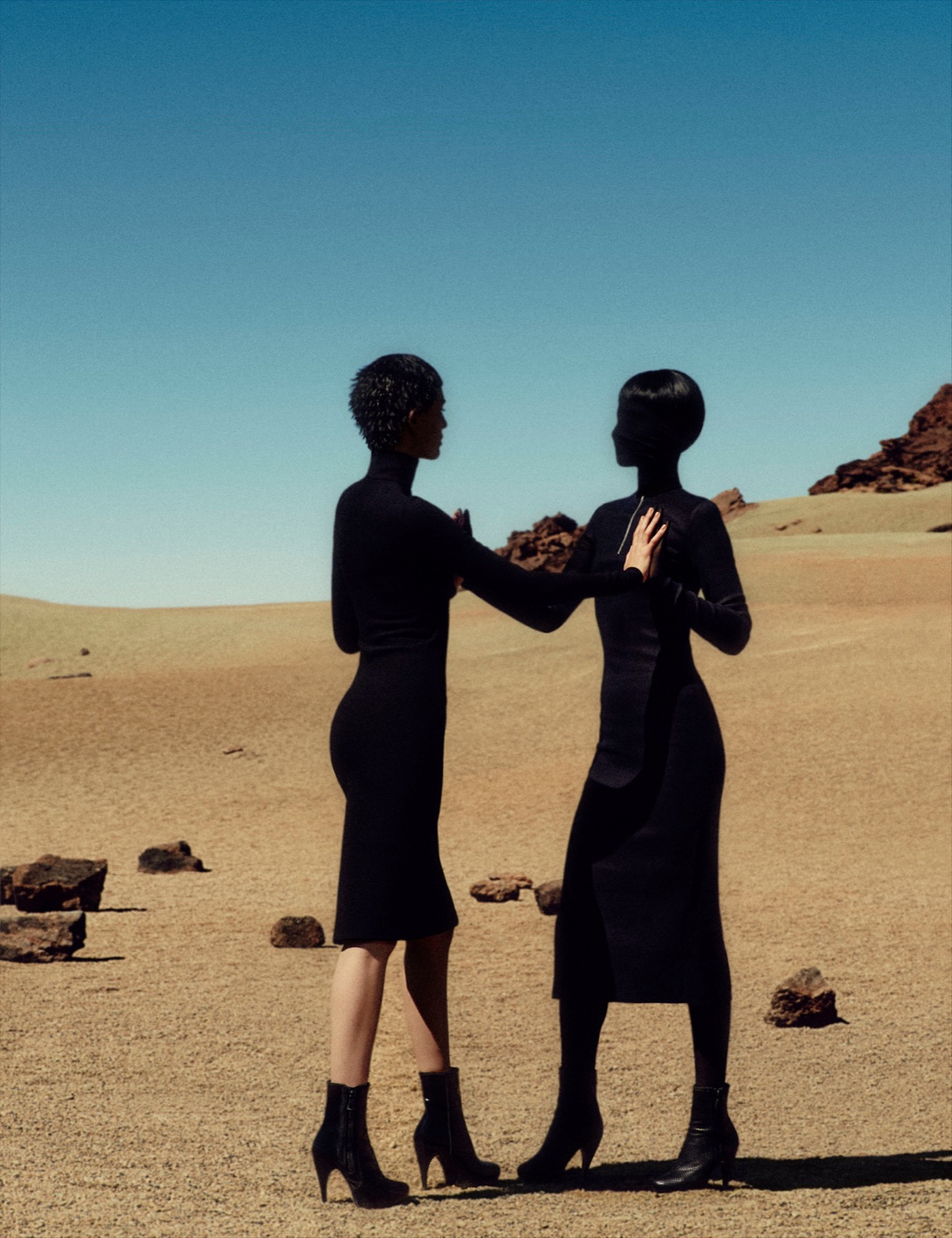
What he does that the older masters didn't is let the heat do the editing. One woman faces us in a ribbed knit that ends at the knee, spiky cropped hair catching a hard rim of light; her boots plant her like punctuation. The other turns away, longer dress to mid-calf, her face thrown so deep into shadow it nearly dissolves into the cloth — and it's her hand, flat against the first woman's chest, that the whole picture hangs on. Push or hold? The gesture refuses to decide, and that refusal is the charge.
This is high-style image-making with the gloss burned off. The clothes read as silhouette, two black notes against scorched sand and a scatter of dark lava rock, the kind of reductive staging Yeste has made his signature across his Tenerife campaigns and his Numéro and editorial work. Glamour here isn't sold to you; it's left out in the sun until only the essential — two bodies, one touch, the long shadows of late light — remains. The duality of the title isn't twins. It's the standoff between intimacy and threat that a good fashion picture has always smuggled in, dressed beautifully and meaning more.
There's a line that runs from the great desert fashion stories — Avedon's Versailles couture dropped into nowhere, Newton stranding his women in hostile glamour — straight into this frame, and Yeste knows exactly where he's standing in it. Two figures in black on the ochre crust of Tenerife's volcanic floor, the blue sky scoured clean behind them, and not a prop or a logo in sight to soften the encounter.
What he does that the older masters didn't is let the heat do the editing. One woman faces us in a ribbed knit that ends at the knee, spiky cropped hair catching a hard rim of light; her boots plant her like punctuation. The other turns away, longer dress to mid-calf, her face thrown so deep into shadow it nearly dissolves into the cloth — and it's her hand, flat against the first woman's chest, that the whole picture hangs on. Push or hold? The gesture refuses to decide, and that refusal is the charge.
This is high-style image-making with the gloss burned off. The clothes read as silhouette, two black notes against scorched sand and a scatter of dark lava rock, the kind of reductive staging Yeste has made his signature across his Tenerife campaigns and his Numéro and editorial work. Glamour here isn't sold to you; it's left out in the sun until only the essential — two bodies, one touch, the long shadows of late light — remains. The duality of the title isn't twins. It's the standoff between intimacy and threat that a good fashion picture has always smuggled in, dressed beautifully and meaning more.