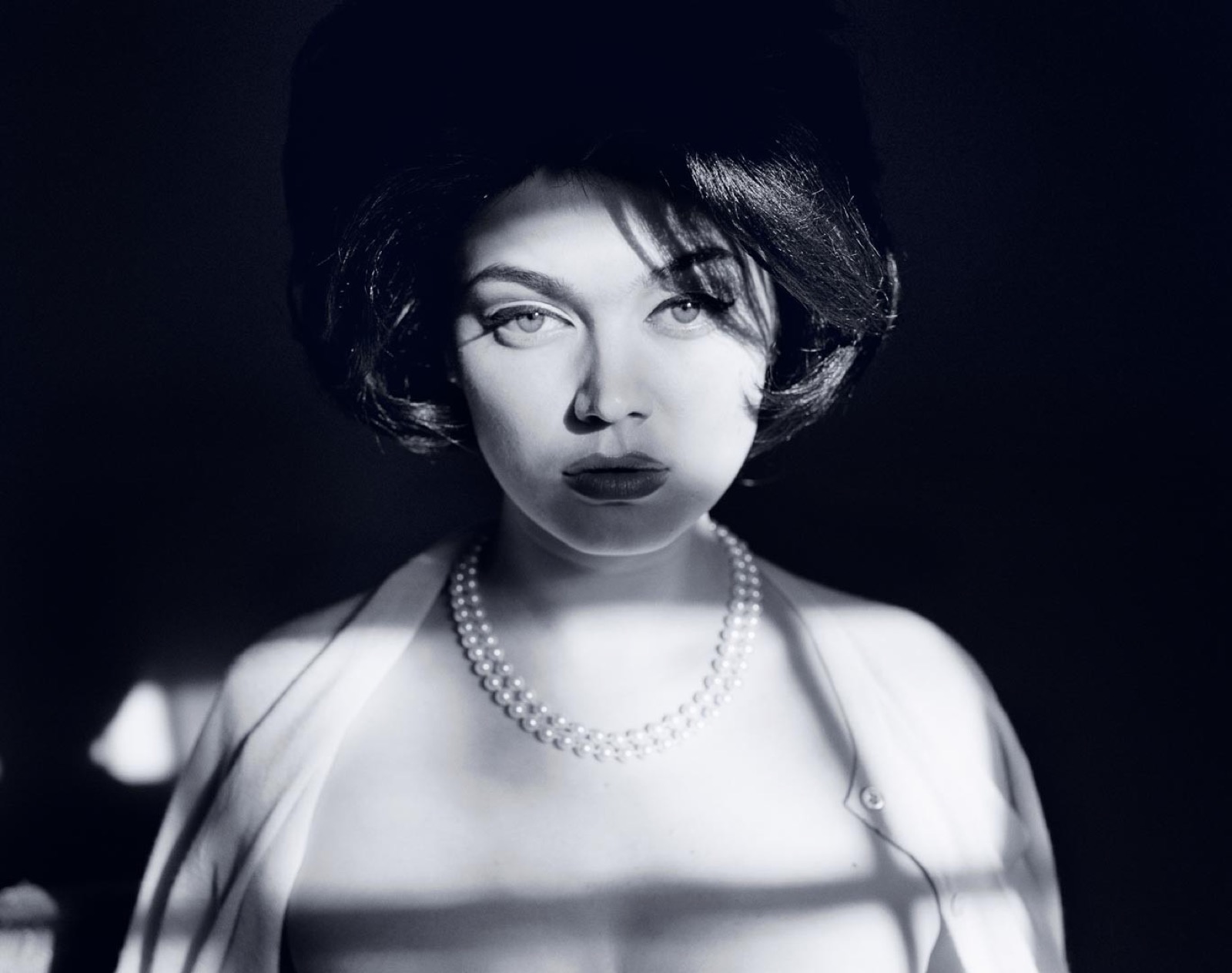
Bands of light fall across the figure in even stripes, the signature of a Venetian blind and, just as surely, the signature of a whole cinema. The young woman with the teased dark hair and the double string of pearls has been lit and styled to summon the early 1960s: the noir heroine, the studio glamour portrait, an image of an image. Hido builds the picture out of borrowed pictures.
This is photography citing its own archive. The bouffant, the pearls, the half-open blouse, the barred light across bare skin, each is a quotation, a costume assembled from a century of magazines and film stills and snapshots of women dressed to be looked at. The portrait does not so much document a person as reconstruct a type, and let us feel the strangeness of a type made flesh again.
Held as an archival pigment print on aluminium, the object is emphatically present, glossy, contemporary, exact, while everything it depicts reaches backward into the past tense. The direct gaze complicates the borrowing: she looks out from inside the costume, unconvinced by it, and the picture turns on that friction between the historical mask and the actual eyes behind it. What we possess is not a woman but a beautifully made specimen of how the camera has always dressed her.
Bands of light fall across the figure in even stripes, the signature of a Venetian blind and, just as surely, the signature of a whole cinema. The young woman with the teased dark hair and the double string of pearls has been lit and styled to summon the early 1960s: the noir heroine, the studio glamour portrait, an image of an image. Hido builds the picture out of borrowed pictures.
This is photography citing its own archive. The bouffant, the pearls, the half-open blouse, the barred light across bare skin, each is a quotation, a costume assembled from a century of magazines and film stills and snapshots of women dressed to be looked at. The portrait does not so much document a person as reconstruct a type, and let us feel the strangeness of a type made flesh again.
Held as an archival pigment print on aluminium, the object is emphatically present, glossy, contemporary, exact, while everything it depicts reaches backward into the past tense. The direct gaze complicates the borrowing: she looks out from inside the costume, unconvinced by it, and the picture turns on that friction between the historical mask and the actual eyes behind it. What we possess is not a woman but a beautifully made specimen of how the camera has always dressed her.