The day is down to its last band of light, a cold silver-blue strip pinned along the horizon beneath a sky thickening to plum-brown dark. Against that strip everything else is silhouette: a telephone pole and its sagging wires, a bare tree, the low roofline of a brick building. Below, the rutted lane is all mud and standing water, and the puddles do what water has always done at dusk: they carry the last of the sky down into the ground.
The picture is built almost entirely from tone. Its forms are soft, seen as if through breathed-on glass, so the pole’s crossarm and wires read like drypoint lines scratched over a wash of grey-blue. One warm note survives: an ember of amber at the tree line, the sun’s last argument. A dark car waits by the building, but nothing here is anecdotal; the subject is the extinguishing itself, the slow exchange by which night takes custody of an ordinary lane. Photography has wagered on such skies since its beginnings; few wagers pay like this one.
The photographer, born in Kent, Ohio, and long based in the San Francisco Bay Area, has made dusk and poor weather his working hours, numbering his pictures rather than titling them; SFMOMA, the Getty and the Whitney hold his prints. In the archival pigment print the values keep their order: the plum dark never collapses into black, the silver band holds its chill, the small amber ember stays lit. It is a print to live with at exactly this hour, when the wall and the window briefly agree.
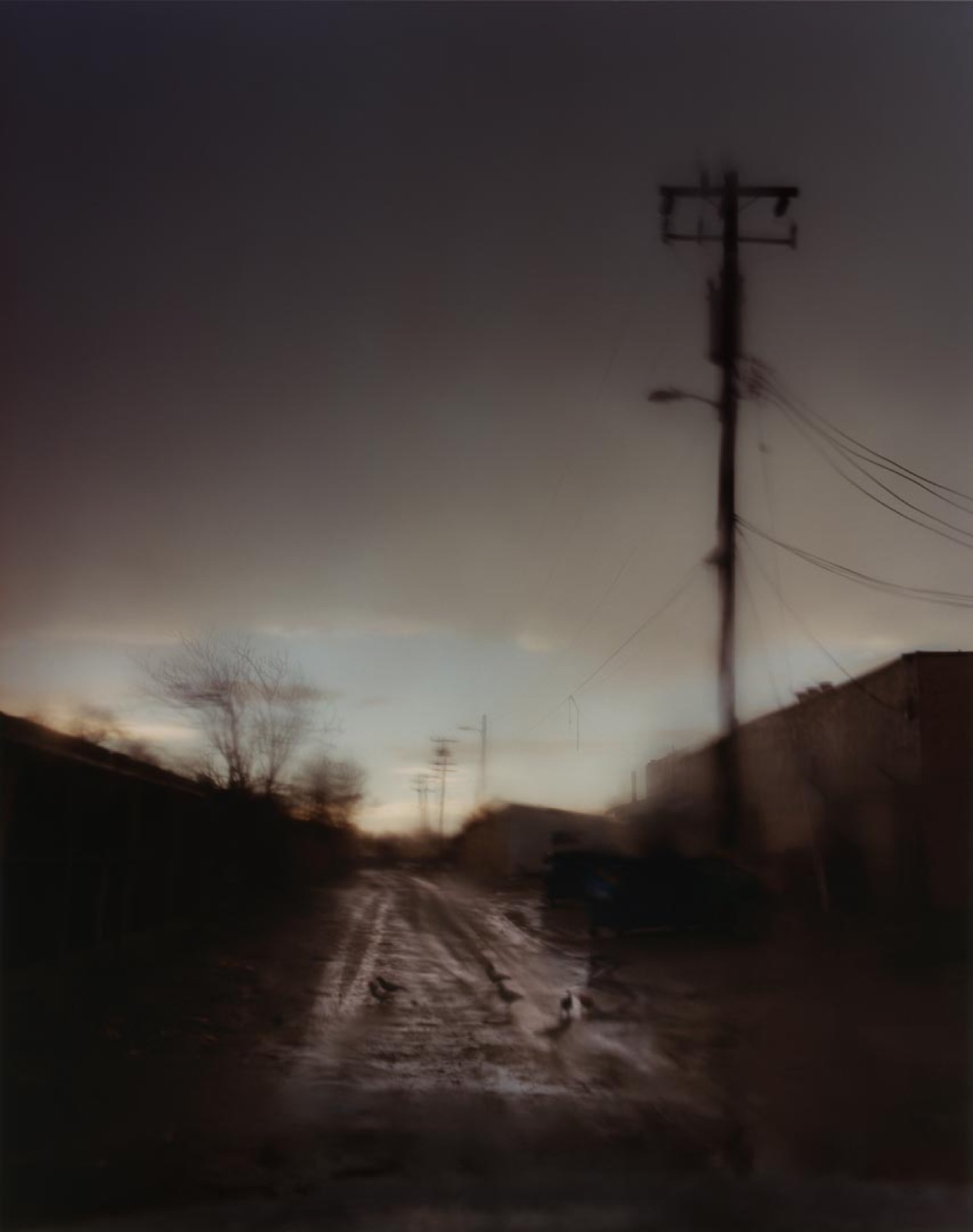

The day is down to its last band of light, a cold silver-blue strip pinned along the horizon beneath a sky thickening to plum-brown dark. Against that strip everything else is silhouette: a telephone pole and its sagging wires, a bare tree, the low roofline of a brick building. Below, the rutted lane is all mud and standing water, and the puddles do what water has always done at dusk: they carry the last of the sky down into the ground.
The picture is built almost entirely from tone. Its forms are soft, seen as if through breathed-on glass, so the pole’s crossarm and wires read like drypoint lines scratched over a wash of grey-blue. One warm note survives: an ember of amber at the tree line, the sun’s last argument. A dark car waits by the building, but nothing here is anecdotal; the subject is the extinguishing itself, the slow exchange by which night takes custody of an ordinary lane. Photography has wagered on such skies since its beginnings; few wagers pay like this one.
The photographer, born in Kent, Ohio, and long based in the San Francisco Bay Area, has made dusk and poor weather his working hours, numbering his pictures rather than titling them; SFMOMA, the Getty and the Whitney hold his prints. In the archival pigment print the values keep their order: the plum dark never collapses into black, the silver band holds its chill, the small amber ember stays lit. It is a print to live with at exactly this hour, when the wall and the window briefly agree.