The leaning telephone pole is one of American photography’s oldest supporting actors. It stood at the edge of the frame for the Depression-era documentarians, marched beside Robert Frank’s highways, and lined up obediently for the New Topographics. Here it takes the lead at last: canted like a mast in heavy weather, crossarm strung with wires that sag away toward a whole cast of smaller poles retreating down the road.
But the picture’s real intelligence is in how it was seen. The horizon tips, the foreground grasses smear, and a dark bar of car interior closes the top of the frame: this is the world from the driver’s seat, photographed rather than merely passed. Hido, who makes many of his landscapes through the window of his car, lets accident in on purpose. The blur across the fence line isn’t a flaw; it’s the signature of transit, proof that a scene this still was seen at speed. Gold hillside, green-grey storm: here the color does the emotional work that captions once did.
That sensibility, houses at night, fogged roads, weather that behaves like memory, has placed his prints in SFMOMA, the Getty and the Whitney, and made his numbered, untitled pictures instantly recognizable without a single name attached. As an archival pigment print, this one holds both registers at once: the storm’s low greens stay dense while the dry grass keeps its ignition-point orange. A century after the pole first wandered into photographs, it finally gets its full-length portrait, tilted, wired to everything, going nowhere.
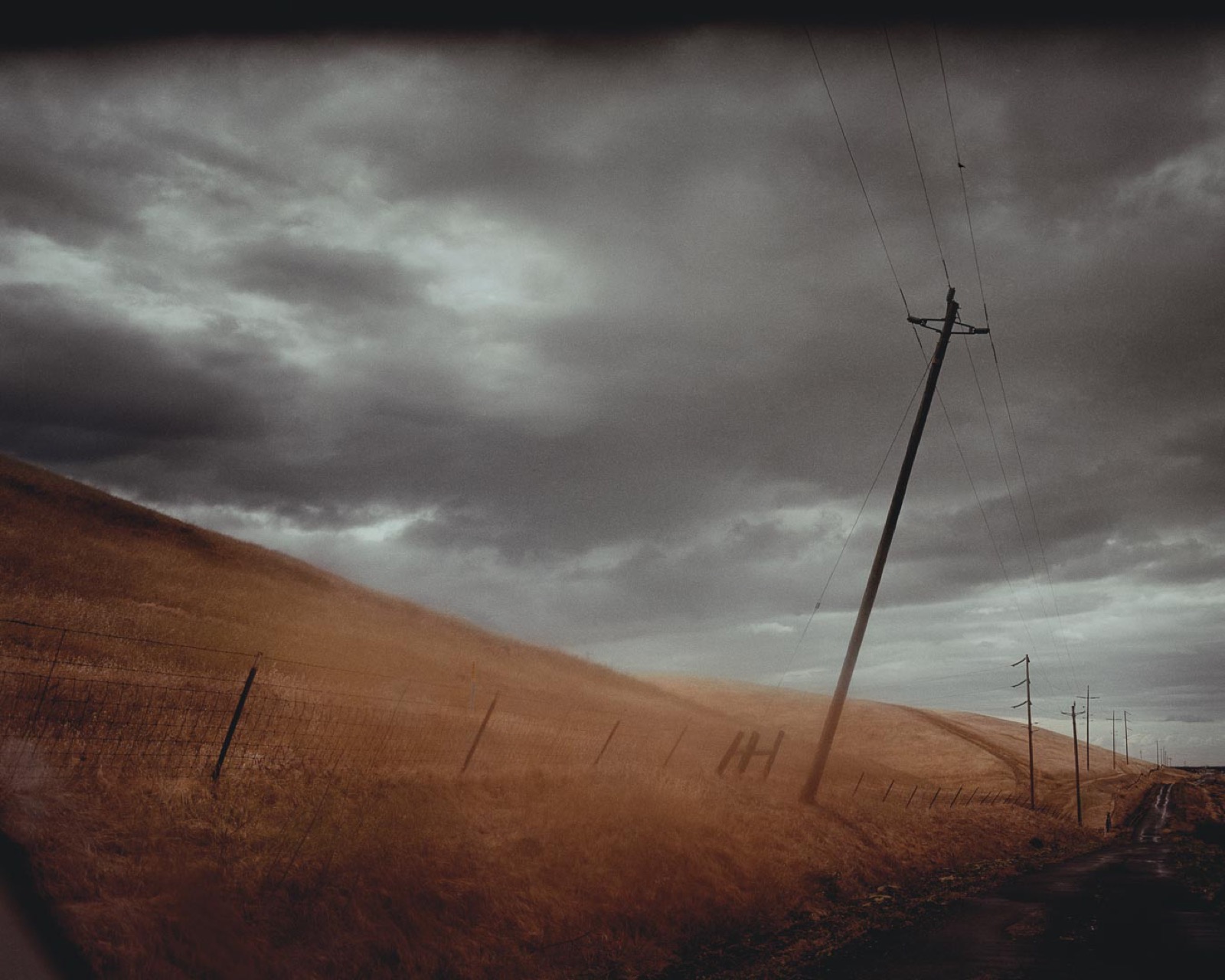

The leaning telephone pole is one of American photography’s oldest supporting actors. It stood at the edge of the frame for the Depression-era documentarians, marched beside Robert Frank’s highways, and lined up obediently for the New Topographics. Here it takes the lead at last: canted like a mast in heavy weather, crossarm strung with wires that sag away toward a whole cast of smaller poles retreating down the road.
But the picture’s real intelligence is in how it was seen. The horizon tips, the foreground grasses smear, and a dark bar of car interior closes the top of the frame: this is the world from the driver’s seat, photographed rather than merely passed. Hido, who makes many of his landscapes through the window of his car, lets accident in on purpose. The blur across the fence line isn’t a flaw; it’s the signature of transit, proof that a scene this still was seen at speed. Gold hillside, green-grey storm: here the color does the emotional work that captions once did.
That sensibility, houses at night, fogged roads, weather that behaves like memory, has placed his prints in SFMOMA, the Getty and the Whitney, and made his numbered, untitled pictures instantly recognizable without a single name attached. As an archival pigment print, this one holds both registers at once: the storm’s low greens stay dense while the dry grass keeps its ignition-point orange. A century after the pole first wandered into photographs, it finally gets its full-length portrait, tilted, wired to everything, going nowhere.