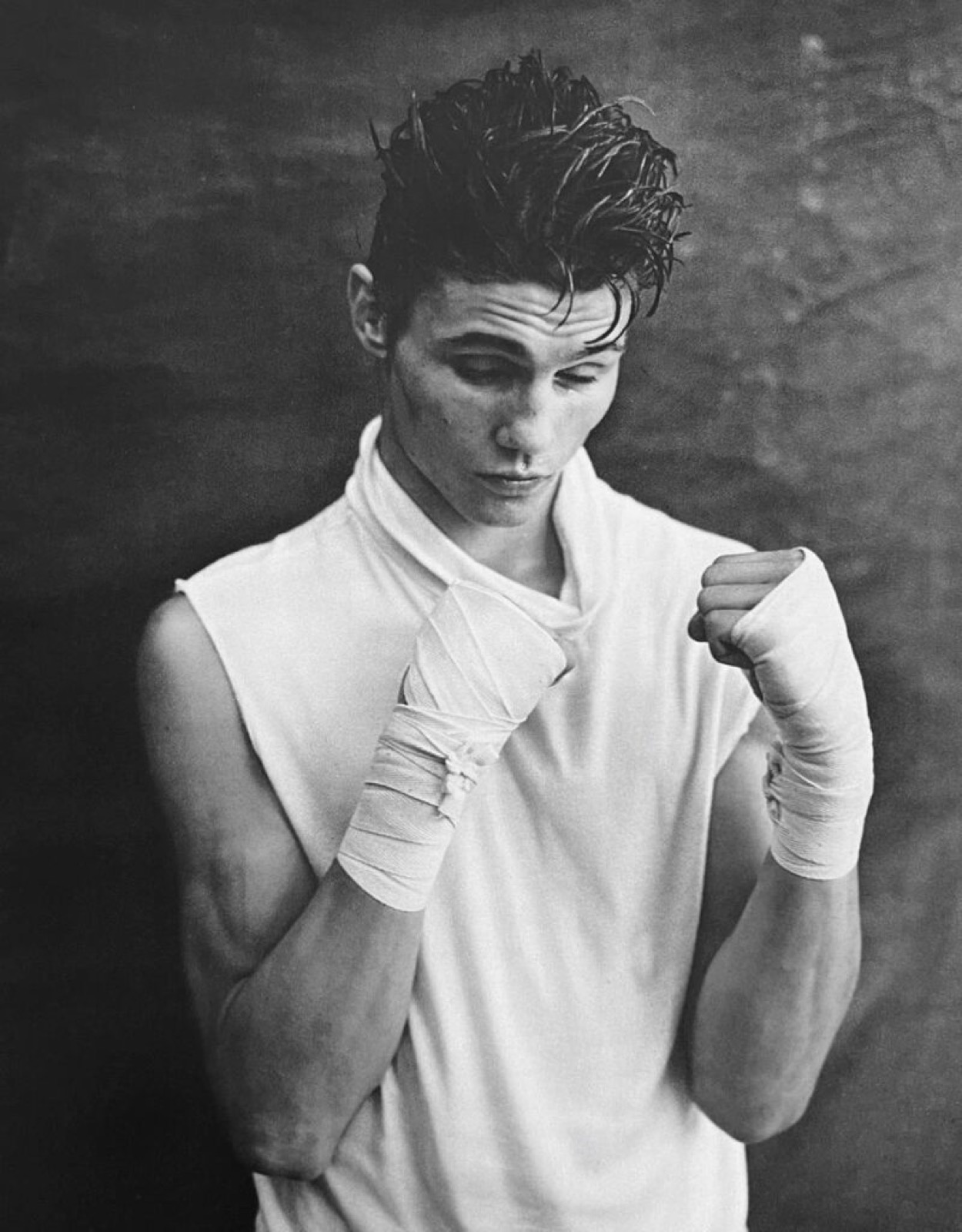
What a portrait usually grants us, the sitter’s returning look, is here withheld. Andy Minsker keeps his eyes lowered, lashes down, attending to something we are not shown: no opponent, no ropes, no ring, only the mottled grey of a studio wall behind him. The fight is entirely implied. What remains visible is the apparatus of readiness, the taped hands, one drawn up to his chin in a boxer’s guard, the wet dark hair spiked as if from the exertion of a round already fought.
Weber builds the picture almost wholly from whites: the sleeveless cotton singlet, the wraps circling each wrist and knuckle, the highlit ridge of a cheekbone. They read against a ground of dappled greys nearer a painter’s scumbled backdrop than any gymnasium. The gelatin silver print carries this range with real delicacy, letting the wraps keep their soft weave where a coarser print would blow them to paper-white, and pooling shadow in the hollows of throat and clavicle.
Weber, then remaking American fashion photography around the athlete’s body, treats the young boxer with the gravity of a Renaissance study rather than a sports page. The downcast eyes turn the guard into something devotional, a boy composing himself before combat. Nothing in the frame names the ring, yet the whole body is braced toward it. As a gelatin silver sheet it belongs to the tradition of the exhibition print, where tonal command is itself the subject. It is a picture about the moment before, and it keeps that moment suspended, the raised fist never yet thrown.
What a portrait usually grants us, the sitter’s returning look, is here withheld. Andy Minsker keeps his eyes lowered, lashes down, attending to something we are not shown: no opponent, no ropes, no ring, only the mottled grey of a studio wall behind him. The fight is entirely implied. What remains visible is the apparatus of readiness, the taped hands, one drawn up to his chin in a boxer’s guard, the wet dark hair spiked as if from the exertion of a round already fought.
Weber builds the picture almost wholly from whites: the sleeveless cotton singlet, the wraps circling each wrist and knuckle, the highlit ridge of a cheekbone. They read against a ground of dappled greys nearer a painter’s scumbled backdrop than any gymnasium. The gelatin silver print carries this range with real delicacy, letting the wraps keep their soft weave where a coarser print would blow them to paper-white, and pooling shadow in the hollows of throat and clavicle.
Weber, then remaking American fashion photography around the athlete’s body, treats the young boxer with the gravity of a Renaissance study rather than a sports page. The downcast eyes turn the guard into something devotional, a boy composing himself before combat. Nothing in the frame names the ring, yet the whole body is braced toward it. As a gelatin silver sheet it belongs to the tradition of the exhibition print, where tonal command is itself the subject. It is a picture about the moment before, and it keeps that moment suspended, the raised fist never yet thrown.