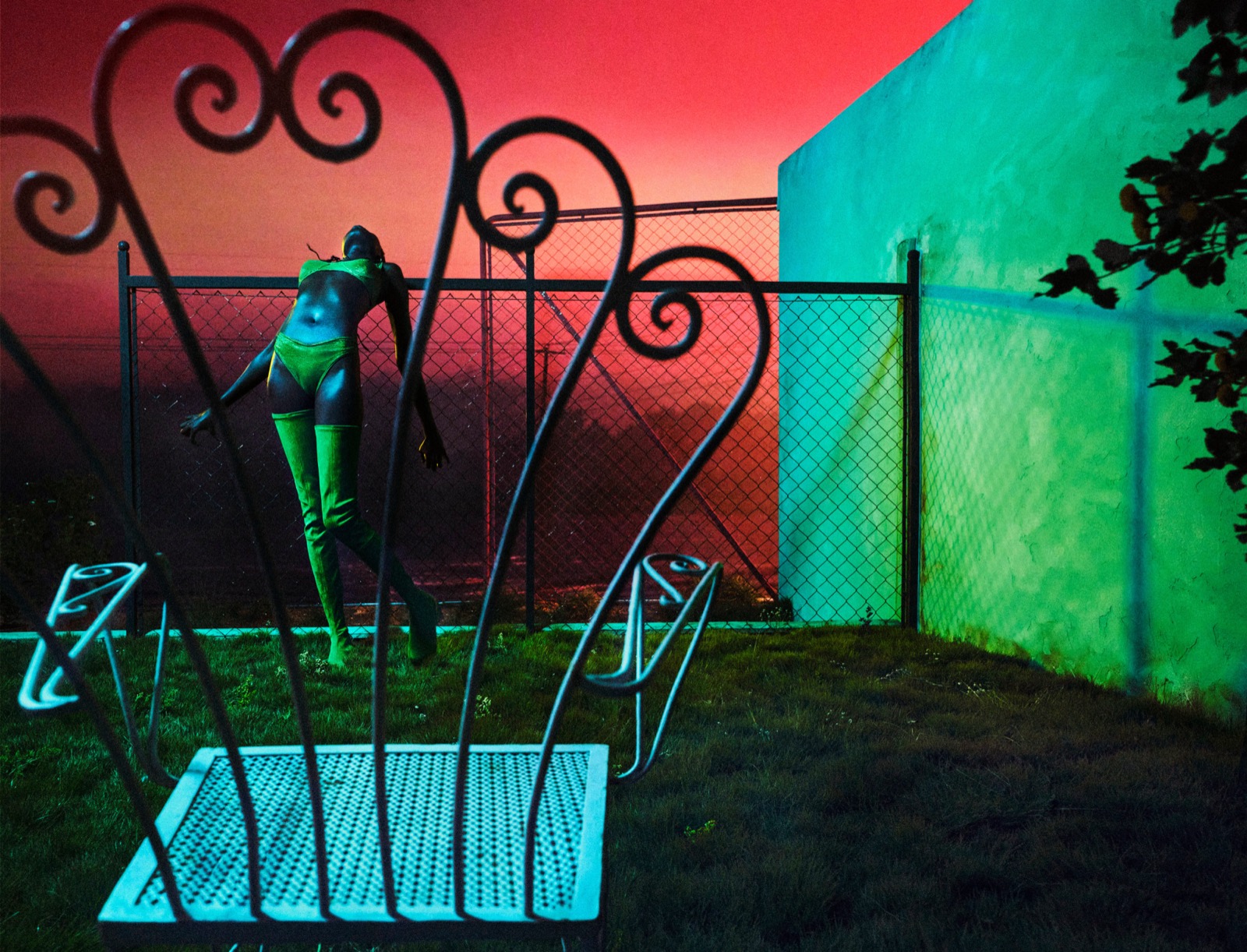
Whose bed ended up out here, its wrought-iron scrolls curling against a red sky like question marks that never found their sentence? It stands upright in the grass, headboard first, the perforated metal base catching a wash of electric green light. Someone has evicted a bedroom into a garden at dusk and left the furniture to fend for itself.
Behind the ironwork a woman arches backward, her legs sheathed in green, her feet bare on the grass — head thrown back, one arm flung wide, a dancer’s collapse frozen a half-second short of the ground. The light does the rest, splitting the frame between two impossible colors: the crimson pouring down from the horizon and a synthetic green climbing the stucco wall at the right. Red and green, the two hues the eye can least reconcile, set arguing across a chain-link fence.
The whole thing should not work and completely does, which is more or less Yeste’s signature. He came up through the front rank of Spanish fashion — Numéro, Harper’s Bazaar, Vogue — and never lost the appetite for a set that feels dreamed rather than scouted: a bit of derelict yard turned theatrical by two gelled lights and an iron bed left standing like a stage flat. There is menace in it, and comedy, and you can’t quite decide the ratio. The archival pigment print keeps those saturated reds and greens from muddying where they meet, which is exactly where a lesser print would give up. The picture holds its charge.
Whose bed ended up out here, its wrought-iron scrolls curling against a red sky like question marks that never found their sentence? It stands upright in the grass, headboard first, the perforated metal base catching a wash of electric green light. Someone has evicted a bedroom into a garden at dusk and left the furniture to fend for itself.
Behind the ironwork a woman arches backward, her legs sheathed in green, her feet bare on the grass — head thrown back, one arm flung wide, a dancer’s collapse frozen a half-second short of the ground. The light does the rest, splitting the frame between two impossible colors: the crimson pouring down from the horizon and a synthetic green climbing the stucco wall at the right. Red and green, the two hues the eye can least reconcile, set arguing across a chain-link fence.
The whole thing should not work and completely does, which is more or less Yeste’s signature. He came up through the front rank of Spanish fashion — Numéro, Harper’s Bazaar, Vogue — and never lost the appetite for a set that feels dreamed rather than scouted: a bit of derelict yard turned theatrical by two gelled lights and an iron bed left standing like a stage flat. There is menace in it, and comedy, and you can’t quite decide the ratio. The archival pigment print keeps those saturated reds and greens from muddying where they meet, which is exactly where a lesser print would give up. The picture holds its charge.