What is in focus here? Not the sun, which has gone to a white blur; not the bare trees on the left ridge, which hold their edges only as silhouette; and certainly not the foreground, where the field dissolves into a swarm of golden discs—the soft, circular ghosts of light caught on glass rather than on anything in the world. The one thing the picture refuses to render sharply is the thing it is supposedly about. To photograph a landscape this way is to admit that what we want from such a view is not information but a mood, and to give us the mood while withholding the place.
This is the deception that makes the image work. The discs scattered across the lower right are not weather and not the meadow; they are the apparatus declaring itself, the lens confessing that it stood between us and the field at sundown. We are not looking at dusk so much as at the residue dusk leaves on a camera pointed almost into the light. The honesty is in the flaw. A sharper, more competent picture would have lied about how seeing actually happens at this hour, when the eye is dazzled and the edges of things give way.
Made in 2002, the frame belongs to the long nocturnal-and-twilight survey that has made this photographer one of the defining American picture-makers of his generation—the numbered images, the houses, the roadside fields, all titled only by their catalogue digits, as if to resist any anecdote we might attach. The refusal to name is of a piece with the refusal to focus. What remains is the burnt-gold light, the three skeletal trees, and our own susceptibility to a beauty we are half-aware is being manufactured for us, one bokeh disc at a time.
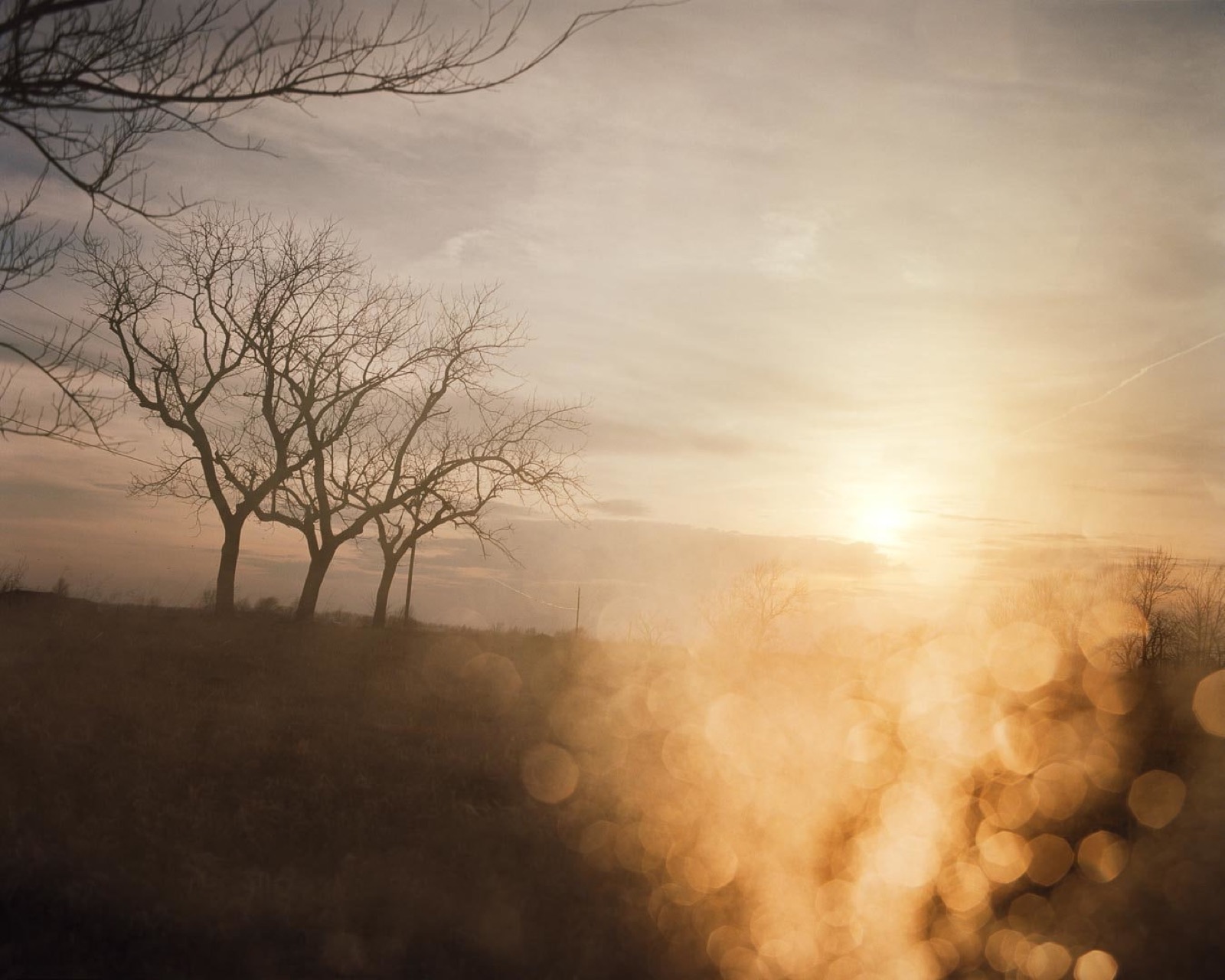

What is in focus here? Not the sun, which has gone to a white blur; not the bare trees on the left ridge, which hold their edges only as silhouette; and certainly not the foreground, where the field dissolves into a swarm of golden discs—the soft, circular ghosts of light caught on glass rather than on anything in the world. The one thing the picture refuses to render sharply is the thing it is supposedly about. To photograph a landscape this way is to admit that what we want from such a view is not information but a mood, and to give us the mood while withholding the place.
This is the deception that makes the image work. The discs scattered across the lower right are not weather and not the meadow; they are the apparatus declaring itself, the lens confessing that it stood between us and the field at sundown. We are not looking at dusk so much as at the residue dusk leaves on a camera pointed almost into the light. The honesty is in the flaw. A sharper, more competent picture would have lied about how seeing actually happens at this hour, when the eye is dazzled and the edges of things give way.
Made in 2002, the frame belongs to the long nocturnal-and-twilight survey that has made this photographer one of the defining American picture-makers of his generation—the numbered images, the houses, the roadside fields, all titled only by their catalogue digits, as if to resist any anecdote we might attach. The refusal to name is of a piece with the refusal to focus. What remains is the burnt-gold light, the three skeletal trees, and our own susceptibility to a beauty we are half-aware is being manufactured for us, one bokeh disc at a time.