The franchise had begun to promise that America could taste the same everywhere, and here is its liturgy in enamel: OVER 25 BILLION SERVED, the number recited beneath two golden arches that rise like a gate over a Missouri crossroads. Meyerowitz stands at the edge of a parking lot in St. Louis, where the sky has gone the color of unpolished pewter and the light refuses drama. A flag stiffens on its pole beside a black lantern; a Clark station glows its red sign across the road. The scene is ordinary to the point of holiness.
What the camera loves is not the arches but their doubling. A second, lower sign repeats the emblem and adds a courtesy: thank you, spelled in an arrow that points us politely away. Between the two signs the everyday continues without our permission: a pale sedan idling, a dark car crossing, telephone wires stitching the pale air into panels. In the foreground, clumps of ornamental grass and a scatter of wood chips stand where a lawn might have been, tended and provisional at once. Color here is a form of description, not decoration; the red and yellow are facts.
Meyerowitz, who helped make color photography serious in the 1970s alongside Shore and Eggleston, reads this vernacular with the patience of the 8×10 view camera that also gave us Cape Light. He was among the first to grant the American roadside the dignity of long looking, and MoMA, the Met and the Boston MFA keep his work. This archival pigment print holds the pewter sky and the enamel red without raising its voice.
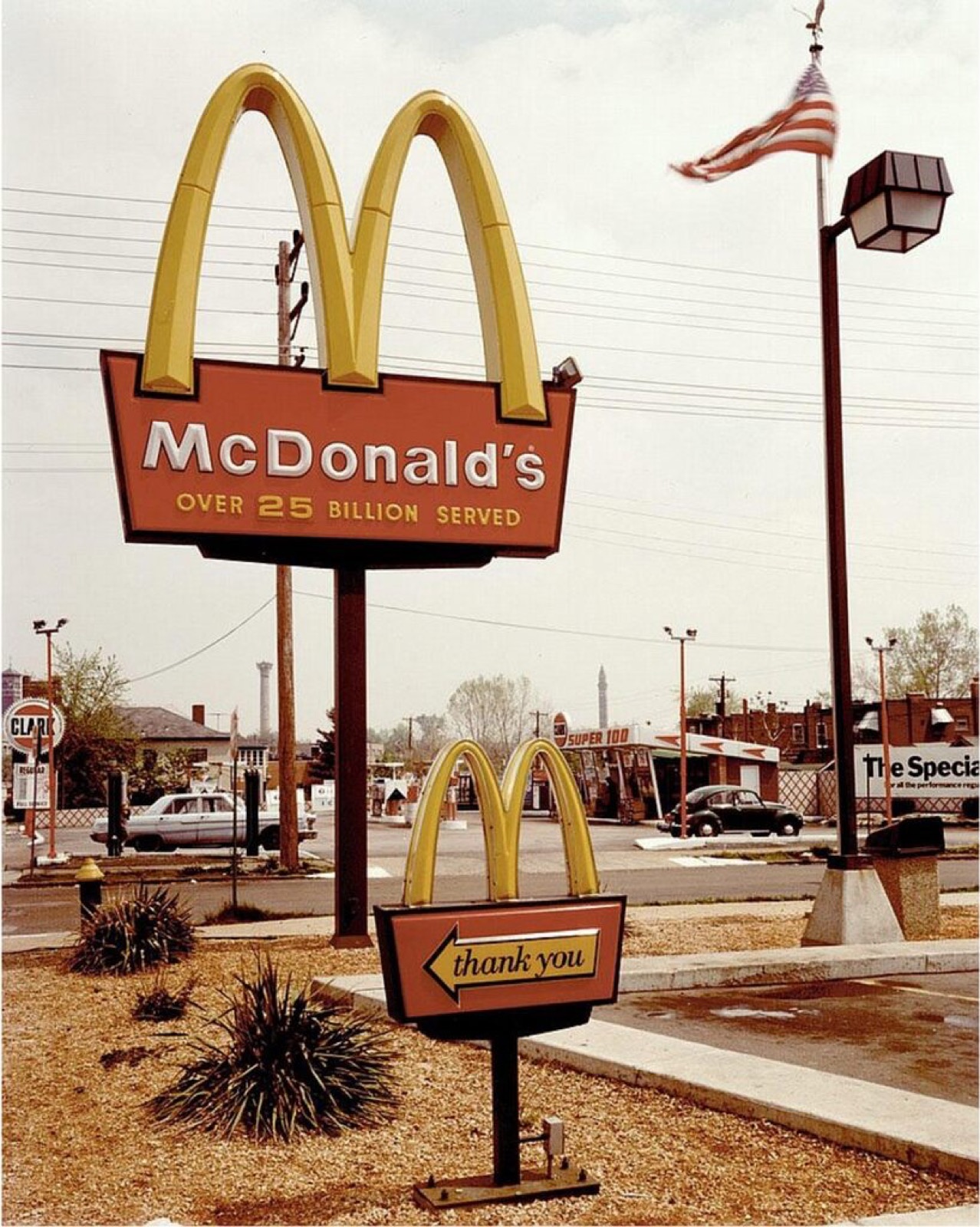

The franchise had begun to promise that America could taste the same everywhere, and here is its liturgy in enamel: OVER 25 BILLION SERVED, the number recited beneath two golden arches that rise like a gate over a Missouri crossroads. Meyerowitz stands at the edge of a parking lot in St. Louis, where the sky has gone the color of unpolished pewter and the light refuses drama. A flag stiffens on its pole beside a black lantern; a Clark station glows its red sign across the road. The scene is ordinary to the point of holiness.
What the camera loves is not the arches but their doubling. A second, lower sign repeats the emblem and adds a courtesy: thank you, spelled in an arrow that points us politely away. Between the two signs the everyday continues without our permission: a pale sedan idling, a dark car crossing, telephone wires stitching the pale air into panels. In the foreground, clumps of ornamental grass and a scatter of wood chips stand where a lawn might have been, tended and provisional at once. Color here is a form of description, not decoration; the red and yellow are facts.
Meyerowitz, who helped make color photography serious in the 1970s alongside Shore and Eggleston, reads this vernacular with the patience of the 8×10 view camera that also gave us Cape Light. He was among the first to grant the American roadside the dignity of long looking, and MoMA, the Met and the Boston MFA keep his work. This archival pigment print holds the pewter sky and the enamel red without raising its voice.