A country announces itself in its hand-lettered signs. Here, by a Wisconsin roadside, someone has nailed a board to a post and written what they have to offer: SUNNY HOLLOW BAKERY, OPEN, PUMPKIN ROLLS. The letters lean and crowd, painted by a hand more practiced at baking than at signage, and they are the more persuasive for it. Jessica Lange found this on Highway 61 and gave it the gravity of a monument. Beside it a dented mailbox keeps its post, and a green county marker counts off the miles to a town just out of frame.
The road itself does the composing. It enters at the left, swings across the middle distance, and curls away over a low rise toward a sky packed with grey cloud, the kind of Midwestern overcast that flattens everything and somehow deepens it. To one side a dark plowed field climbs the hill in furrows; to the other, scrub and the soft shoulder where the asphalt gives out. There is no bakery in the picture. There is only the promise of one, somewhere down a lane the sign assumes you already know how to find.
I have driven past a thousand such invitations and stopped at almost none, and that is the quiet ache of the thing. The sign was written for a neighbor, not for a traveler; it belongs to a world of regulars and short distances, of pumpkin season and the people who wait for it. Lange, passing through, keeps the courtesy of the outsider — she records the offer without pretending to belong to the place that made it. What endures is the gap between the warm word OPEN and the empty, beautiful road that carries us on past.
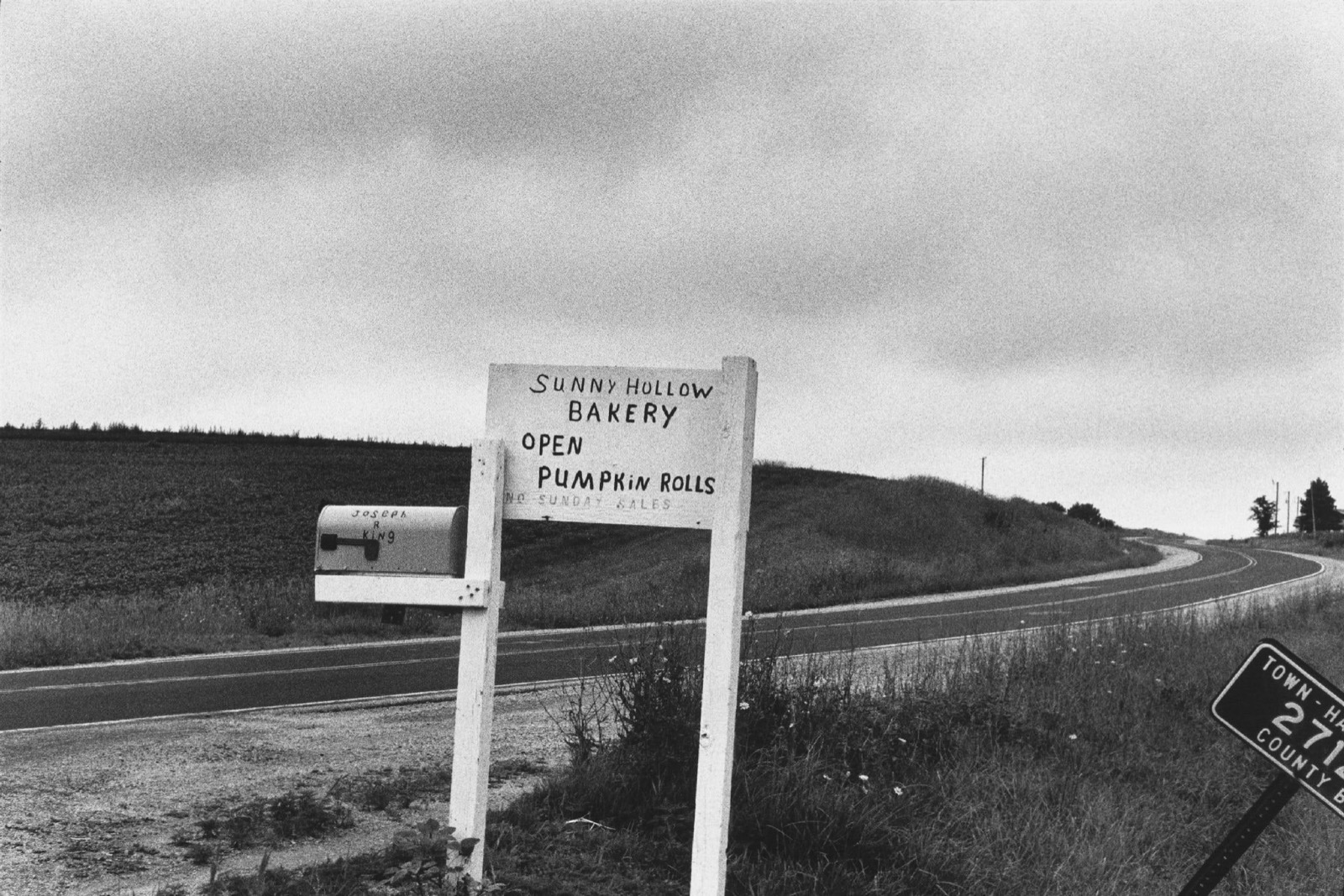

A country announces itself in its hand-lettered signs. Here, by a Wisconsin roadside, someone has nailed a board to a post and written what they have to offer: SUNNY HOLLOW BAKERY, OPEN, PUMPKIN ROLLS. The letters lean and crowd, painted by a hand more practiced at baking than at signage, and they are the more persuasive for it. Jessica Lange found this on Highway 61 and gave it the gravity of a monument. Beside it a dented mailbox keeps its post, and a green county marker counts off the miles to a town just out of frame.
The road itself does the composing. It enters at the left, swings across the middle distance, and curls away over a low rise toward a sky packed with grey cloud, the kind of Midwestern overcast that flattens everything and somehow deepens it. To one side a dark plowed field climbs the hill in furrows; to the other, scrub and the soft shoulder where the asphalt gives out. There is no bakery in the picture. There is only the promise of one, somewhere down a lane the sign assumes you already know how to find.
I have driven past a thousand such invitations and stopped at almost none, and that is the quiet ache of the thing. The sign was written for a neighbor, not for a traveler; it belongs to a world of regulars and short distances, of pumpkin season and the people who wait for it. Lange, passing through, keeps the courtesy of the outsider — she records the offer without pretending to belong to the place that made it. What endures is the gap between the warm word OPEN and the empty, beautiful road that carries us on past.