Majesty is never found; it is built, and it can be built from hair. On a park path in Harlem a woman stands in a long black leather coat, shoulders cut like architecture, belt cinched, boots creased with light, and around her head her hair opens into an immense fan, black rays against a white sky. She looks at me without hurry. The assertion holds: I believe the crown before I believe the trees.
And yet what detains me is off to the side: a young tree in its cylinder of wire, staked, caged, being trained to grow straight. Once seen, it rewrites everything. The fan of hair is also a training, hours of patient discipline persuading a living material into geometry; the coat is a husk of the same will. Elegance, the picture admits, is horticulture: something tended, pruned, held upright against its own wildness. Behind her, small figures idle on a distant lawn, unaware; her shadow pours across the gravel like something spilled and permanent.
Yeste photographs fashion at the front rank of the Spanish school, for Numéro, Harper’s Bazaar, Vogue, and often in the elements, sand, wind, fire; here the element is a city park, and it submits like the rest. In black and white the leather gives back a wet gleam, the leaves turn to lace, the sky becomes paper. The archival pigment print holds these blacks with a density the coat itself would envy. I came for the crown; I stay for the caged sapling, which tells the truth about it.
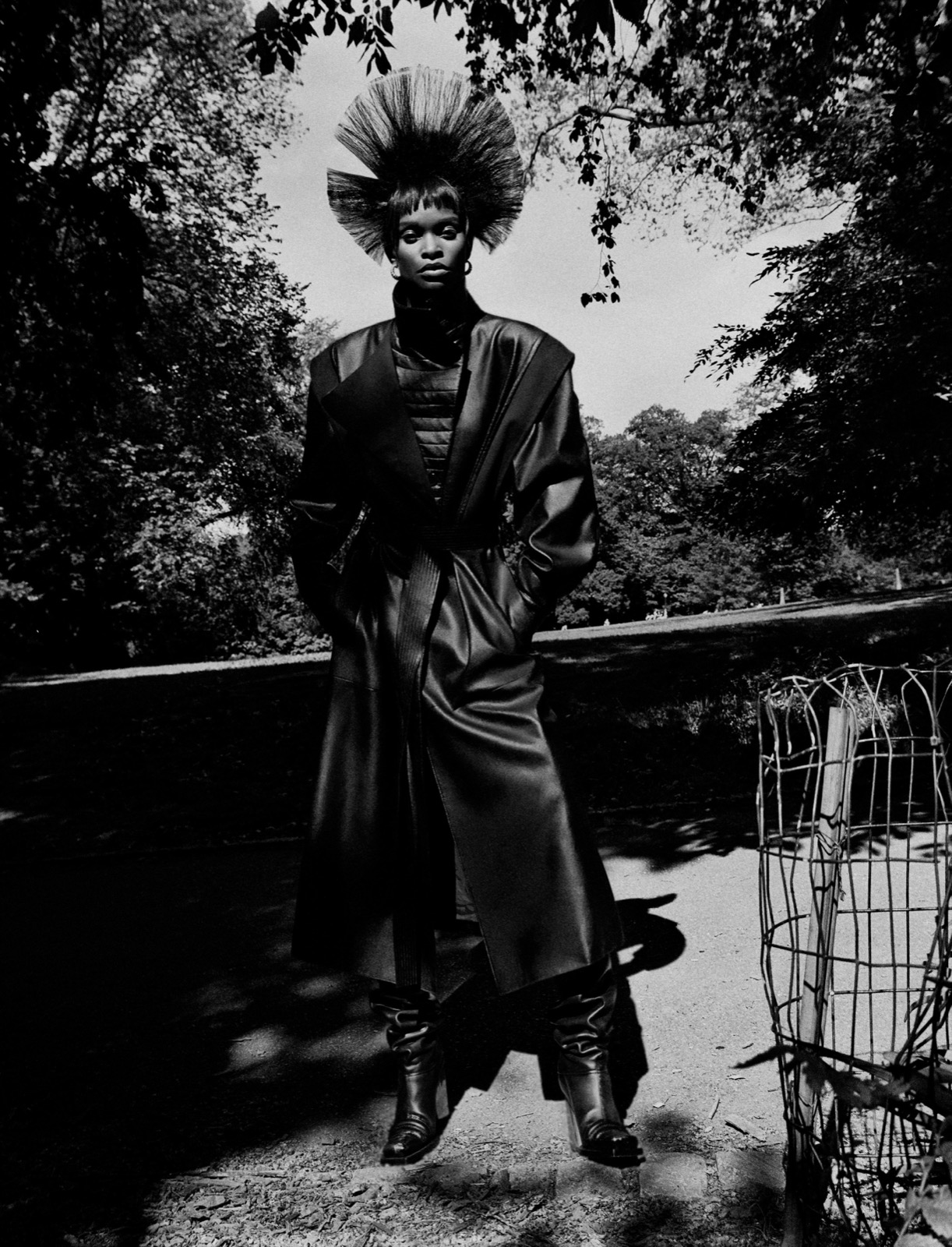

Majesty is never found; it is built, and it can be built from hair. On a park path in Harlem a woman stands in a long black leather coat, shoulders cut like architecture, belt cinched, boots creased with light, and around her head her hair opens into an immense fan, black rays against a white sky. She looks at me without hurry. The assertion holds: I believe the crown before I believe the trees.
And yet what detains me is off to the side: a young tree in its cylinder of wire, staked, caged, being trained to grow straight. Once seen, it rewrites everything. The fan of hair is also a training, hours of patient discipline persuading a living material into geometry; the coat is a husk of the same will. Elegance, the picture admits, is horticulture: something tended, pruned, held upright against its own wildness. Behind her, small figures idle on a distant lawn, unaware; her shadow pours across the gravel like something spilled and permanent.
Yeste photographs fashion at the front rank of the Spanish school, for Numéro, Harper’s Bazaar, Vogue, and often in the elements, sand, wind, fire; here the element is a city park, and it submits like the rest. In black and white the leather gives back a wet gleam, the leaves turn to lace, the sky becomes paper. The archival pigment print holds these blacks with a density the coat itself would envy. I came for the crown; I stay for the caged sapling, which tells the truth about it.