We are looking at this road from inside a car, and the weather has followed us onto the glass. Melted snow beads the windshield, each droplet holding a grain of the low sun, scattering soft amber discs across the foreground. Beyond them, two dark wheel tracks run up an unpaved road through the snow, toward a horizon that is hardly more than a seam of orange light pressed under a lid of winter cloud.
The tonal structure is disciplined. Nearly everything sits within a narrow register of pewter, buff, and cream; the sun, breaking low through bare trees at the left, supplies the only saturated note, and the snow answers it faintly where the light skims its crust. A utility pole stands among the branches, the one man-made vertical; tawny grasses stitch the ditches. What matters most, though, is the decision not to wipe the glass. Photographed through it, this is not simply a landscape but a record of looking at one, vision admitted to be bodily, weathered, imperfect.
Hido has long photographed from the driver’s seat, and these road pictures, made through fogged or wet windows, are as central to his achievement as the glowing suburban houses at night that first made his reputation. Born in Kent, Ohio, and based in the San Francisco Bay Area, he is represented in the collections of SFMOMA, the Getty, and the Whitney. As an archival pigment print, this image keeps its long, quiet tonal reach: the fine gradations of the clouded sky survive intact, and the droplets still carry their small cargo of light.
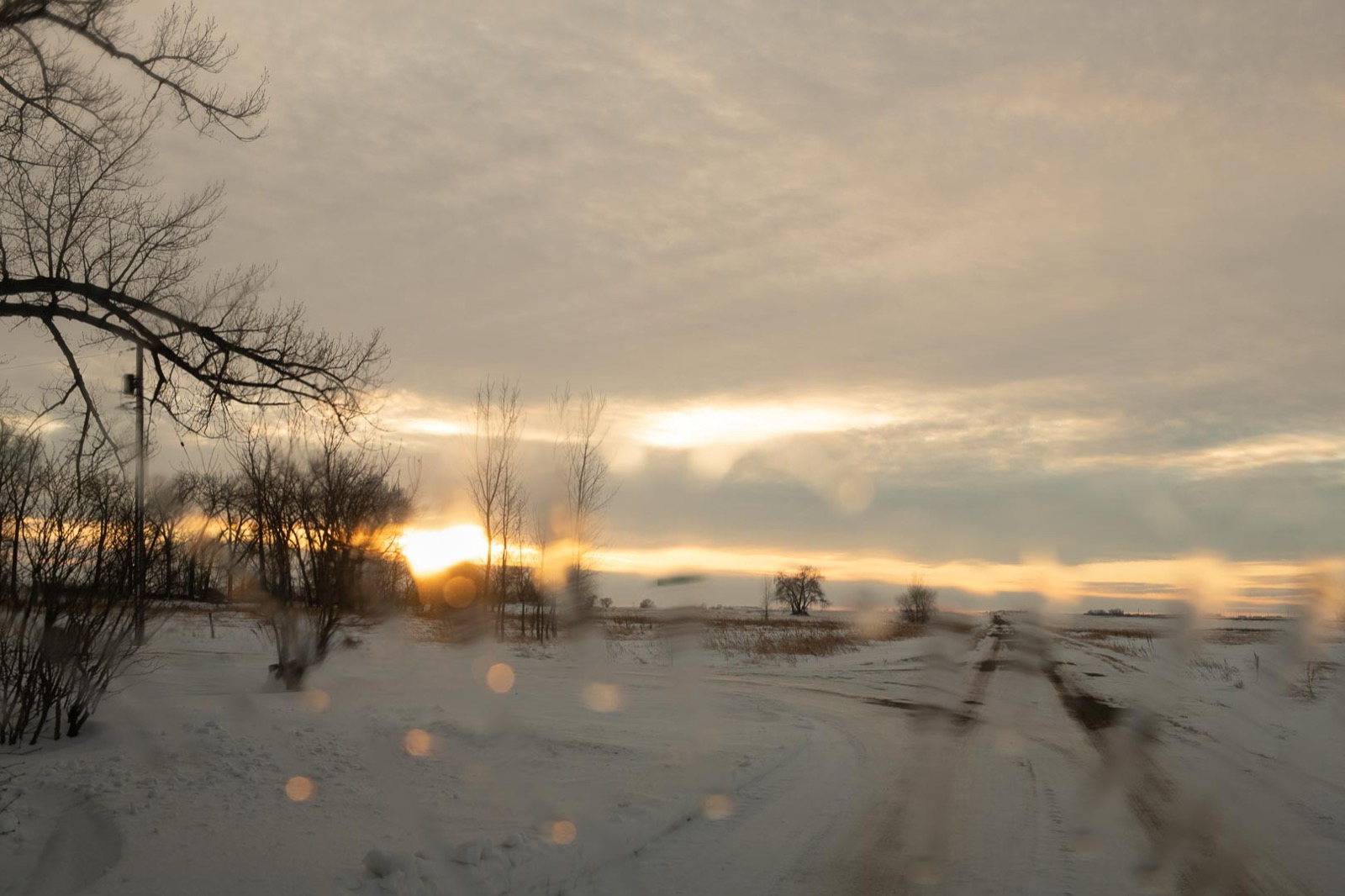

We are looking at this road from inside a car, and the weather has followed us onto the glass. Melted snow beads the windshield, each droplet holding a grain of the low sun, scattering soft amber discs across the foreground. Beyond them, two dark wheel tracks run up an unpaved road through the snow, toward a horizon that is hardly more than a seam of orange light pressed under a lid of winter cloud.
The tonal structure is disciplined. Nearly everything sits within a narrow register of pewter, buff, and cream; the sun, breaking low through bare trees at the left, supplies the only saturated note, and the snow answers it faintly where the light skims its crust. A utility pole stands among the branches, the one man-made vertical; tawny grasses stitch the ditches. What matters most, though, is the decision not to wipe the glass. Photographed through it, this is not simply a landscape but a record of looking at one, vision admitted to be bodily, weathered, imperfect.
Hido has long photographed from the driver’s seat, and these road pictures, made through fogged or wet windows, are as central to his achievement as the glowing suburban houses at night that first made his reputation. Born in Kent, Ohio, and based in the San Francisco Bay Area, he is represented in the collections of SFMOMA, the Getty, and the Whitney. As an archival pigment print, this image keeps its long, quiet tonal reach: the fine gradations of the clouded sky survive intact, and the droplets still carry their small cargo of light.