There is a man at the center of this Chicago night, and he is looking back. He wears a snap-brim hat and a workman's jacket, hands loose at his sides, and he holds the camera's gaze without performance or apology. The whole street is a theater of light around him — a discount watch shop blazing at the right, a row of bare bulbs raking the awning in warm tungsten, the windows dense with their promises: BIG DISCOUNTS, RADIOS, CLEARANCE, 5,000 WATCHES. Commerce hums in its small electric letters. Five thousand watches, and still this one unhurried man, keeping his own time.
What moves me is the question of who gets to be seen, and how. A bespectacled man in a topcoat slides through the foreground, already half-dissolved by his own motion; another lifts a paper cup mid-sip. They are passing through. But the man in the hat has stopped, and Vivian Maier, working her Rolleiflex at waist level, meets him at the chest, never from above. The square format does not crowd him. It lets him stand inside the amber light with the full dignity of his attention, the night behind him gone deep and blue.
Maier photographed for no audience but herself, and her enormous archive surfaced only after her death; she is now among the central figures of mid-century American street photography, held by major institutions, shown across the world. Her color is rarer than her black-and-white, more coveted for it. A chromogenic print, made later, from an edition of 15.
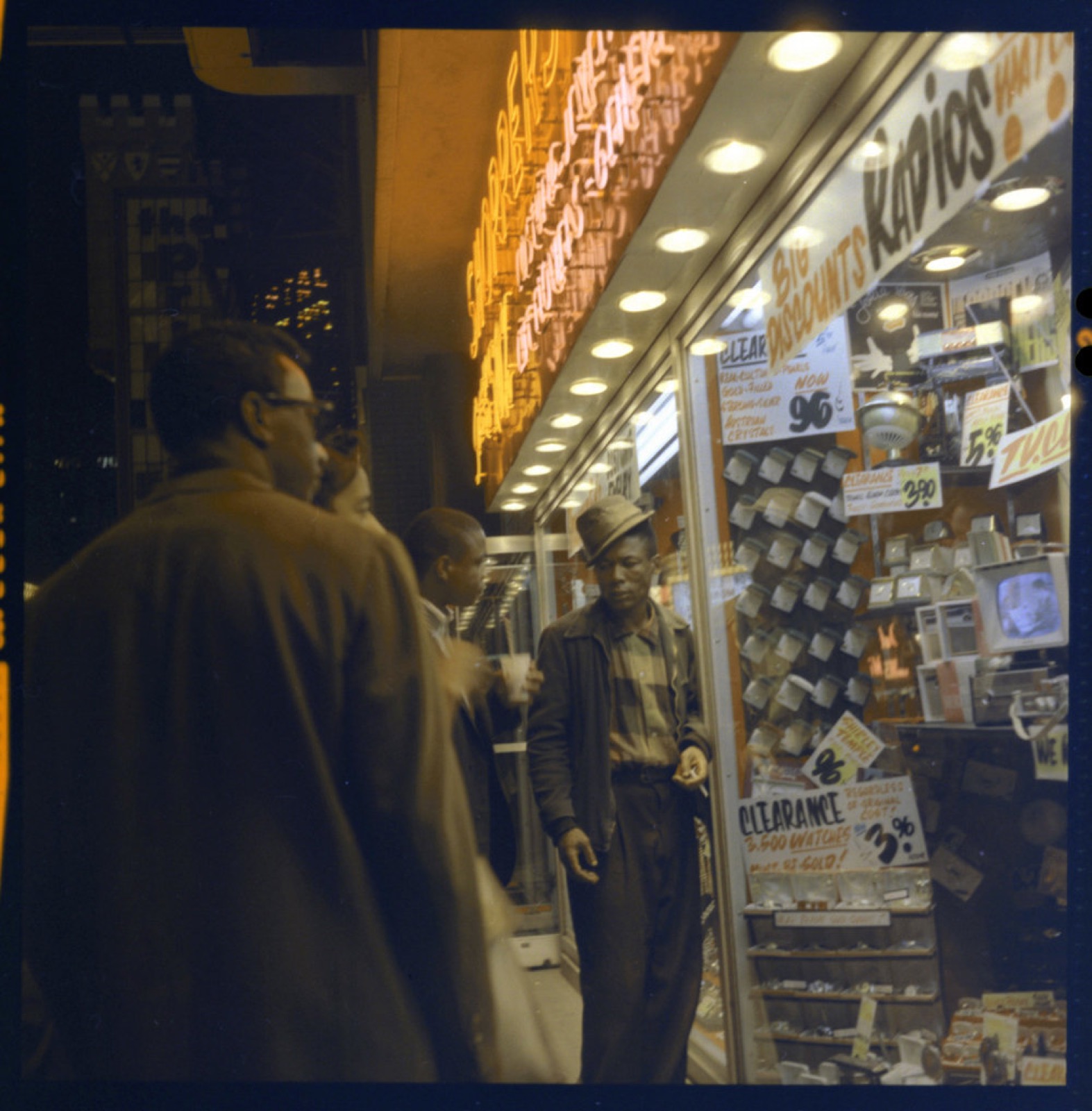

There is a man at the center of this Chicago night, and he is looking back. He wears a snap-brim hat and a workman's jacket, hands loose at his sides, and he holds the camera's gaze without performance or apology. The whole street is a theater of light around him — a discount watch shop blazing at the right, a row of bare bulbs raking the awning in warm tungsten, the windows dense with their promises: BIG DISCOUNTS, RADIOS, CLEARANCE, 5,000 WATCHES. Commerce hums in its small electric letters. Five thousand watches, and still this one unhurried man, keeping his own time.
What moves me is the question of who gets to be seen, and how. A bespectacled man in a topcoat slides through the foreground, already half-dissolved by his own motion; another lifts a paper cup mid-sip. They are passing through. But the man in the hat has stopped, and Vivian Maier, working her Rolleiflex at waist level, meets him at the chest, never from above. The square format does not crowd him. It lets him stand inside the amber light with the full dignity of his attention, the night behind him gone deep and blue.
Maier photographed for no audience but herself, and her enormous archive surfaced only after her death; she is now among the central figures of mid-century American street photography, held by major institutions, shown across the world. Her color is rarer than her black-and-white, more coveted for it. A chromogenic print, made later, from an edition of 15.