A little cluster of glass flowers sits pinned at the collar of the girl in the white blouse, and once you have found it you cannot stop reading outward from it. It tells you the morning was dressed for: these three came downtown deliberately, to sit on the granite steps of the new United Nations and be young in front of it. The brooch is the picture’s smallest fact and its truest one. Everything larger in the frame, the Secretariat slab, the sailor, the folded newspaper, arranges itself around that decision to look nice on a warm day.
Maier organizes the thing with a plain intelligence. The steps run as a shallow diagonal; the black handrail cuts the right third into a clean vertical; the modernist wall behind is all repeated stone, a grid that refuses to compete for attention. Against that order she sets disorder: one girl laughs sideways, one leans in with a hand cupped to her ear, one holds the newspaper open so its masthead, NEW YORK, faces us. High on the landing a sailor stands with arms crossed, alone, a small formal counterweight to their easy heap.
Working at waist level with the Rolleiflex, she keeps her own vantage low and near, so we sit almost among them rather than above. This gelatin silver print, made later from her negative, holds the whole tonal ladder, bright cotton, dark skirt, pale bright sky, with the evenness she rarely lived to see. Her archive surfaced only after her death; the composure was always hers.
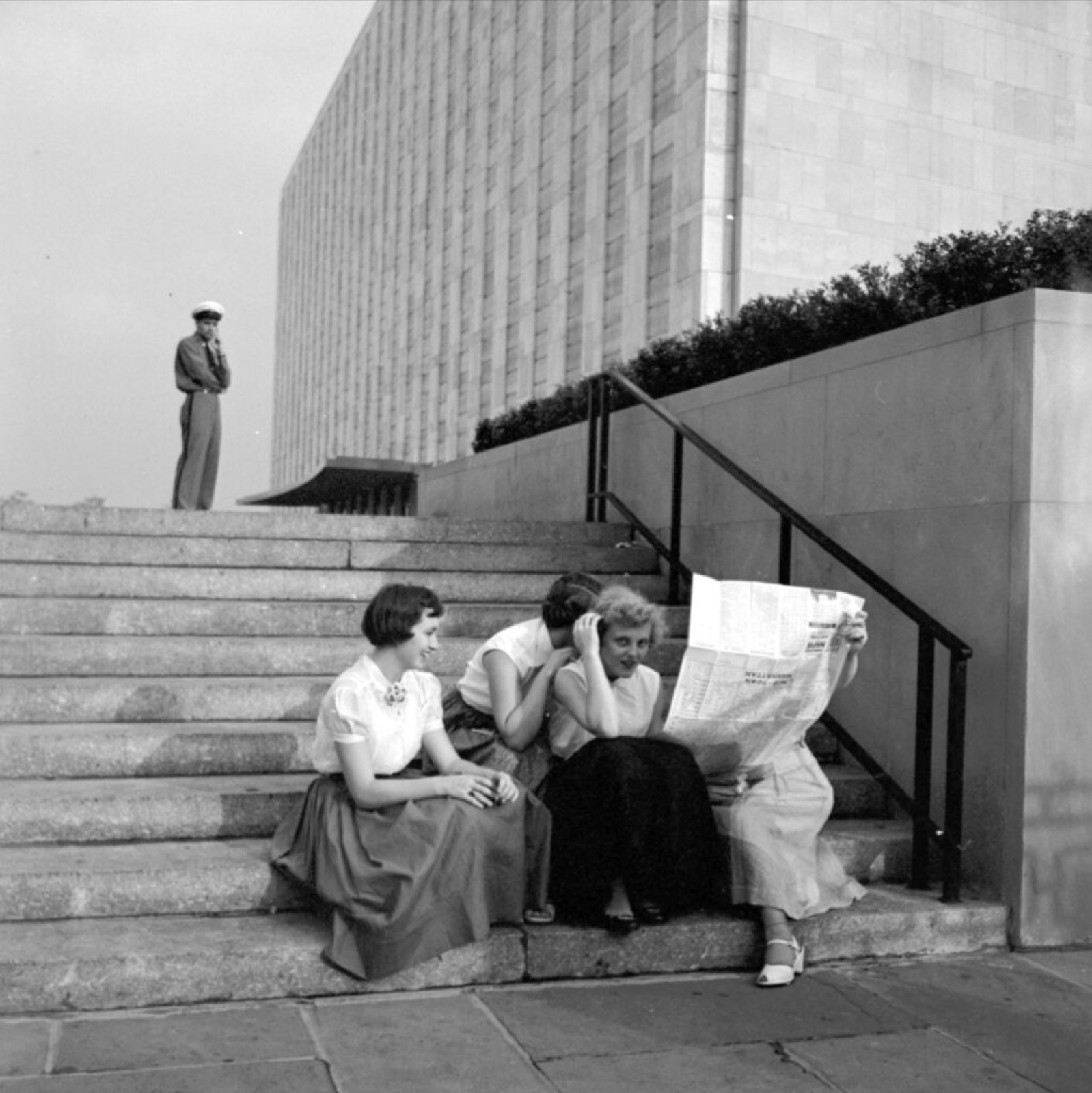

A little cluster of glass flowers sits pinned at the collar of the girl in the white blouse, and once you have found it you cannot stop reading outward from it. It tells you the morning was dressed for: these three came downtown deliberately, to sit on the granite steps of the new United Nations and be young in front of it. The brooch is the picture’s smallest fact and its truest one. Everything larger in the frame, the Secretariat slab, the sailor, the folded newspaper, arranges itself around that decision to look nice on a warm day.
Maier organizes the thing with a plain intelligence. The steps run as a shallow diagonal; the black handrail cuts the right third into a clean vertical; the modernist wall behind is all repeated stone, a grid that refuses to compete for attention. Against that order she sets disorder: one girl laughs sideways, one leans in with a hand cupped to her ear, one holds the newspaper open so its masthead, NEW YORK, faces us. High on the landing a sailor stands with arms crossed, alone, a small formal counterweight to their easy heap.
Working at waist level with the Rolleiflex, she keeps her own vantage low and near, so we sit almost among them rather than above. This gelatin silver print, made later from her negative, holds the whole tonal ladder, bright cotton, dark skirt, pale bright sky, with the evenness she rarely lived to see. Her archive surfaced only after her death; the composure was always hers.