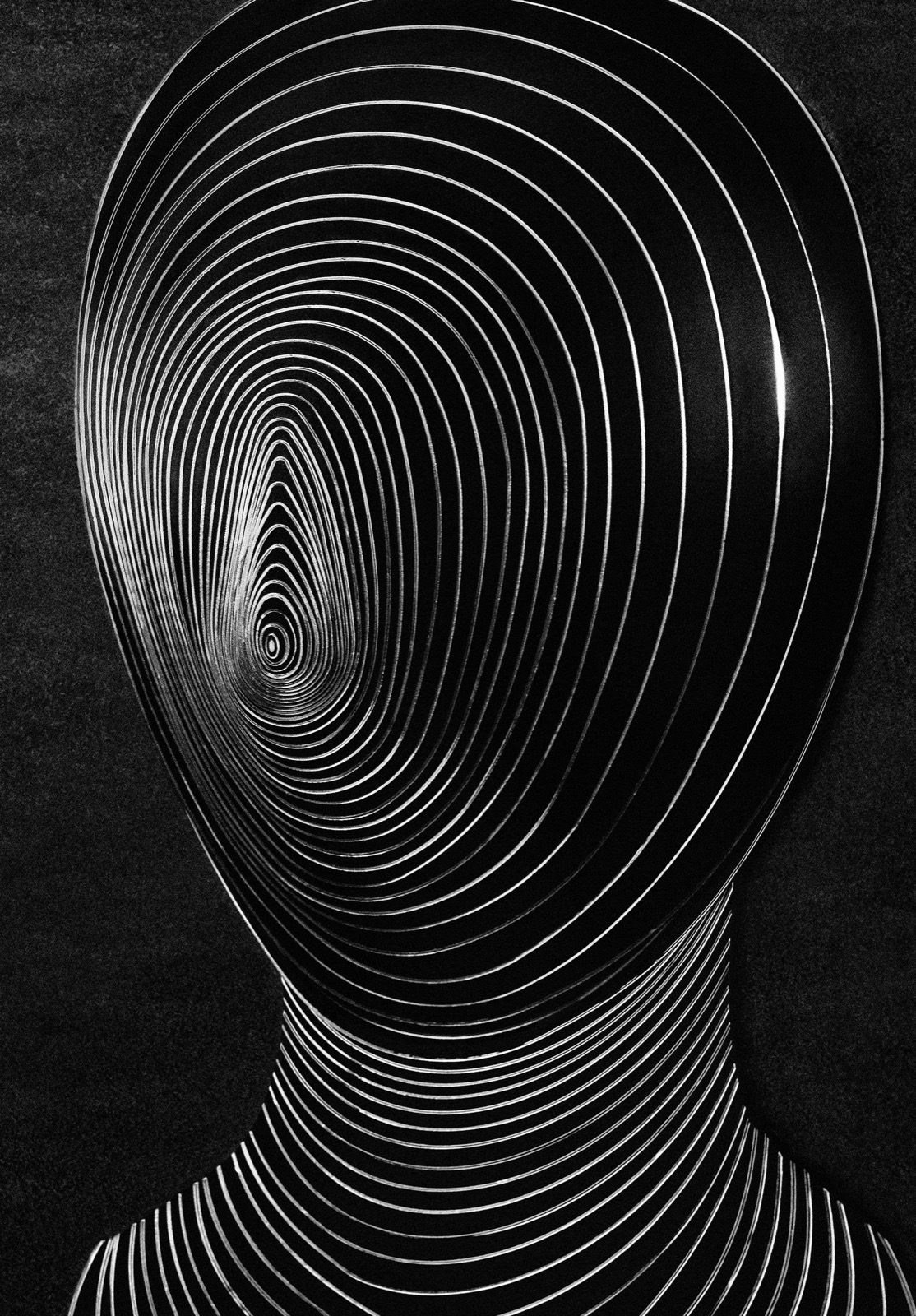
Silver is rationed here: it exists only along the raised edges, thin bright contour lines circling a head that is otherwise pure black. The rings begin at the crown and descend in patient orbits, around the skull, down the throat, across the shoulders, as if a face were something a lathe could produce. Between the lines, the black of the methacrylate absorbs everything. I am looking at a portrait in which nothing is skin and yet the whole surface behaves like skin, catching light the way a cheekbone would.
What unsettles my composure is the whorl. Left of centre, where an eye ought to open, the circles tighten and tighten until they vanish into a point, like the core of a fingerprint or the eye of a small private storm. I cannot stop attending to it. A face read as landscape asks for weather, and this one is all isobars, pressure gathered exactly there. It does not look at me, having nothing to look with; still I feel consulted, the way one feels before a mask that knows it will outlast the party.
The title concedes its source: a variation on a painting by Pavel Tchelitchew, the painted line translated into silver metal over black methacrylate, then translated once more by the camera. This last translation is the tender one, for the print is gelatin silver: silver describing silver, the metal returning to its own element on paper. Yeste, a fixture of Numéro, Harper’s Bazaar and Vogue, here subtracts the face from beauty photography altogether; the genre, to my surprise, survives in the gleam.
Silver is rationed here: it exists only along the raised edges, thin bright contour lines circling a head that is otherwise pure black. The rings begin at the crown and descend in patient orbits, around the skull, down the throat, across the shoulders, as if a face were something a lathe could produce. Between the lines, the black of the methacrylate absorbs everything. I am looking at a portrait in which nothing is skin and yet the whole surface behaves like skin, catching light the way a cheekbone would.
What unsettles my composure is the whorl. Left of centre, where an eye ought to open, the circles tighten and tighten until they vanish into a point, like the core of a fingerprint or the eye of a small private storm. I cannot stop attending to it. A face read as landscape asks for weather, and this one is all isobars, pressure gathered exactly there. It does not look at me, having nothing to look with; still I feel consulted, the way one feels before a mask that knows it will outlast the party.
The title concedes its source: a variation on a painting by Pavel Tchelitchew, the painted line translated into silver metal over black methacrylate, then translated once more by the camera. This last translation is the tender one, for the print is gelatin silver: silver describing silver, the metal returning to its own element on paper. Yeste, a fixture of Numéro, Harper’s Bazaar and Vogue, here subtracts the face from beauty photography altogether; the genre, to my surprise, survives in the gleam.