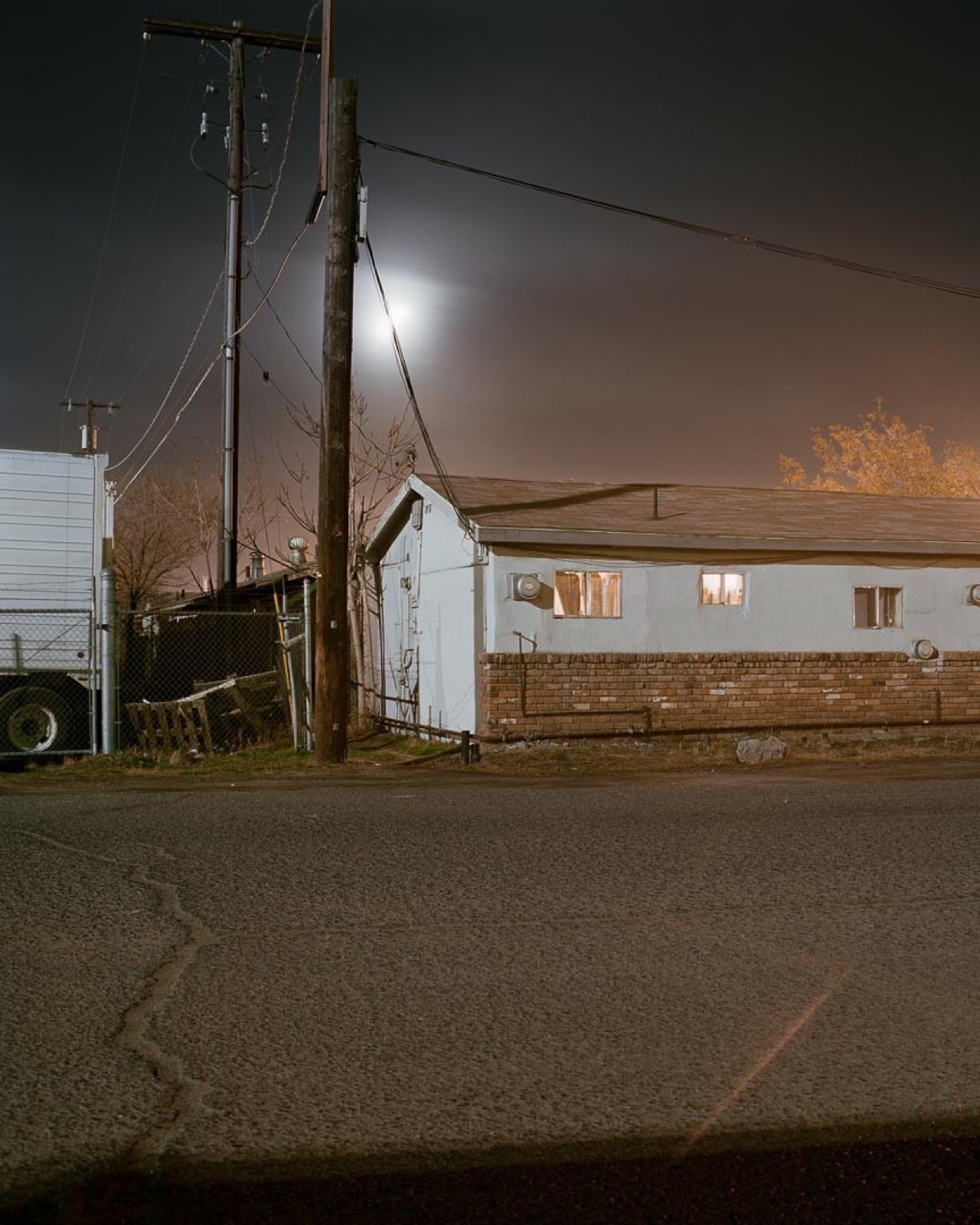
Somewhere on the ragged edge of a town, past the point where streetlights are kept for pedestrians rather than cars, Hido has stopped before a long single-storey building with a brick skirt and a corrugated roof. Two of its windows burn a domestic orange behind thin curtains; the rest is handed to the sodium wash and the mineral colours that long night exposures on colour negative produce.
The picture has a lineage. Its deadpan frontality and its interest in the anonymous built environment descend from the New Topographics — Shore, the Bechers' patient inventories — yet Hido complicates that cool inheritance by shooting at night and letting reciprocity failure tilt the palette toward the uncanny. The empty apron of asphalt across the lower third is not neglect but structure, a buffer that keeps us at the distance of a passing driver.
Materially the work insists on its own making. As an archival pigment print face-mounted to aluminium Dibond, the surface is seamless and faintly reflective, so those two pooled windows sit on the sheet like something remembered rather than seen. Part of Outskirts, it is less a record of an address than an account of what colour film does to the night — how it finds a little warmth in a place that offers almost none.

Somewhere on the ragged edge of a town, past the point where streetlights are kept for pedestrians rather than cars, Hido has stopped before a long single-storey building with a brick skirt and a corrugated roof. Two of its windows burn a domestic orange behind thin curtains; the rest is handed to the sodium wash and the mineral colours that long night exposures on colour negative produce.
The picture has a lineage. Its deadpan frontality and its interest in the anonymous built environment descend from the New Topographics — Shore, the Bechers' patient inventories — yet Hido complicates that cool inheritance by shooting at night and letting reciprocity failure tilt the palette toward the uncanny. The empty apron of asphalt across the lower third is not neglect but structure, a buffer that keeps us at the distance of a passing driver.
Materially the work insists on its own making. As an archival pigment print face-mounted to aluminium Dibond, the surface is seamless and faintly reflective, so those two pooled windows sit on the sheet like something remembered rather than seen. Part of Outskirts, it is less a record of an address than an account of what colour film does to the night — how it finds a little warmth in a place that offers almost none.