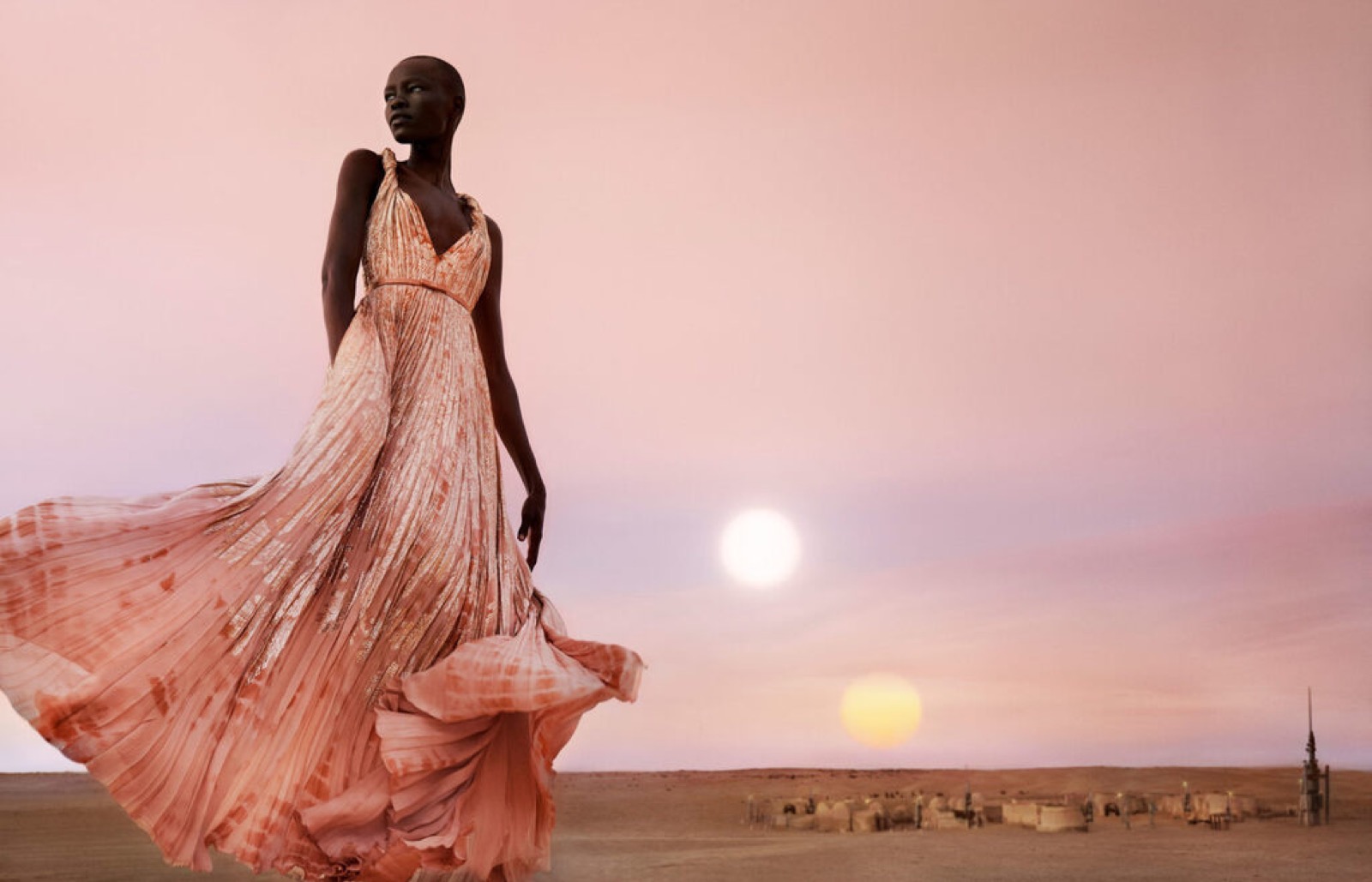
Two suns. One high in the frame, a hard white disc; the other lower and to its left, larger, orange, sitting just above the horizon. Below them a mud-walled settlement runs along the desert floor with a minaret at the right edge, and at the left a woman stands in a pleated gown of rose and gold whose skirt has been thrown out sideways into a long horizontal sweep. The sky is a graded pink. Her head is turned away from both suns.
The picture does not conceal its own manufacture; it advertises it. A second sun is not a subtle intervention — it declares that this landscape has been assembled rather than found, and once the doubled sky is accepted you begin to notice everything else that has been arranged: the settlement scaled to sit precisely at the hem, a wind that reaches the skirt and not the sky, a figure lit from a direction neither sun could supply. The image works in the register of the constructed tableau, borrowing the science-fiction horizon and the ethnographic vista and combining them without apology.
What is interesting is how frankly it sits between categories. It has the surface of a campaign image and the syntax of the digitally composited artwork that photography absorbed from painting in the 2000s — pictures that ask to be read as propositions rather than records. Yeste, working from Spain across editorial and gallery contexts, is not trying to persuade anyone that a place with two suns exists. He is making an image whose real subject is its own impossibility, and letting the dress carry it.
Two suns. One high in the frame, a hard white disc; the other lower and to its left, larger, orange, sitting just above the horizon. Below them a mud-walled settlement runs along the desert floor with a minaret at the right edge, and at the left a woman stands in a pleated gown of rose and gold whose skirt has been thrown out sideways into a long horizontal sweep. The sky is a graded pink. Her head is turned away from both suns.
The picture does not conceal its own manufacture; it advertises it. A second sun is not a subtle intervention — it declares that this landscape has been assembled rather than found, and once the doubled sky is accepted you begin to notice everything else that has been arranged: the settlement scaled to sit precisely at the hem, a wind that reaches the skirt and not the sky, a figure lit from a direction neither sun could supply. The image works in the register of the constructed tableau, borrowing the science-fiction horizon and the ethnographic vista and combining them without apology.
What is interesting is how frankly it sits between categories. It has the surface of a campaign image and the syntax of the digitally composited artwork that photography absorbed from painting in the 2000s — pictures that ask to be read as propositions rather than records. Yeste, working from Spain across editorial and gallery contexts, is not trying to persuade anyone that a place with two suns exists. He is making an image whose real subject is its own impossibility, and letting the dress carry it.