Archival pigment print mounted on aluminium Dibond.
One Size Only / 40.6 x 61 cm / 16 x 24 in
Hand-signed by the artist, with title, date, and edition number inscribed in ink on an archival label affixed to the reverse side of the mounted photograph
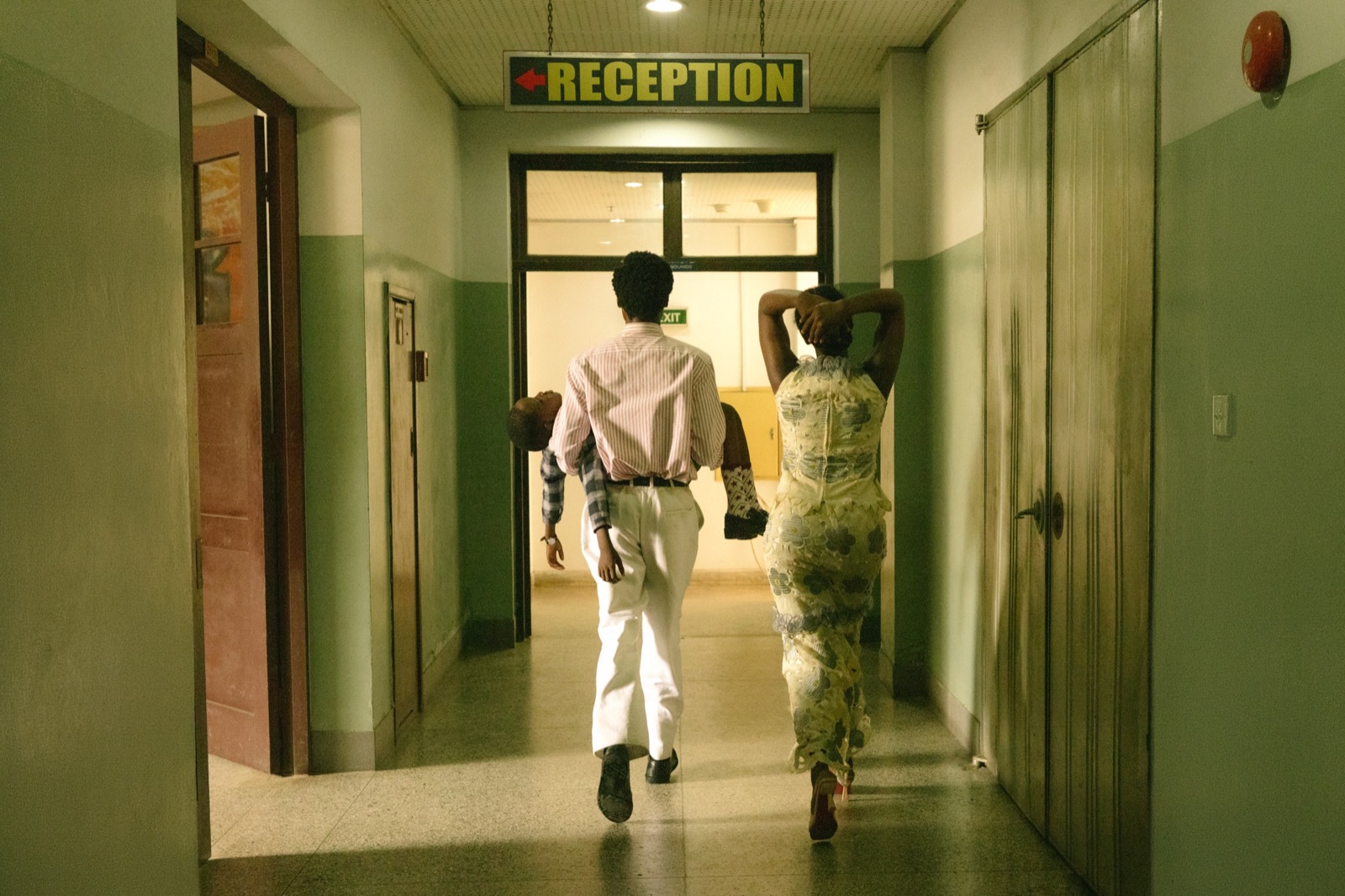
Idun-Tawiah photographs three people from behind, walking away down an institutional corridor toward a lit doorway and a hanging sign that reads RECEPTION, its yellow letters and red arrow the sharpest graphic note in a muted green-and-cream interior. At the centre a man in a striped shirt and white trousers carries a sleeping child, head lolling back, legs dangling at his side; beside him a woman in a pale floral gown walks with both hands raised to the back of her head. The picture is all recession, a one-point perspective pulling the eye toward the exit.
What interests here is the temporality the image builds. By turning the figures away, Idun-Tawiah makes the photograph about leaving rather than arriving, about a moment already dissolving into the next. The sleeping child is the still point in a scene defined by transit, a small body that has surrendered its own sense of time to the adults conveying it. The RECEPTION sign, the distant EXIT, the institutional light all locate this tenderness inside a bureaucratic architecture, and the friction between public setting and private cargo is the picture’s cool intelligence.
The title reframes the whole. In the hand of the father: the phrase makes the carried, dreaming child the literal object of the words, and turns an anonymous back view into a statement about custody and care. Idun-Tawiah withholds the faces so the gesture can stand for more than these particular people, so fatherhood registers not as expression but as posture, the plain fact of holding on while walking toward the light.
Idun-Tawiah photographs three people from behind, walking away down an institutional corridor toward a lit doorway and a hanging sign that reads RECEPTION, its yellow letters and red arrow the sharpest graphic note in a muted green-and-cream interior. At the centre a man in a striped shirt and white trousers carries a sleeping child, head lolling back, legs dangling at his side; beside him a woman in a pale floral gown walks with both hands raised to the back of her head. The picture is all recession, a one-point perspective pulling the eye toward the exit.
What interests here is the temporality the image builds. By turning the figures away, Idun-Tawiah makes the photograph about leaving rather than arriving, about a moment already dissolving into the next. The sleeping child is the still point in a scene defined by transit, a small body that has surrendered its own sense of time to the adults conveying it. The RECEPTION sign, the distant EXIT, the institutional light all locate this tenderness inside a bureaucratic architecture, and the friction between public setting and private cargo is the picture’s cool intelligence.
The title reframes the whole. In the hand of the father: the phrase makes the carried, dreaming child the literal object of the words, and turns an anonymous back view into a statement about custody and care. Idun-Tawiah withholds the faces so the gesture can stand for more than these particular people, so fatherhood registers not as expression but as posture, the plain fact of holding on while walking toward the light.