Salt has dried to a fine grit across every shoulder, catching the light in a thousand small points so that the wet skin seems dusted with silver. That texture is the first truth of the picture: a knot of young bodies just out of the sea at Golden Beach, hair slicked flat, arms overlapping, the grays running from near-white on a sunlit cheek to the deep black of a single wet jacket at the center. Everything is close, warm, saline.
At the heart of the cluster, seen from behind, one figure in dark wet cloth is turned away from us, and it is toward him that the others incline. Kate Moss, bare-shouldered, her hair darkened with water, lifts a ringed hand to his chin with the ease of long familiarity; a sandy boy leans in from the left, others press close behind. The photograph asks how to look at such intimacy without intruding, and answers by making us one more body in the crowd, held inside the group’s gravity.
Weber has always understood the beach as a kind of republic, where clothing thins and hierarchy with it, and youth arranges itself into these easy, classical friezes. It is a vision half Whitman, half fashion campaign, and the gelatin silver print carries both registers at once: the sensuous grain of salt on skin, the sculptural weight of the massed forms, the long tonal scale that lets a dozen faces stay distinct in the press. A crowd, a coastline, a warm gray light, gathered and made to hold still.
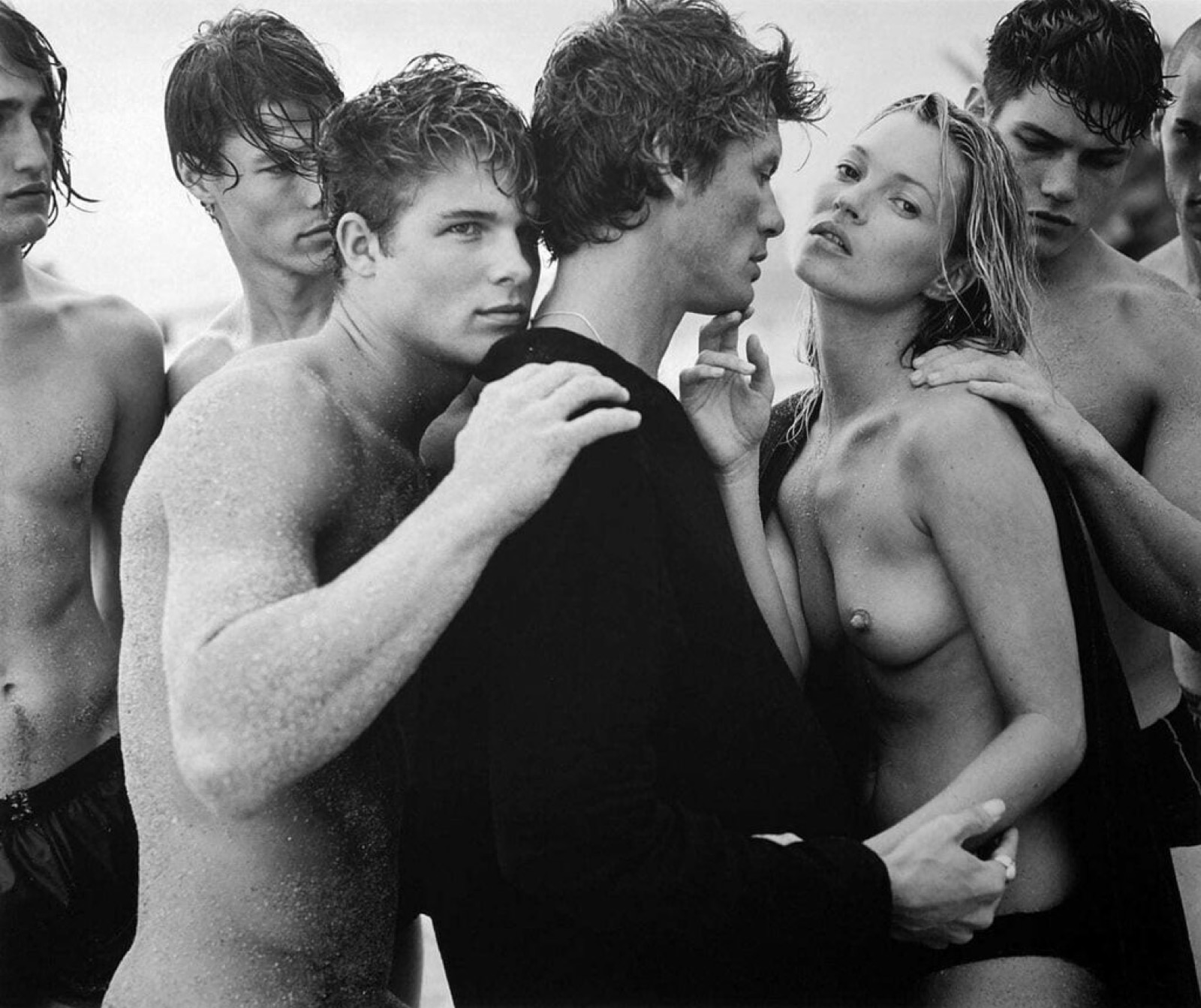

Salt has dried to a fine grit across every shoulder, catching the light in a thousand small points so that the wet skin seems dusted with silver. That texture is the first truth of the picture: a knot of young bodies just out of the sea at Golden Beach, hair slicked flat, arms overlapping, the grays running from near-white on a sunlit cheek to the deep black of a single wet jacket at the center. Everything is close, warm, saline.
At the heart of the cluster, seen from behind, one figure in dark wet cloth is turned away from us, and it is toward him that the others incline. Kate Moss, bare-shouldered, her hair darkened with water, lifts a ringed hand to his chin with the ease of long familiarity; a sandy boy leans in from the left, others press close behind. The photograph asks how to look at such intimacy without intruding, and answers by making us one more body in the crowd, held inside the group’s gravity.
Weber has always understood the beach as a kind of republic, where clothing thins and hierarchy with it, and youth arranges itself into these easy, classical friezes. It is a vision half Whitman, half fashion campaign, and the gelatin silver print carries both registers at once: the sensuous grain of salt on skin, the sculptural weight of the massed forms, the long tonal scale that lets a dozen faces stay distinct in the press. A crowd, a coastline, a warm gray light, gathered and made to hold still.