Archival pigment print mounted on aluminium Dibond.
One Size Only / 40.6 x 50.8 cm / 16 x 20 in
Hand-signed by the artist, with title, date, and edition number inscribed in ink on an archival label affixed to the reverse side of the mounted photograph
Chalk and wool, first of all. The wall behind him is whitewashed and scuffed to the grey of old plaster, and against it the suit reads as a single soft expanse of grey flannel, too large by years, the trousers pooling at the ankle, the jacket sleeve swallowing the wrist. Everything here has a nap, a grain you could feel with the eyes closed: the tooth of the threshold, the brushed cloth, the straw of the hat resting on its dark band, the deep oiled shine of the brogues lined up beside a bare patch of light.
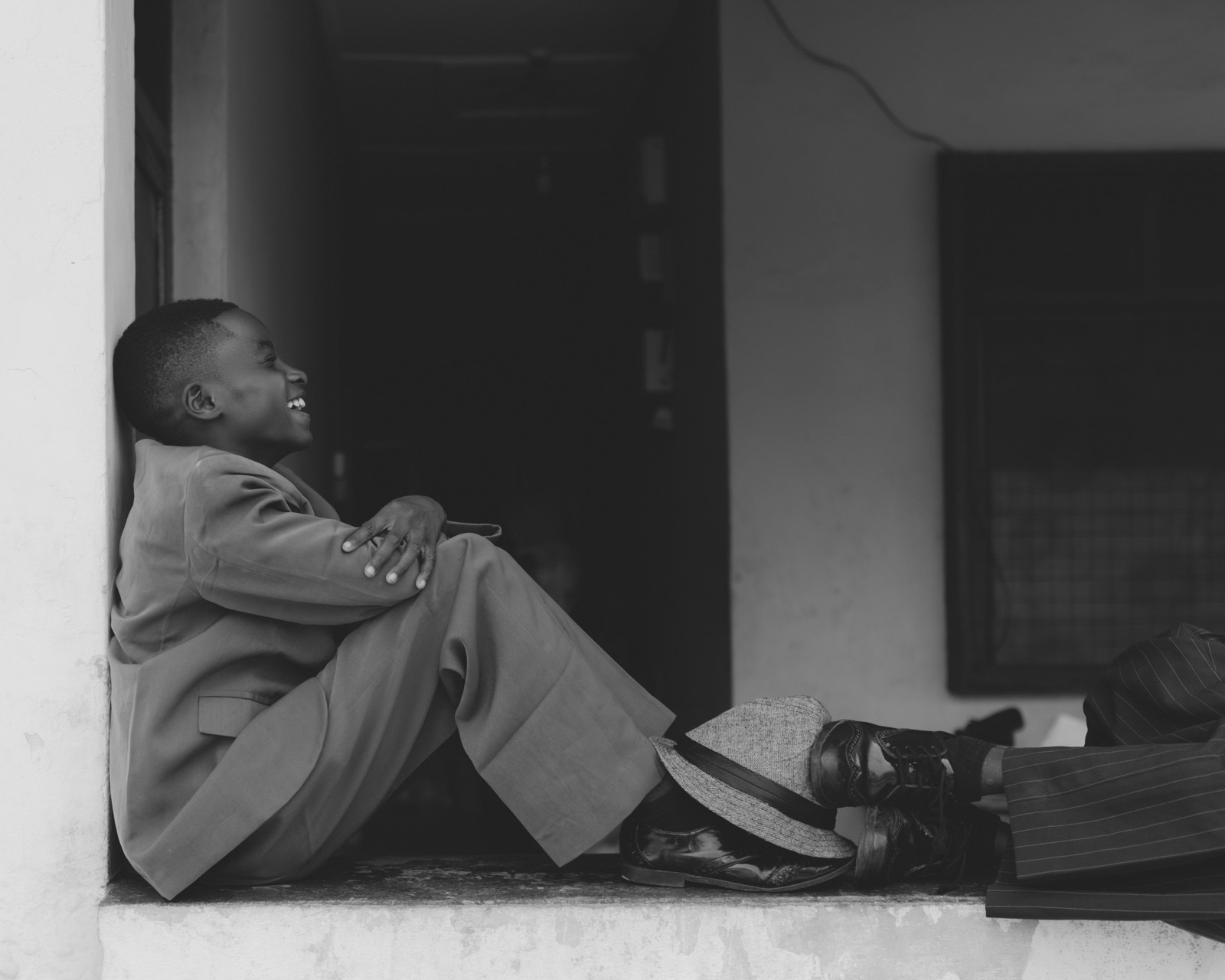
Into that field of muted greys he has thrown back his head and laughed. The picture is monochrome but the laugh is its colour. He sits in profile, knees drawn up, fingers laced over his shins, pale nails catching the light, and the whole loose architecture of the borrowed suit arranges itself around that open mouth. Behind him a doorway falls away into black; a single wire loops across the upper wall like a line of script. The clothes are a man's; the joy is wholly a child's. He has dressed up into a future and, for this instant, finds it funny.
Carlos Idun-Tawiah, working in Accra, makes pictures that look both backward and forward at once, staging Ghanaian life with the warmth and deliberation of the old studio portraitists while speaking plainly to the present. Joy Comes in the Morning belongs to that project: a young African subject granted the dignity of tailoring and the freedom of laughter in the same frame, neither performing for the camera nor hiding from it. The print, archival pigment on aluminium Dibond and made in a single size, holds the textures with the patience they ask for. What it keeps is not a costume but a temperament, the morning kind, the kind that arrives.

Chalk and wool, first of all. The wall behind him is whitewashed and scuffed to the grey of old plaster, and against it the suit reads as a single soft expanse of grey flannel, too large by years, the trousers pooling at the ankle, the jacket sleeve swallowing the wrist. Everything here has a nap, a grain you could feel with the eyes closed: the tooth of the threshold, the brushed cloth, the straw of the hat resting on its dark band, the deep oiled shine of the brogues lined up beside a bare patch of light.
Into that field of muted greys he has thrown back his head and laughed. The picture is monochrome but the laugh is its colour. He sits in profile, knees drawn up, fingers laced over his shins, pale nails catching the light, and the whole loose architecture of the borrowed suit arranges itself around that open mouth. Behind him a doorway falls away into black; a single wire loops across the upper wall like a line of script. The clothes are a man's; the joy is wholly a child's. He has dressed up into a future and, for this instant, finds it funny.
Carlos Idun-Tawiah, working in Accra, makes pictures that look both backward and forward at once, staging Ghanaian life with the warmth and deliberation of the old studio portraitists while speaking plainly to the present. Joy Comes in the Morning belongs to that project: a young African subject granted the dignity of tailoring and the freedom of laughter in the same frame, neither performing for the camera nor hiding from it. The print, archival pigment on aluminium Dibond and made in a single size, holds the textures with the patience they ask for. What it keeps is not a costume but a temperament, the morning kind, the kind that arrives.