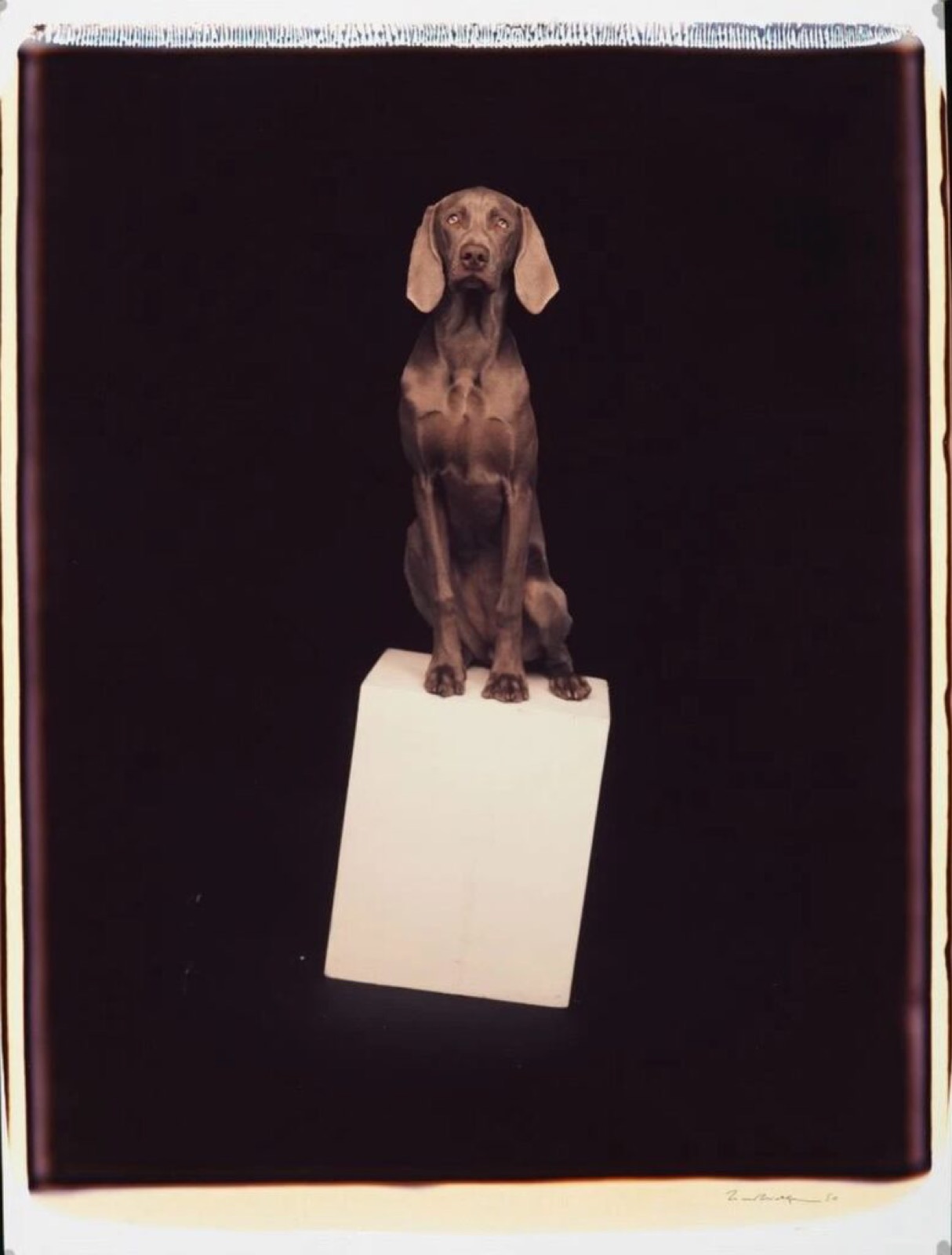
The Weimaraner sits where sculpture is supposed to sit: on a white plinth, in a dark room, alone. Her forepaws are gathered at the box's front edge so the nails just clear the rim, and her body has been composed into the taper of a monument — haunches squared, spine lifted, the long ears hanging on either side of her face like drapery. But the eyes refuse the part. Pale, almost gilded, they are turned up and away from us, fixed on someone beyond the frame. The pose is stone; the gaze is entirely dog.
The sitter is Fay Ray, in these years Wegman's constant collaborator, and the picture was made with the room-sized 20 × 24 Polaroid camera, which yields no negative — only this one sheet, its warm darkness ebbing to a chemical brown where the developer seeped toward the corners. One exposure, one object: a discipline nearer to bronze casting than to photography's usual abundance, and fitting for a picture about statuary. The plinth is the oldest trick in the museum, and Wegman plays it straight enough that the joke turns serious: lift a living thing onto a pedestal and it becomes, for the length of an exposure, an artifact.
I keep returning to the question Berger asked — why look at animals? — because the photograph will not let me do it innocently. Fay is not looking at me; she is looking at him, holding her pose out of something the picture can only record and never quite name: obedience, or trust, or the concentration of a shared task. To stand before this print is to intercept an attention that was never meant for us. The pedestal honors her and subjects her in the same gesture — that is what pedestals do — and the camera notarizes the agreement. We arrive late, and are admitted only as far as the surface of her patience.
The Weimaraner sits where sculpture is supposed to sit: on a white plinth, in a dark room, alone. Her forepaws are gathered at the box's front edge so the nails just clear the rim, and her body has been composed into the taper of a monument — haunches squared, spine lifted, the long ears hanging on either side of her face like drapery. But the eyes refuse the part. Pale, almost gilded, they are turned up and away from us, fixed on someone beyond the frame. The pose is stone; the gaze is entirely dog.
The sitter is Fay Ray, in these years Wegman's constant collaborator, and the picture was made with the room-sized 20 × 24 Polaroid camera, which yields no negative — only this one sheet, its warm darkness ebbing to a chemical brown where the developer seeped toward the corners. One exposure, one object: a discipline nearer to bronze casting than to photography's usual abundance, and fitting for a picture about statuary. The plinth is the oldest trick in the museum, and Wegman plays it straight enough that the joke turns serious: lift a living thing onto a pedestal and it becomes, for the length of an exposure, an artifact.
I keep returning to the question Berger asked — why look at animals? — because the photograph will not let me do it innocently. Fay is not looking at me; she is looking at him, holding her pose out of something the picture can only record and never quite name: obedience, or trust, or the concentration of a shared task. To stand before this print is to intercept an attention that was never meant for us. The pedestal honors her and subjects her in the same gesture — that is what pedestals do — and the camera notarizes the agreement. We arrive late, and are admitted only as far as the surface of her patience.