TO-DAY’S Special, promises the sign, the hyphen a holdover from an older America, the script flourish borrowed from a diner menu. It never says what the special is. It needn’t: above the placard looms the true advertisement, a colossal fiberglass Indian, right arm flung skyward, hailing traffic for a car lot in Albion, New York. Winter photographed a landscape already dense with writing — PARK IN REAR on its sign, the clipped name on the building behind, and, sprayed across the giant’s thighs, the town’s anonymous graffiti, answering back.
The statue is the photograph’s natural kin: a mass-produced thing, one of the fiberglass giants cast for roadside commerce in the 1960s, the cigar-store Indian inflated to highway scale. It exists, like a print, in multiples; what makes this one singular is its circumstance — the strings of bare bulbs and pennants crossing the sky, the ranked sedans with their chrome grilles, and in the foreground a passing car dissolved into blur, the mobile customer this apparatus was built to arrest, declining to stop.
Winter’s picture, made in 1972, works as material history. His subject was the automotive landscape where commerce and community meet, and here every layer of that economy is legible at once: the pitch, the instruction, the vandal’s reply, the merchandise waiting in rows. Such giants have largely disappeared from American roads, and the ordinary ephemera around them — bulb strings, banner flags, painted specials — went first. The photograph holds the entire ensemble in place, an archive of one gray afternoon when the sales pitch stood taller than the town.
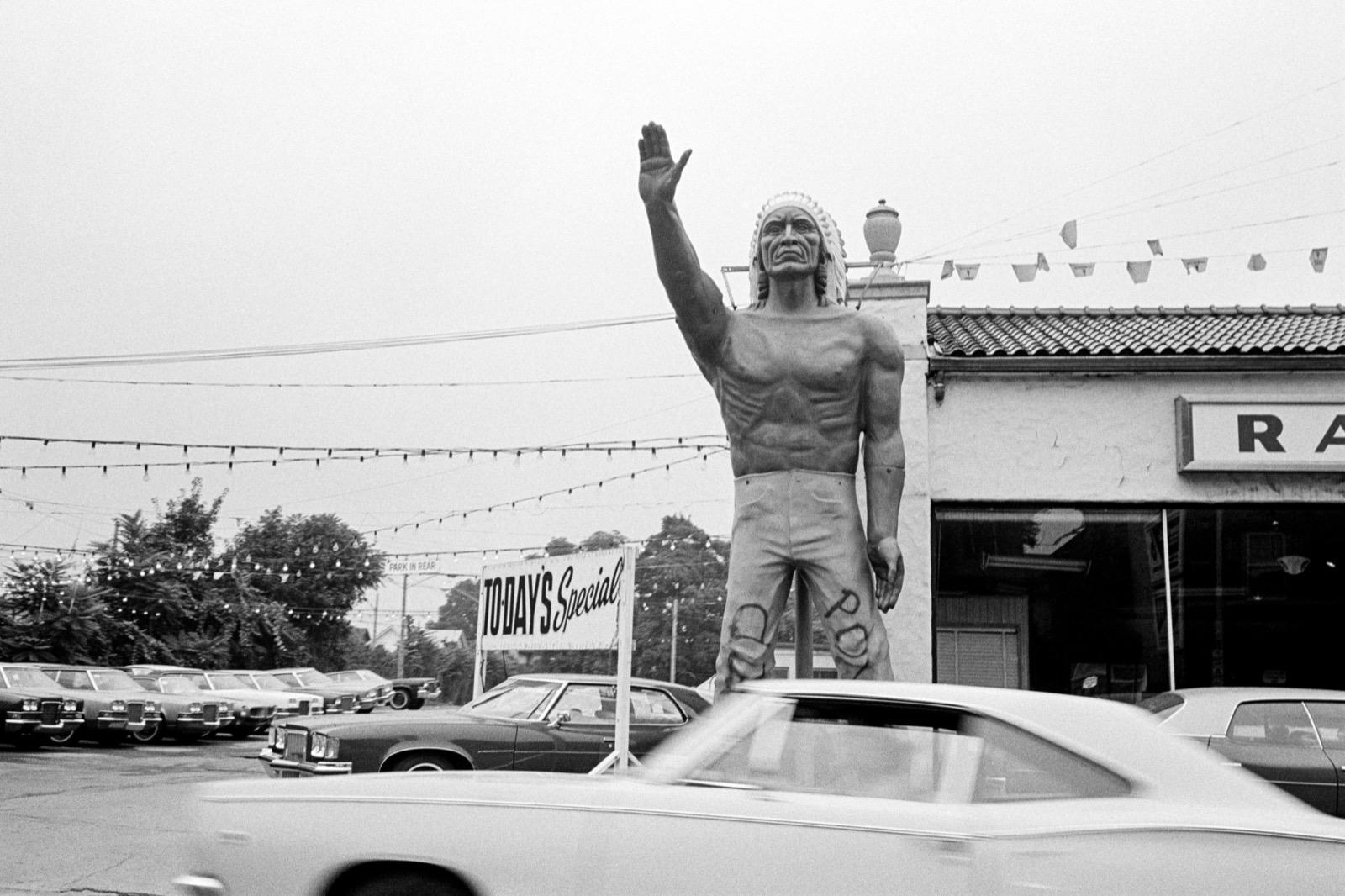

TO-DAY’S Special, promises the sign, the hyphen a holdover from an older America, the script flourish borrowed from a diner menu. It never says what the special is. It needn’t: above the placard looms the true advertisement, a colossal fiberglass Indian, right arm flung skyward, hailing traffic for a car lot in Albion, New York. Winter photographed a landscape already dense with writing — PARK IN REAR on its sign, the clipped name on the building behind, and, sprayed across the giant’s thighs, the town’s anonymous graffiti, answering back.
The statue is the photograph’s natural kin: a mass-produced thing, one of the fiberglass giants cast for roadside commerce in the 1960s, the cigar-store Indian inflated to highway scale. It exists, like a print, in multiples; what makes this one singular is its circumstance — the strings of bare bulbs and pennants crossing the sky, the ranked sedans with their chrome grilles, and in the foreground a passing car dissolved into blur, the mobile customer this apparatus was built to arrest, declining to stop.
Winter’s picture, made in 1972, works as material history. His subject was the automotive landscape where commerce and community meet, and here every layer of that economy is legible at once: the pitch, the instruction, the vandal’s reply, the merchandise waiting in rows. Such giants have largely disappeared from American roads, and the ordinary ephemera around them — bulb strings, banner flags, painted specials — went first. The photograph holds the entire ensemble in place, an archive of one gray afternoon when the sales pitch stood taller than the town.