One pine has stopped standing to attention. Just right of center it leans hard into the frame, its lower branch crooked like an arm reaching for the ground, and that single lapse of posture re-reads the whole wood: what looked like scenery becomes a cast. Around it, the fog lies in flat bands, and the sun hangs low between the trunks, an apricot disc dimmed to the point of politeness.
The picture has the finish of a production still. Fog behaves like a rented effect, pooling at shrub height as though a smoke machine were parked just out of frame; the sun performs as backlight, giving each trunk its rim of definition; the bog floor, all moss and tussock, is dressed rather than merely grown. None of it is staged, which is the point. Hido works the way a director of photography reads a location, waiting until the atmosphere does what a crew would charge a fortune to fake. The result is a landscape with the emotional pitch of cinema: nothing happens, and it feels like a plot.
It is the sensibility that made his suburban nights canonical and that museums, SFMOMA and the Getty among them, keep on their walls. In an archival pigment print the effect depends on gradients: the apricot core cooling through mauve to gray, band by band, without a seam, and the process carries that dissolve intact. What stays with you, though, is the crooked pine, mid-gesture, caught somewhere between falling and setting off toward the light. Every still needs its lead.
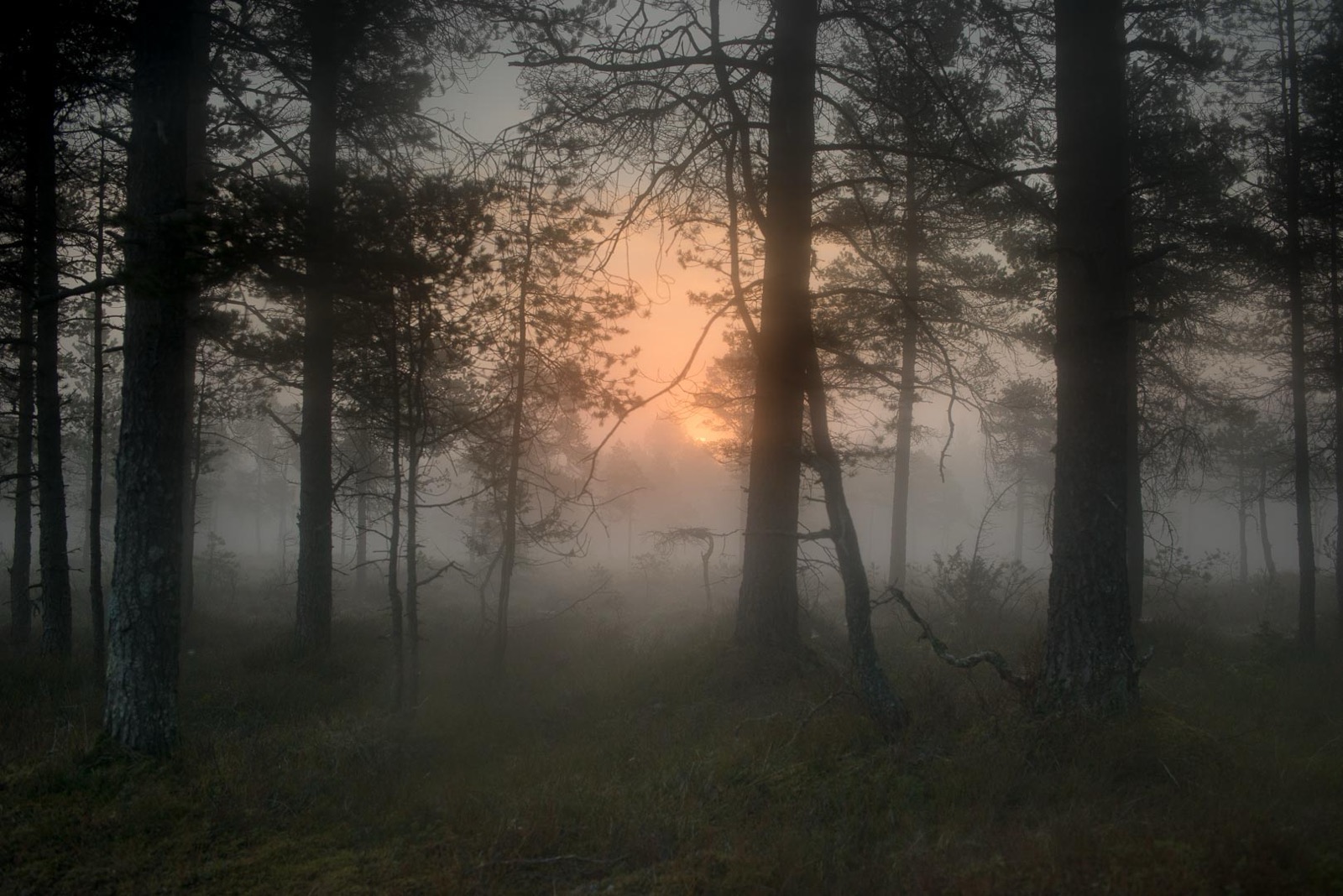

One pine has stopped standing to attention. Just right of center it leans hard into the frame, its lower branch crooked like an arm reaching for the ground, and that single lapse of posture re-reads the whole wood: what looked like scenery becomes a cast. Around it, the fog lies in flat bands, and the sun hangs low between the trunks, an apricot disc dimmed to the point of politeness.
The picture has the finish of a production still. Fog behaves like a rented effect, pooling at shrub height as though a smoke machine were parked just out of frame; the sun performs as backlight, giving each trunk its rim of definition; the bog floor, all moss and tussock, is dressed rather than merely grown. None of it is staged, which is the point. Hido works the way a director of photography reads a location, waiting until the atmosphere does what a crew would charge a fortune to fake. The result is a landscape with the emotional pitch of cinema: nothing happens, and it feels like a plot.
It is the sensibility that made his suburban nights canonical and that museums, SFMOMA and the Getty among them, keep on their walls. In an archival pigment print the effect depends on gradients: the apricot core cooling through mauve to gray, band by band, without a seam, and the process carries that dissolve intact. What stays with you, though, is the crooked pine, mid-gesture, caught somewhere between falling and setting off toward the light. Every still needs its lead.