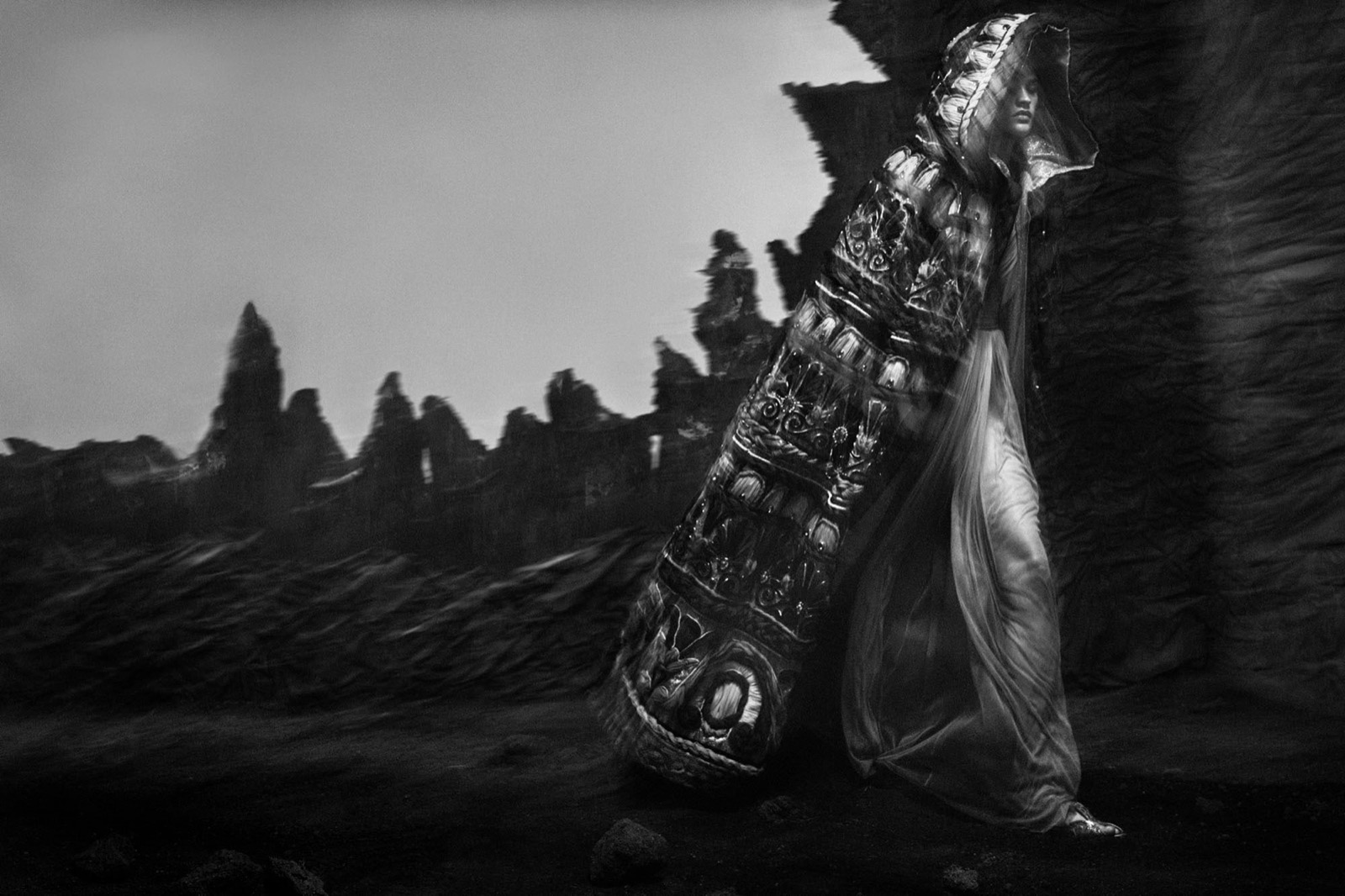
At the bottom right, under all that carried ornament, a bare foot steps out from a film of chiffon. It is a small thing, but it resets the whole picture: this tower of embroidery is not a monument, it is a person, and she is walking. The great panel slung over her shoulder drags its palmettes and braids toward the ground like cargo from another century.
Photography, we are told, freezes things. This picture prefers duration. The rock pinnacles behind her stream sideways, blurred the way a landscape blurs from a moving train, while the embroidery keeps its needlepoint clarity; the exposure is long enough to liquefy the world and still hold the stitch. Through the veil a face appears, eyes lowered, private. Fashion imagery mostly wants the arrested instant, the pose held; Yeste lets time leak in, and the title admits the plot: a getaway, the second act, escape already under way. Where she is going, across ground as dark as slag, the picture declines to say.
Yeste belongs to the front rank of Spanish fashion photography, a fixture of Numéro, Harper’s Bazaar and Vogue, and his strongest pictures run on the elements: wind, sand, fire, cloth that behaves like weather. Here cloth behaves like architecture instead, and the human walks out from under it one step at a time. The archival pigment print carries the tonal range the terrain demands: grays shading to charcoal, whites reserved for thread, veil and skin. One bare foot is enough to turn the whole spectacle back into a journey.
At the bottom right, under all that carried ornament, a bare foot steps out from a film of chiffon. It is a small thing, but it resets the whole picture: this tower of embroidery is not a monument, it is a person, and she is walking. The great panel slung over her shoulder drags its palmettes and braids toward the ground like cargo from another century.
Photography, we are told, freezes things. This picture prefers duration. The rock pinnacles behind her stream sideways, blurred the way a landscape blurs from a moving train, while the embroidery keeps its needlepoint clarity; the exposure is long enough to liquefy the world and still hold the stitch. Through the veil a face appears, eyes lowered, private. Fashion imagery mostly wants the arrested instant, the pose held; Yeste lets time leak in, and the title admits the plot: a getaway, the second act, escape already under way. Where she is going, across ground as dark as slag, the picture declines to say.
Yeste belongs to the front rank of Spanish fashion photography, a fixture of Numéro, Harper’s Bazaar and Vogue, and his strongest pictures run on the elements: wind, sand, fire, cloth that behaves like weather. Here cloth behaves like architecture instead, and the human walks out from under it one step at a time. The archival pigment print carries the tonal range the terrain demands: grays shading to charcoal, whites reserved for thread, veil and skin. One bare foot is enough to turn the whole spectacle back into a journey.