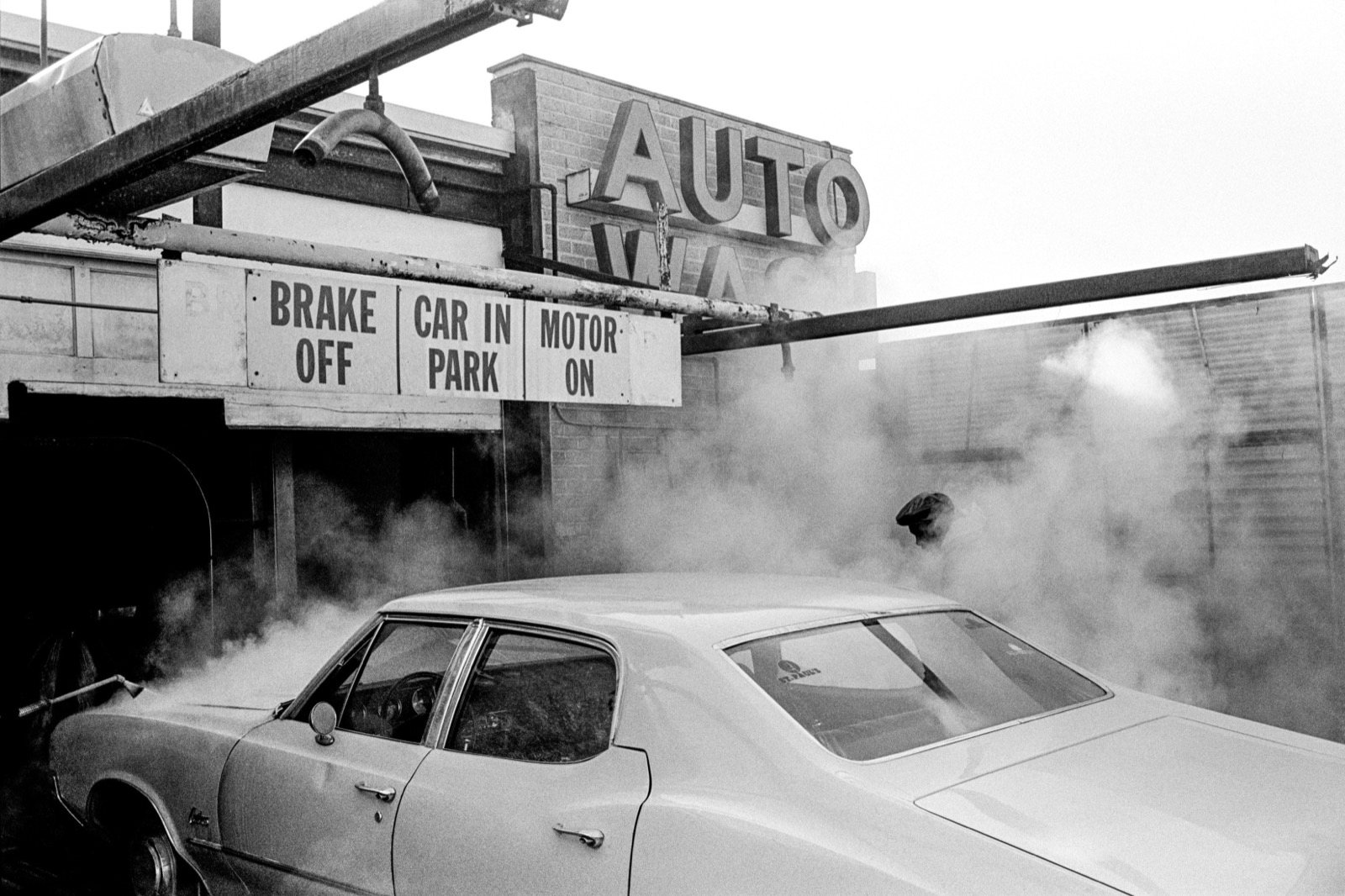
Three panels of hand-lettered instruction hang at eye level across the top of the frame—BRAKE OFF, CAR IN PARK, MOTOR ON—and it is on those words that Clark Winter has built the picture. They divide the upper register like a predella, and the camera reads them with deadpan exactness: the imperative grammar of a working New York, addressed to the driver but, here, to us. Above them the great cut-metal AUTO WASH letters lean against a flat 1971 sky, half their height lost where the paper edge crops the W.
Below, the photograph gives itself to steam. A pale sedan, its chrome and vinyl roofline described with quiet precision, noses out of a bank of vapor that rises and dissolves toward the right margin; at the picture's center a single attendant bends into the cloud, nearly erased by it. Winter lets the diffusion do the tonal work—deep shadow under the canopy at left, the blown white of vapor at right—so that the frame holds both the legible and the half-seen at once.
The vantage is the heart of it: Winter has stood back far enough to keep the signs, the marquee, the car, and the swallowed figure in one even gray field, refusing to dramatize any of them. That clarity belongs to his sustained looking at American commercial vernacular through these years—the gas stations, the lettered storefronts, the rituals of the automobile—where the camera's task is to describe a place accurately enough that its strangeness surfaces on its own. Printed as a gelatin silver print at this generous scale, it is a characteristic and increasingly scarce example of that project, and it earns its hold the honest way: by showing, with great economy, exactly how the thing looked.
Three panels of hand-lettered instruction hang at eye level across the top of the frame—BRAKE OFF, CAR IN PARK, MOTOR ON—and it is on those words that Clark Winter has built the picture. They divide the upper register like a predella, and the camera reads them with deadpan exactness: the imperative grammar of a working New York, addressed to the driver but, here, to us. Above them the great cut-metal AUTO WASH letters lean against a flat 1971 sky, half their height lost where the paper edge crops the W.
Below, the photograph gives itself to steam. A pale sedan, its chrome and vinyl roofline described with quiet precision, noses out of a bank of vapor that rises and dissolves toward the right margin; at the picture's center a single attendant bends into the cloud, nearly erased by it. Winter lets the diffusion do the tonal work—deep shadow under the canopy at left, the blown white of vapor at right—so that the frame holds both the legible and the half-seen at once.
The vantage is the heart of it: Winter has stood back far enough to keep the signs, the marquee, the car, and the swallowed figure in one even gray field, refusing to dramatize any of them. That clarity belongs to his sustained looking at American commercial vernacular through these years—the gas stations, the lettered storefronts, the rituals of the automobile—where the camera's task is to describe a place accurately enough that its strangeness surfaces on its own. Printed as a gelatin silver print at this generous scale, it is a characteristic and increasingly scarce example of that project, and it earns its hold the honest way: by showing, with great economy, exactly how the thing looked.